Onze-Lieve-Vrouwkerk: A Medieval Parish Church in Herent, Belgium


Site at a Glance
- Rating
- 4.2
- Popularity
- Very Low
- Country
- Belgium
- Primary era
- Medieval
- External website
- Open
- Eras represented
- Medieval, Early Modern, Modern
- Civilizations
- Belgian, Duchy of Brabant, Holy Roman Empire, Spanish
- Site type
- Religious
- Remains
- Church
On this page13 sections
History
Onze-Lieve-Vrouwkerk is a Belgian parish church in Herent, Belgium, dedicated to Our Lady and belonging to the Herent deanery. Its oldest surviving element is a square Romanesque tower built in the second half of the twelfth century. Romanesque architecture is characterized by massive walls, round-headed openings, and heavy construction. The lower levels of the tower provided refuge for local people during times of danger, giving the church a defensive role as well as a religious one.
Medieval construction
The tower received its spire later in the twelfth century. During the thirteenth century, several building campaigns extended the church with a Gothic choir and transepts. Gothic architecture developed after the Romanesque period and is associated with pointed arches, larger windows, and more vertically oriented spaces. The resulting building combined the older Romanesque elements with newer Gothic forms.
Destruction and rebuilding
In 1578, the Geuzen looted the church before a fire consumed the tower and three naves. The Geuzen were Dutch-speaking Protestant rebels who opposed Spanish Habsburg rule during the Dutch Revolt. With insufficient funds for immediate reconstruction, the surviving naves and the remaining choir were adapted for temporary worship.
A partial rebuilding followed in 1626–1629. The Romanesque side aisles were modified, while the central nave was reconstructed in Gothic form. The church was fully restored by about 1724, preserving the layered character created by its medieval construction and later rebuilding.
Later restoration and parish life
A major restoration of the entire building took place around 1900, and the organ was moved during that work. The high altar was presented to parish priest Hyppolit Van Bladel by parishioners and friends in 1906, marking his twenty-fifth year as parish priest of Herent. The altar itself was made in 1908.
Another large restoration project began in mid-2017 after the municipality of Herent sought approval and subsidy from the Flemish Agency for Immovable Heritage. The work addressed the facades, roof structure, roof covering, surrounding ground, cemetery walls, and drainage system. These interventions formed part of the continuing care of a church whose fabric reflects many centuries of use and repair.
Remains
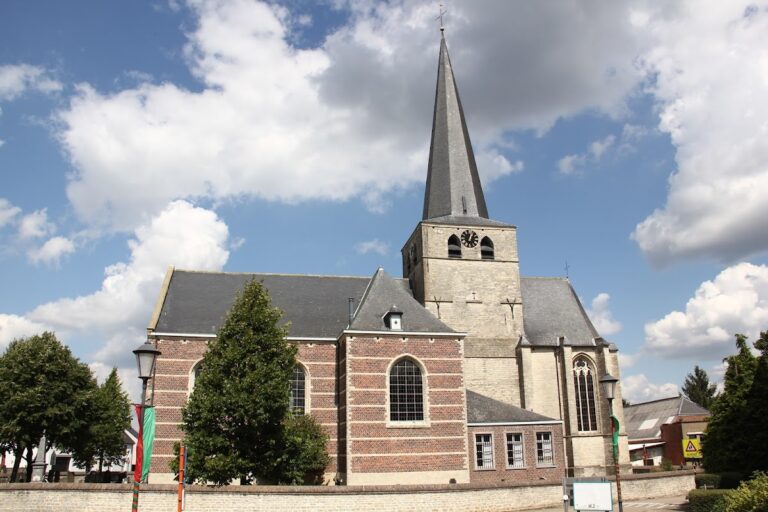
The surviving church presents a combination of a four-level Romanesque tower, Gothic choir and transepts, Romanesque side aisles altered in the seventeenth century, and a Gothic central nave from the same rebuilding phase. White sandstone forms the square tower, while the choir and transepts use Lediaan stone, a pale regional limestone, together with iron sandstone, whose iron compounds produce reddish or brownish tones. The building also retains historic furnishings, devotional images, an organ, and a large stained-glass rose window.
Medieval structure
Romanesque tower
The square tower dates from the second half of the twelfth century and rises through four levels. Its white-sandstone walls have distinctive masonry, and narrow windows in the lower levels reflect the structure’s earlier use as a refuge. The spire was added later in the twelfth century. Together, tower and spire form the oldest architectural group in the church.
Choir, transepts, and naves
The choir and transepts are Gothic and are built partly from Lediaan stone and partly from iron sandstone. The side aisles preserve a Romanesque character but were altered during the rebuilding of 1626–1629. The central nave took on its Gothic form during that same campaign, creating the contrasting architectural arrangement visible in the church today.
Organ and furnishings
Robustelly organ
The church contains a Robustelly organ dating from 1770. Robustelly was an eighteenth-century organ builder, whose name identifies this instrument. During the 1900 restoration, the organ was removed from the church and placed in the tower room. This installation required changes to its case and pipework. Organ builder Jean-Pierre Draps of Erps-Kwerps restored it in 1996, returning it to its original form. A specially constructed new dorsal then allowed the instrument to be brought back into the church. The restoration was celebrated on 6 April 1997 with a performance by concert organist Jos Van Immerseel of Antwerp.
Van Bladel Altar
The high altar, also known as the Van Bladel Altar, is a Neogothic work made of gilded bronze by the goldsmith J. Wilmotte in 1908. Its name commemorates Hyppolit Van Bladel, the parish priest who received it as a gift from parishioners and friends in 1906.
Rose window
A large stained-glass rose window occupies the eastern side of the church. A rose window is a circular stained-glass window divided into radiating sections. Its exact date is unknown, although the parish priest had it installed in 1854, possibly involving an alteration or a complete replacement. Lou Asperslagh restored it after the Second World War.
The window’s imagery centers on the Assumption of Mary, the Christian belief that Mary was taken bodily into heaven. Six smaller circles contain angels honoring Mary, while six larger circles represent important events in her life. Six small pointed figures symbolically represent the Holy Trinity and the Four Evangelists.
Devotional artworks
A sixteenth-century statue of Our Lady with the Child shows Mary carrying Jesus on her right arm. Jesus reaches toward a halved bunch of grapes held in Mary’s left hand, while her feet rest on a crescent moon rather than on the dragon, serpent, or devil often associated with such imagery. The church also contains an early-sixteenth-century painting of the Sacred Conversation, a devotional image showing the Virgin and Child together with saints in an intimate unified scene.
Other surviving works include a polychromed Gothic group of the Holy Family and an eighteenth-century Madonna and Child. The pulpit and confessionals date from the middle of the eighteenth century and are made in the Louis XV style.