Géronde: Monastery, Church, and Archaeological Site in Switzerland


Site at a Glance
- Rating
- 4.7
- Popularity
- Very Low
- Country
- Switzerland
- Primary era
- Medieval
- External website
- Open
- Eras represented
- Medieval, Early Modern
- Civilizations
- Holy Roman Empire
- Site type
- Religious
- Remains
- Monastery
On this page10 sections
History
Géronde is a monastery, church, and archaeological site in Switzerland, near Sierre, whose religious complex preserves an eleventh-century Romanesque foundation and a church built between 1425 and 1430. Located on Géronde Hill, the site developed from an early settlement into a long-standing centre of religious life for the surrounding region.
Early settlement and the medieval priory
Géronde Hill formed the heart of early Sierre. Graves and excavation finds indicate settlement there during the Bronze Age. By 1233, a priory was established on the hill under the authority of the Augustinian Canons Regular of Abondance Abbey in Savoy. These were clergy who followed a communal religious rule while undertaking pastoral and liturgical duties.
In 1331, Bishop Aymon de la Tour founded the first Carthusian monastery at Géronde, replacing the earlier priory. Carthusians combined communal worship with a strongly solitary monastic life. Their stay was short, ending in 1354 when wars between the Valaisans and the Savoyards forced them to leave.
Carmelite and Jesuit occupations
The Carmelites occupied Géronde from 1425 to 1644. In that year, André de Gualdo, Bishop of Sion, promulgated the foundation charter for the Carmelite monastery. The conventual church was initially dedicated to Saint Martin before being placed under the patronage of the Virgin.
Adrien IV de Riedmatten transferred the monastery to the Jesuits in 1656. Their occupation lasted until 1662. Géronde later housed the diocesan seminary at various times from the eighteenth century into the early nineteenth century. A diocesan seminary provided religious and clerical training for candidates to the priesthood of a particular diocese.
Disruption, institutional reuse, and renewed monastic life
Following the French invasion, the partly abandoned monastery was heavily pillaged. Trappists, members of a Catholic order centred on prayer, silence, communal discipline, and manual work, found shelter at Géronde from 1804 to 1806 and again from 1831 to 1834. French Dominicans also took refuge there from around 1870.
An agreement with the State of Valais in 1893 led to the conversion of several monastery buildings into an institute for deaf-mutes directed by the Sisters of the Holy Cross of Ingenbohl. The institute opened on 1 October 1894 and included experimental agricultural teaching until 1929. Its buildings later returned to monastic use.
At the request of Victor Bieler, Bishop of Sion, Bernardine nuns from Collombey settled at Géronde in 1935 and resumed monastic life. Bernardines belong to a reform tradition within the Cistercian family. Their community was organized around silence, prayer, and work, including viticulture, vegetable gardening, orchard cultivation, the production of altar breads, and the manufacture of liturgical clothing.
Fire, restoration, and the present community
The cloister, monastic cells, and conventual church were restored between 1962 and 1964. On 1 May 1980, a violent fire devastated the entire upper part of the complex, although Saint Martin’s Chapel and its Gothic choir stalls survived.
Since 2008, the community has belonged to the Order of Cistercians of the Strict Observance, commonly known as the Trappists. Géronde is an autonomous priory directly dependent on the order and supervised by Acey Abbey, and it is a daughter house of Notre-Dame d’Acey Abbey. On 8 September 2009, the nuns elected Mother Miryam-Monique Frossard as prioress for an indefinite term. Géronde is classified as a Swiss cultural property of regional importance in category B.
Remains
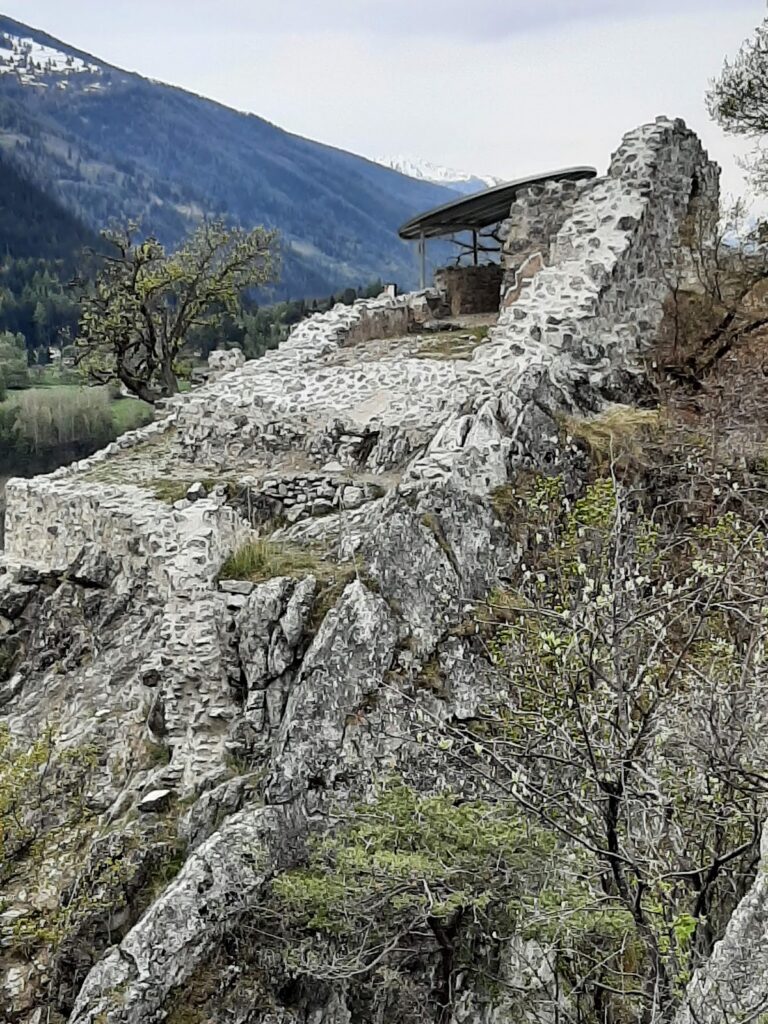
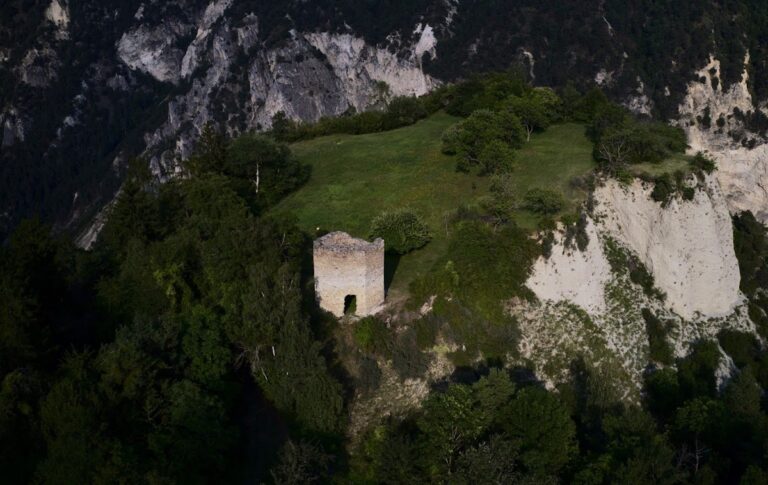
Géronde’s monastery, church, and archaeological remains occupy the summit and slopes of Géronde Hill near Sierre. The hill faces the mouth of the Val d’Anniviers, overlooks the Rhône valley and the municipality of Chippis, and is reflected in Lake Géronde. The summit contains foundations and remains from several long-destroyed buildings, including a Carolingian chapel dedicated to Saint Felix and the monastery complex. The surviving structures bring together medieval foundations, later church additions, monastic buildings, and remains altered by institutional reuse and fire.
Church and chapel
Conventual church
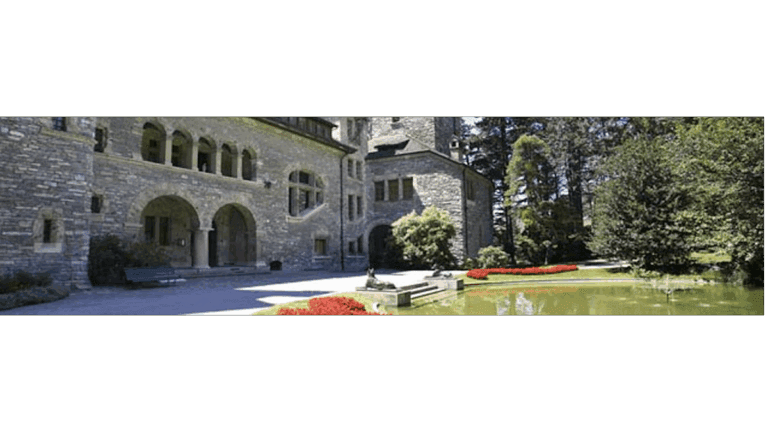
The foundations of the present conventual church were built in the eleventh century in the Romanesque style, whose forms belong to medieval western European architecture before the widespread adoption of Gothic design. A large Gothic choir, the eastern liturgical section of the church, was added in the fifteenth century. The church itself was constructed between 1425 and 1430, and its nave vault received a Baroque treatment in the eighteenth century.
The church contains stained-glass windows made in 1965 by Sister Marie-Jean, also known as Myriam Olsommer, who lived from 1935 to 2017 and belonged to the community. The church, cloister, and monastic cells were restored between 1962 and 1964, while later fire damage affected the upper part of the wider complex.
Saint Martin’s Chapel
Saint Martin’s Chapel preserves the Gothic choir stalls carved around 1430. The stalls are housed in the chapel, which survived the fire of 1 May 1980 that destroyed the upper part of the complex. Their survival gives the chapel a direct connection with the fifteenth-century phase of Géronde’s church.
Monastic and archaeological complex
The cloister and monastic cells form part of the convent complex and retain the spatial framework of communal religious life. The former monastery buildings were adapted in the late nineteenth century for the institute for deaf-mutes, including its agricultural teaching programme, before being returned to monastic use by the Bernardine community. Around the summit, archaeological remains preserve evidence of earlier construction, including the Carolingian chapel of Saint Felix and other buildings that were later destroyed.