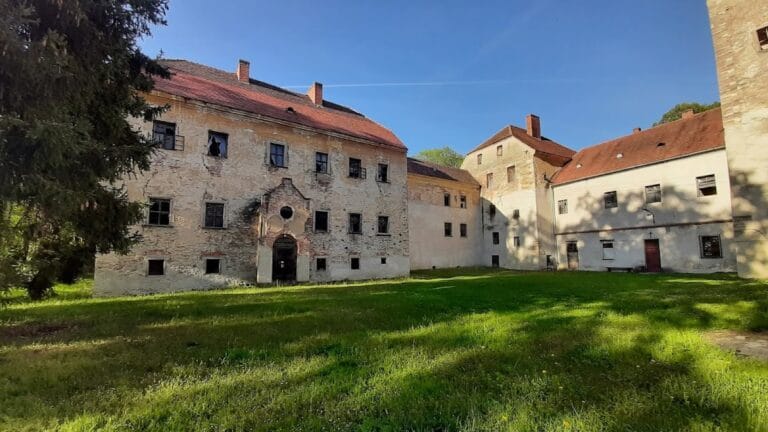
Saint John of Nepomuk Church in Zielenice: A Medieval Parish Church in Poland


Site at a Glance
- Rating
- 4.5
- Popularity
- Very Low
- Country
- Poland
- Primary era
- Medieval
- Eras represented
- Medieval, Early Modern, Modern
- Civilizations
- Habsburg, Holy Roman Empire, Kingdom of Prussia
- Site type
- Religious
- Remains
- Church
On this page7 sections
History
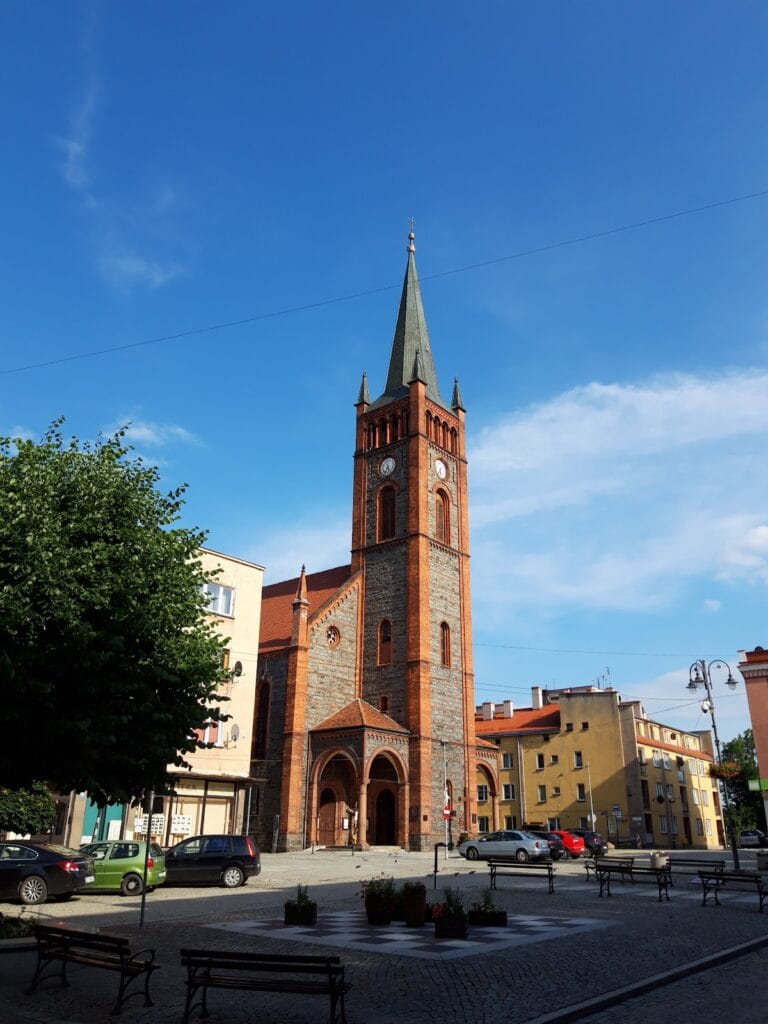
Saint John of Nepomuk church in Zielenice, Poland, formerly known as Grünhartau, originated as a fourteenth-century foundation and medieval church. Tradition attributes its establishment as a chapel to the Duke of Brieg, who used it for prayer while travelling between Brieg, Liegnitz, and Wohlau. The church was first mentioned in 1335, while a document from 1376 referred to its rector at “Major Hartha.”
Medieval and Lutheran history
A bell dated 1483 shows that the church existed by the late fifteenth century. Around 1530, it became an evangelical Lutheran church. Georg Friese, who served as its first documented evangelical pastor in 1574 and died in 1586, led the congregation during this period. Until the seventeenth century, legal patronage belonged to the lord of Niemitz, who guaranteed evangelical worship. A church patron was the person or institution responsible for particular legal, financial, and clerical privileges connected with a church.
The church underwent a complete renovation in 1662 or 1672. Between 1691 and 1692, Adam Count von Gfug and Fellendorf of Manze commissioned a new altar, pulpit, and baptismal font at his own expense. After evangelical churches in Manze and Roßwitz were taken over by Catholics, inhabitants of those communities had their children baptized at Grünhartau.
Refuge church and later development
Following the recatholicization of Karzen in 1705, the congregation of Karzen, together with those of Brockuth, Pudigau, Tiefensee, Klein-Jeseritz, Grögersdorf, and Karschau, used Grünhartau as a refuge church for the next four years. The Altranstädt Convention, an early-eighteenth-century settlement that restored certain Protestant churches and rights in Silesia, eventually returned the evangelical congregation of Karzen to its own church. About 4,000 communicants were associated with the refuge congregation, and Grünhartau was enlarged between 1701 and 1705 to accommodate them.
The older bell cracked and was recast in 1775. In 1827, the local community purchased the estate together with the church patronage. The roof was reshingled in 1852, and a new church tower was inaugurated on 29 August 1858. Pastor Otto Robert Hertwig issued a commemorative publication for the inauguration. During the nineteenth century, the evangelical parish comprised Grünhartau, Glosenau, and Reisau, while Manze, Roßwitz, and Kampen attended as guest congregations. The parish belonged to the Nimptsch church district.
Twentieth-century Catholic parish
During the nineteenth century, the church possessed a 1,600 Reichstaler endowment, whose interest paid school fees for poor children. After the expulsion of the German population following 1945, the Roman Catholic Church took over the building. Since then, it has served as a Roman Catholic parish church dedicated to Saint John of Nepomuk, a fourteenth-century Bohemian priest and martyr venerated in Central Europe as a protector of the seal of confession and a patron associated with bridges and waterways. The Roman Catholic parish, newly founded in 1958, belongs to the Borów deanery of the Archdiocese of Wrocław.
Remains
The surviving features combine the church building, memorials, liturgical furnishings, and a bell associated with its medieval history. The exterior includes two granite gravestones attributed to French Templars, each marked with an incised cross.
Interior memorials and furnishings
Inside the church is a Carrara-marble epitaph commemorating Count Adam von Gfug and Fellendorf, who died in 1671, and his wife. The altar painting, Christ and the Samaritans, was donated by Dr. Kummer, a royal Saxon mint master from Dresden. Earlier furnishings also included a Gothic communion chalice measuring 14 centimetres in height and dating from the thirteenth or fourteenth century.
Bell
A Marian bell dated 1483 hung in the church tower. After it cracked, it was recast in 1775 and carried the inscription “O rex gloriae, veni cum pace, avec Maria MCCCCLXXXIII,” translated as “O King of Glory, come in peace, with Mary, 1483.”