Martin-Luther-Kirche Dewitz: A Romanesque Branch Church in Germany


Site at a Glance
- Rating
- 4.6
- Popularity
- Very Low
- Country
- Germany
- Primary era
- Medieval
- External website
- Open
- Eras represented
- Medieval, Early Modern, Modern
- Civilizations
- German, Holy Roman Empire
- Site type
- Religious
- Remains
- Church
On this page8 sections
History
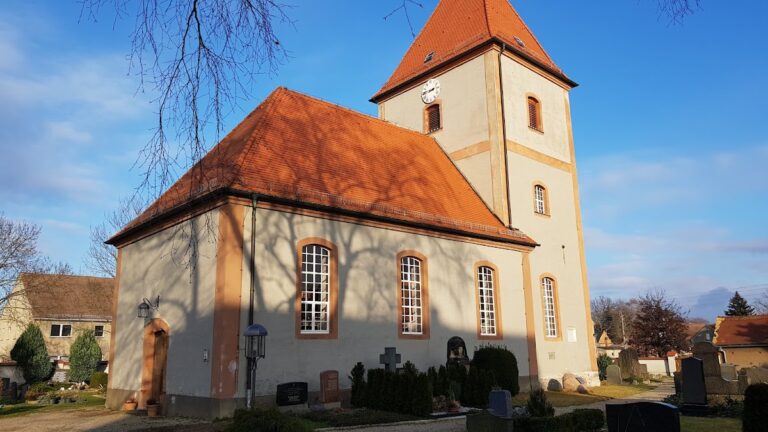
Martin-Luther-Kirche Dewitz is a Romanesque Evangelical Lutheran church in Germany, located in Dewitz, a district of Taucha in Saxony. Its present form dates from the thirteenth century, probably around 1280, and the building has remained structurally unchanged since that period. The church has long formed part of Dewitz’s local townscape and is protected as a cultural monument in Saxony.
Medieval origins
The church’s Romanesque architecture belongs to the medieval period associated with substantial masonry, rounded arches, and compact, heavy forms. Its continued survival in essentially the same structural form preserves the character of a thirteenth-century village church.
Parish changes and modern restoration
Dewitz and Sehlis long belonged to a single parish. After Dewitz was incorporated into Taucha in 1937, that parish ceased to function as an independent parish. In 1938, Taucha established a sister-church relationship with Dewitz, and the church officially adopted the name Martin-Luther-Kirche. Martin Luther was the sixteenth-century German theologian and reformer whose teachings initiated the Protestant Reformation, while Lutheran churches are associated with his theological tradition. Since then, the church has also been officially designated the Martin-Luther-Kirche Taucha, and Sehlis has been treated as a branch church.
As a branch church, Dewitz is institutionally attached to a principal parish church rather than operating as an independent parish. It belongs to Taucha within the Leipzig Church District of the Evangelical Lutheran State Church of Saxony. Recent repair and conservation work included an exterior renovation in 2022.
Remains
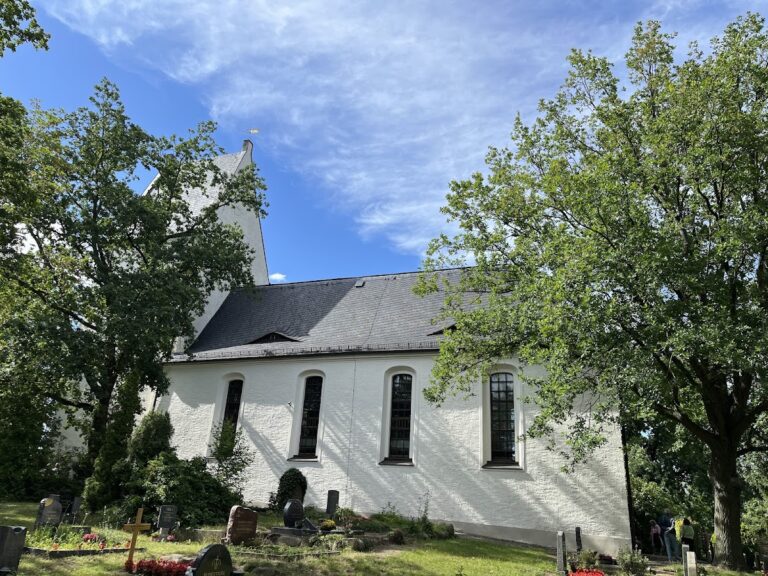
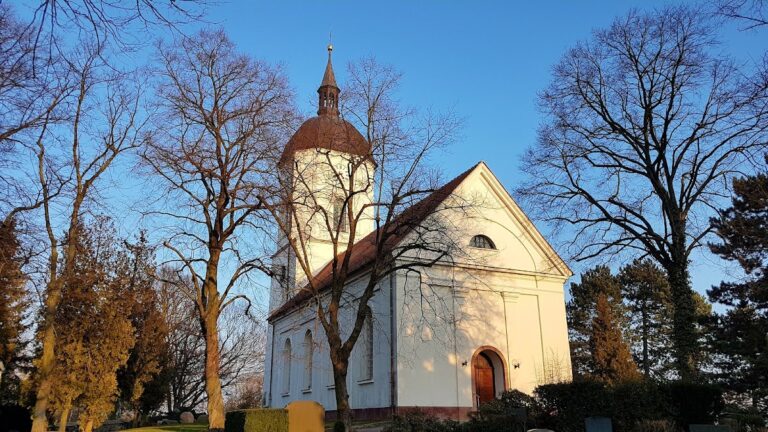
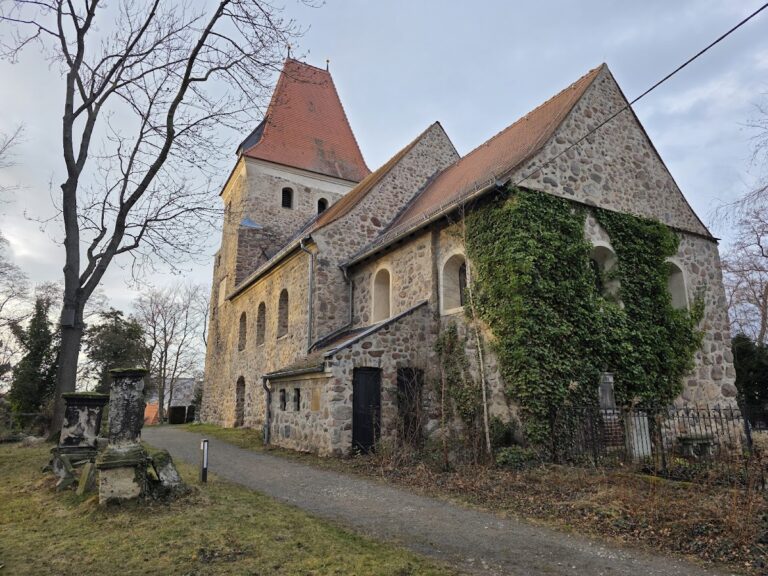
The church stands on a small rise and is built from fieldstone. A cemetery enclosed by a fieldstone wall surrounds the building. From east to west, the plan consists of a semicircular apse, a rectangular altar room, a broader nave, and a squat west tower containing the entrance area.
Church structure
The apse forms the eastern end of the church behind the altar, while the rectangular altar room extends westward from it. A sacristy with a barrel-vaulted ceiling adjoins the north side of the altar room. The wider nave follows to the west and connects with the short west tower, which contains the entrance area. Together, these parts preserve the compact arrangement of the medieval building.
Interior furnishings
A polygonal pulpit dating from around 1650 is decorated with painted scenes of Moses holding the Tablets of the Law and Christ as Judge of the World. The pulpit was transferred to Dewitz from the church at Kulkwitz-Knautnaundorf. Two bronze altar candlesticks from the sixteenth century remain in the church. Each is 47 centimetres high and has three knobs.
Organ
The organ stands on the low west gallery and rises to the flat ceiling. It has seven stops, the sets of pipes that provide different tonal colors, on one manual, the keyboard played by the hands, and a pedal keyboard operated by the feet. Its simple three-part case, with lower side panels, reflects the type used in western Saxony and eastern Thuringia around 1800.
The instrument was acquired by the congregation in 1853 from Leipzig’s Second Citizens’ School, where it had previously been used. It was restored in 2007. Johann Gottlieb Mauer, who took over his father-in-law Johann Christian Immanuel Schweinefleisch’s Leipzig workshop and university organ-builder’s office in 1771, is identified as its builder. Its attribution, design, and tonal characteristics place its construction in the early nineteenth century. Because much of its original material survives, the organ represents the transition from the Baroque to the Romantic period and is probably the only surviving work by this important Leipzig organ builder in Saxony. Its case is notably similar to that of the organ at Ermlitz, and a comparable instrument is in St. Nicolai et Antonii Church in Halle-Dölau.
Church bells
Two of the church’s original three bells remain. The larger bell is 83 centimetres high and one metre in diameter. The smaller bell measures 43 centimetres in height and 84 centimetres in diameter; it carries Leipzig’s coat of arms and a German inscription naming Gabriel Kertzer as pastor and Lorentz Bühl and Gregor Falcke as church wardens. A church warden was a lay official responsible for aspects of church administration and maintenance.
The two-bell peal consists of a fifteenth-century bronze bell sounding a’ -9, whose founder is unknown, and a second bronze bell sounding h’ -9, cast in 1681 by P. Stengel.