Church of Our Lady of the Island in Solin: Croatia’s Oldest Marian Sanctuary
Site at a Glance
- Rating
- 4.9
- Popularity
- Low
- Country
- Croatia
- Primary era
- Modern
- External website
- Open
- Eras represented
- Classical, Medieval, Modern
- Civilizations
- Kingdom of Croatia, Roman
- Site type
- Religious
- Remains
- Church
On this page8 sections
History
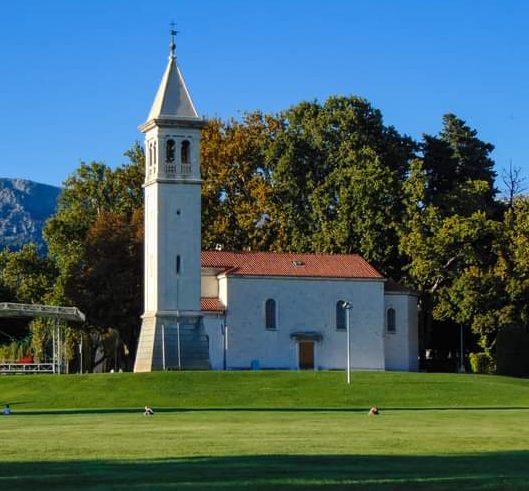
The Church of Our Lady of the Island in Solin, Croatia, is a Roman Catholic parish church in the Romanesque style, erected in 1878 over the foundations of an earlier church. Dedicated to the Virgin Mary and affiliated with the Archdiocese of Split-Makarska, it is regarded as Croatia’s oldest Marian sanctuary.
Salona and the Island Churches
The church stands on an island formed by branches of the Jadro River, south of the ruins of ancient Salona. Some scholars believe the island may have been the first Croatian settlement in the area. Salona was the region’s principal commercial and administrative center and flourished especially during the third and fourth centuries. In the fifth century, it became an episcopal center with two basilicas, a baptistery, and an episcopal palace. Its Latin-speaking population abandoned the city in 614 after repeated attacks by pagan Slavs and Avars.
In 976, Croatian Queen Jelena Slavna commissioned two churches on the island, east of the ancient ruins. The larger was dedicated to the Virgin Mary and the smaller to Saint Stephen. Together they formed a paired church complex, probably built by Benedictines. The Marian church probably served as a coronation church for Croatian kings until the reign of King Zvonimir, who transferred that function to the nearby Church of Saint Peter and Moses, popularly known as the Hollow Church. Local tradition holds that seven Croatian kings were crowned at Solin.
Destruction and Rebuilding
Fourteenth-century medieval documents mention the earlier church, indicating that it survived the Tatar invasion. It was probably destroyed by the Turks during the sixteenth century. A replacement church stood on the site before 1670, when the baptismal register of the Solin-Vranjic parish recorded a baptism there on 8 September. That building was reconstructed in 1640, burned in 1875, and replaced by the present parish church, which was erected over its foundations in 1878.
The area around the church was also associated with several mills owned by the royal family. Medieval records referred to their operators as the “king’s millers.” Control of mills represented control over feudal grain production, and the mills continued to be regarded as a form of wealth until the First World War.
Archaeological Investigation
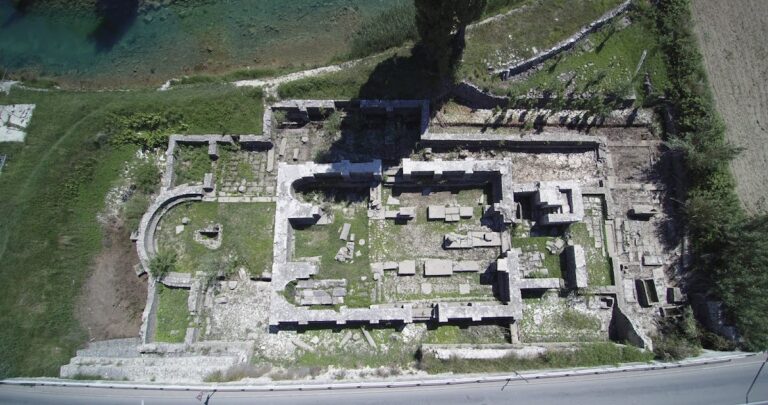
Work on the foundations of the present bell tower led to archaeological investigations in 1898. Father Frane Bulić, a Catholic priest and archaeologist, continued the excavations and uncovered the foundations of the entire earlier church. On 28 August, fragments of Queen Jelena’s tomb slab were found in the church vestibule. Its Latin inscription identified her as the wife of King Mihajlo Krešimir II and the mother of King Držislav, and stated that she had commissioned the church in 976.
The excavations also revealed the remains of Jelena’s sarcophagus in the earlier basilica’s narthex, an entrance vestibule at the west end of an early Christian or medieval church. The discovery was identified as the first excavated Croatian royal tomb in the country and the first known mausoleum of the Croatian kings.
Remains
Earlier Marian Basilica
The earlier Marian church was a three-aisled basilica approximately the size of the present parish church. It measured about 23 metres in length and 10 metres in width. The distance from the entrance to the sanctuary was about 11 metres, while the central nave was 3.5 metres wide and each side aisle measured 2.25 metres.
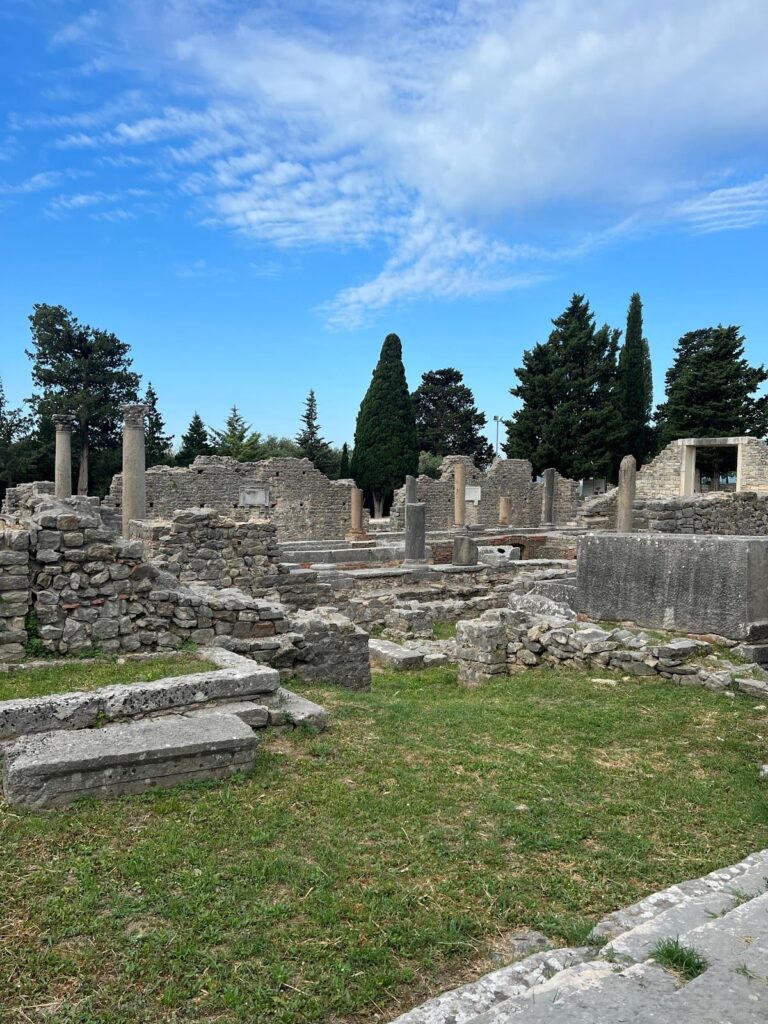
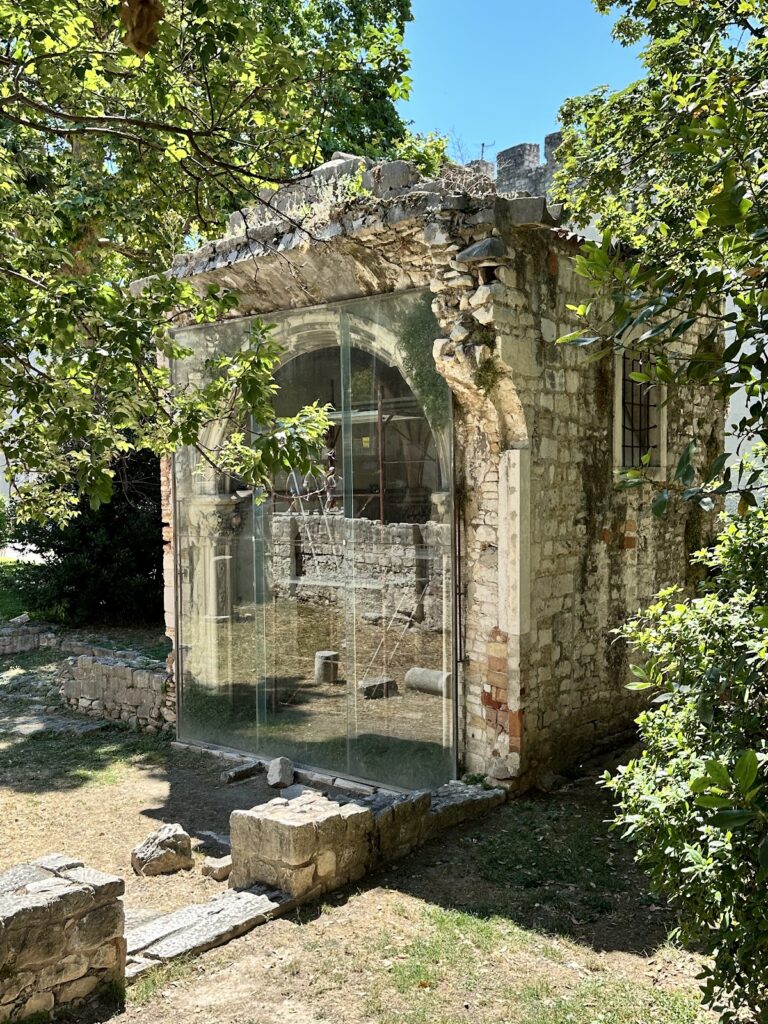
Its walls were built from rubble stone heavily bonded with mortar, probably incorporating carved stones or other material reused from older buildings. The facade may have carried one or two bell towers. The foundations are marked on the north side of the present church, while excavation beneath the current altar uncovered a broad Roman wall, showing that Roman buildings had occupied the location in antiquity.
Queen Jelena’s Burial
In the basilica’s narthex, the excavations exposed the remains of Queen Jelena’s sarcophagus. Fragments of her tomb slab, bearing the inscription that connected her with King Mihajlo Krešimir II, King Držislav, and the church’s foundation in 976, were found in the vestibule of the later church.
Present Parish Church
The present church is a stone Romanesque building about 23 metres long and 10 metres wide. It stands over the foundations of the church destroyed by fire in 1875. Numerous elm trees once surrounded the building, giving rise to the popular name “Our Lady among the Elms.” A spring west of the church was known as Our Lady’s Well, and tradition held that its water never became cloudy, even during the heaviest rains.
The church contains an organ built by Ferdo Heferer in 1913, identified as opus 222. It has pneumatic action, three couplers named Pedal Coupler, Superoctave Coupler, and Suboctave Coupler, and four combination settings marked P, MF, F, and 0.