Nederlands Hervormde Kerk, Meedhuizen: Medieval Parish Church


Site at a Glance
- Rating
- 4.6
- Popularity
- Very Low
- Country
- Netherlands
- Primary era
- Medieval
- External website
- Open
- Eras represented
- Medieval, Early Modern, Modern
- Civilizations
- Dutch, Holy Roman Empire
- Site type
- Religious
- Remains
- Church
On this page9 sections
History
Nederlands Hervormde Kerk, Meedhuizen is a medieval church in the Netherlands, founded as a Roman Catholic church probably during the thirteenth century. A fifteenth-century forged charter of the Ripperda family mentions a church at Meedhuizen in 1237, while its foundation is generally placed around 1265. Monks from a nearby monastery are believed to have chosen the highest ground in the village for the building. The church may have been dedicated to Saint Lawrence, a Christian martyr traditionally associated with Rome, although this identification remains uncertain.
Medieval parish foundation
The church and the relics kept within it appear together in a testament of 1375. At that time, it formed one of the fifteen parishes of the Oosterdeel subdivision of Fivelgo, a historic region of Groningen. Its position as a local parish church continued through the late medieval period, when it served the religious life of the surrounding community.
Reformation and changing congregations
The building remained in Roman Catholic use until the Reduction of Groningen in 1594. This political and religious transition brought Groningen into the Protestant Dutch revolt and changed the church to Reformed use. From 1594 to 1624, its congregation was combined with that of Farmsum. Meedhuizen then received its own minister.
Later changes to the local population led to repeated congregational mergers. In 1968, Meedhuizen joined Oterdum, Heveskes, and Weiwerd to form the Oosterhoek-Meedhuizen church congregation. That body merged with Farmsum’s congregation in 1969. Industrialization subsequently depopulated the Oosterhoek area, making further consolidation unavoidable, and in 2005 the congregation merged with Delfzijl’s.
Rebuilding, discoveries, and adaptive reuse
Dendrochronological research places a major rebuilding of the church around 1700. The earlier gables and three domed vaults were probably already close to collapse, so they were removed and replaced by heavy beams, an exposed roof structure, and tie rods. A ceiling was added above the beams around 1750. The separate entrances formerly used by men and women, probably blocked at an earlier date, and their corresponding hagioscopes were then made visible from inside the church.
Part of the rear wall collapsed in 1896 after a section was removed, revealing that the church had a double rear wall. Three skeletons were reportedly found standing in the space between the walls and were reburied immediately behind the wall in the churchyard. During restoration in 2010, further skeletons and bones were found inside a surviving buttress. The buttress proved to be hollow, and its interior may have served as an ossuary, a space for storing human bones after burial remains had been disturbed or rearranged. No entrance was found, and the buttress was sealed again.
In 2006, the congregation exchanged the Meedhuizen church building for the one at Farmsum. The Meedhuizen building remained for sale for three years before restoration converted it into a multifunctional center in 2010. This change preserved the building while ending its use as the congregation’s principal church.
Remains
Site and medieval structure
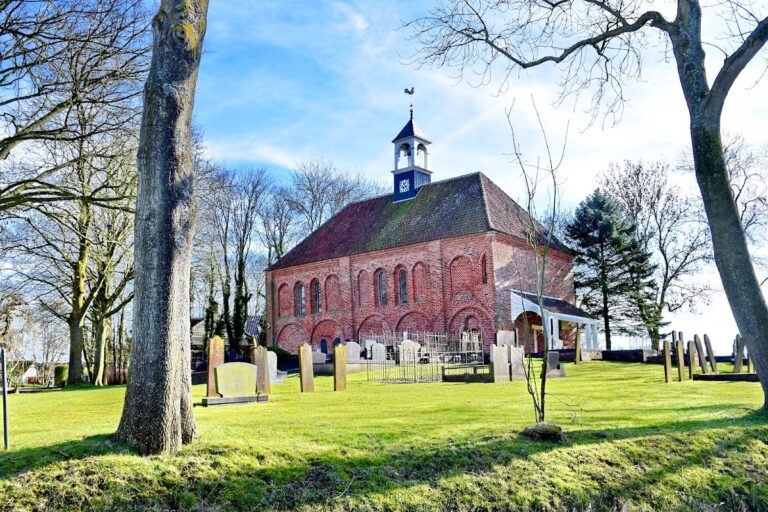
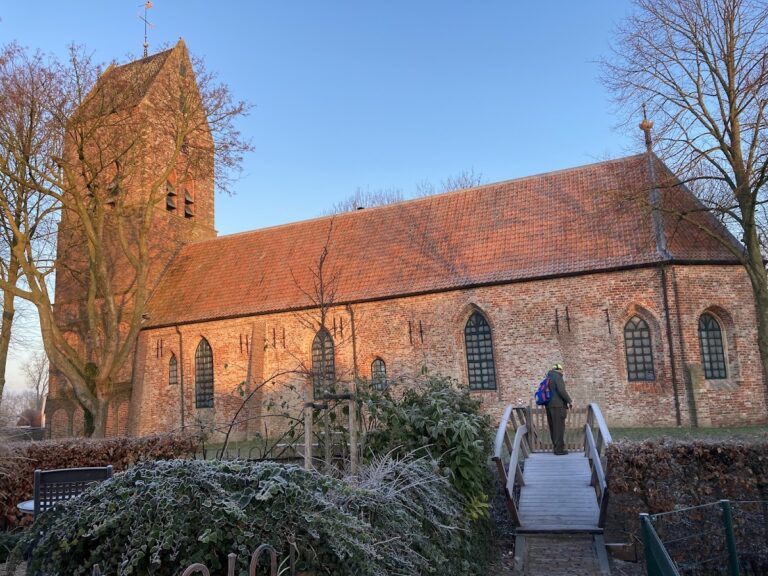
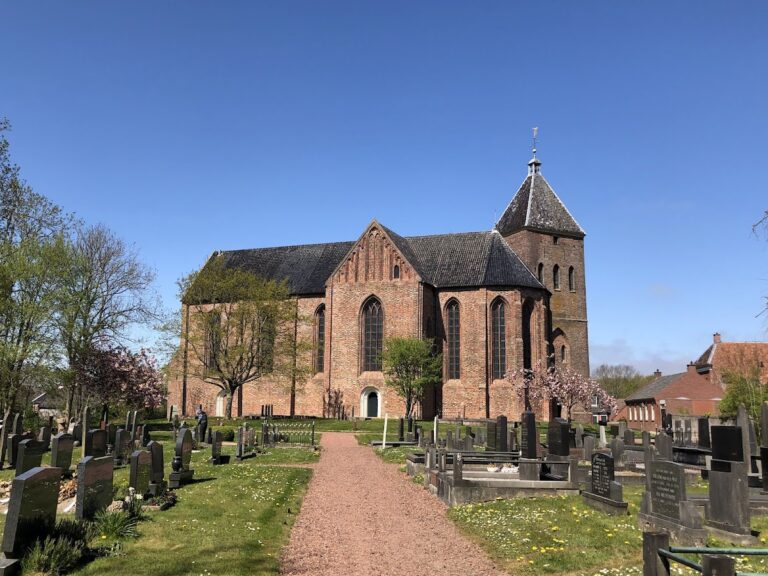
The church is a single-nave medieval building with a western tower, standing on the highest point of Meedhuizen. Until the nineteenth century, a moat completely surrounded it. Part of the moat was later filled in, while sections remain along the east, or rear, side and the south side. Tall beech trees stand immediately around the church. Heavy medieval wall sections survive, divided into bays by narrow pilaster strips. Two blocked windows remain in the east wall.
Roof and interior fabric
The original church had three brick domed vaults. Their removal around 1700 produced the present roof arrangement with heavy beams, an exposed roof structure, and tie rods. The former gables were replaced by hipped roof ends, creating a clipped-hipped form, and the roof was later changed to a tent roof in 1833.
Inside, the former south entrance for men and north entrance for women can still be seen. Two hagioscopes, small openings that allowed people in separate spaces to see the altar or another focus of the service, are visible at the level of the front pews. The walls also contain a piscina, a niche or basin for washing hands or vessels, a sacrament niche for the consecrated sacrament, and two seating niches on either side of the pulpit. The pulpit dates from around 1700, while the gravestone of the minister Jacobus Ringels, who died in 1742, remains in the church.
Western tower
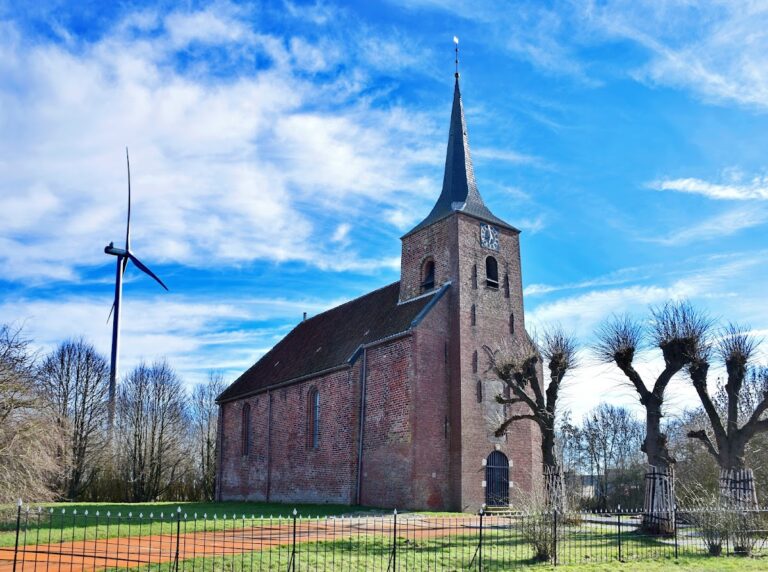
The western tower has an undivided shaft and a constricted spire. It was slightly lowered in 1833 when the church roof was replaced. In 1928, a brick outer shell was built around the old tower, enclosing it within the present tower, and the structure was raised by seven metres. Its foundations had been inadequate, causing the tower to settle out of alignment. The problem became fully apparent after the old trees around the church were felled. A weather vane on top carries the heraldic arms of the noble Rengers and Van der Noot families, commemorating Edzard Rengers and Catharina van der Noot.
Organ and liturgical object
The church contains a keyboard organ made in 1906 by Marten Eertman, then a relatively inexperienced organ builder and innkeeper from Noordwolde. The instrument is exceptionally large for the building. Its two largest principal pipes extend through the organ case and the ceiling. The upper cover of the central tower is so high that the lowered ceiling concealed it from view between 1937 and 1989.
A seventeenth-century communion cup associated with the church bears an image of Saint Lawrence. The object preserves the possible connection between the building and the saint, although the church’s original dedication remains uncertain.