San Francesco: Gothic Franciscan Church in Fondi, Italy


Site at a Glance
- Rating
- 4.6
- Popularity
- Low
- Country
- Italy
- Primary era
- Medieval
- External website
- Open
- Eras represented
- Classical, Medieval, Modern
- Civilizations
- Kingdom of Naples, Roman
- Site type
- Religious
- Remains
- Church
On this page8 sections
History
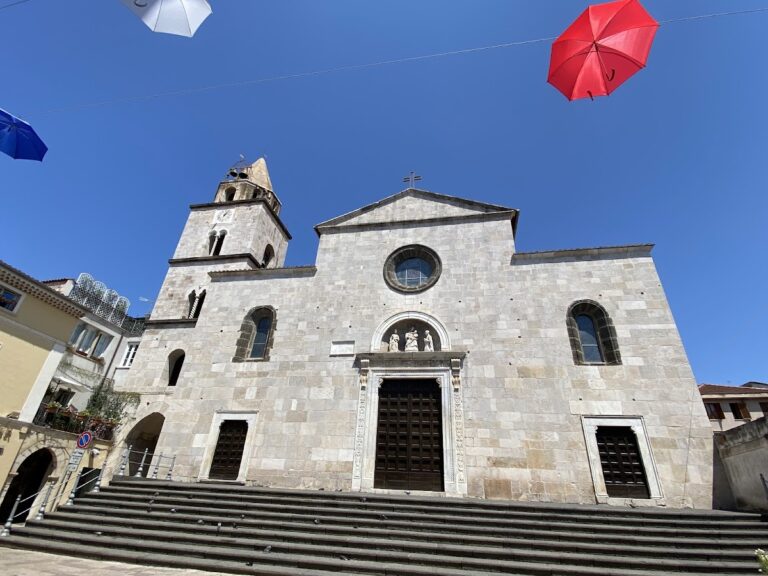
San Francesco, also known as the Church of San Francesco d’Assisi, is a Roman Catholic Franciscan church in Fondi, Italy. Built by the Franciscans around 1363 in a Gothic style with Romanesque influences, it was commissioned by Onorato I Gaetani on the site of an earlier Franciscan building. The church belongs to the Archdiocese of Gaeta and is dedicated to Francis of Assisi, the thirteenth-century Italian religious leader whose teachings gave rise to the Franciscan movement.
Fourteenth-century foundation
The foundation of the present church is commemorated by an epitaph on the architrave of the entrance portal. The building was consecrated and completed in 1363, establishing a new Franciscan centre in Fondi alongside its convent. Its Gothic design, tempered by Romanesque influences, belongs to the medieval development of the complex.
Observant Franciscan administration
From 1466, San Francesco was held by the Neapolitan Observant Friars Minor, a reform branch of the Franciscan Order that placed particular emphasis on strict observance of the original rule. Their possession continued through limited periods of later institutional change. The church was closed during the French occupation and reopened between 1843 and 1866. The friars were permitted to return again in 1881, although that presence was brief. Their withdrawal in 1860 is also associated with the later restoration of Franciscan activity at the site.
War damage and Franciscan revival
The convent buildings suffered serious damage during the Second World War and were restored in 1946. A new Franciscan pastoral presence began in Fondi in August 1967, when Friar Giacinto Caronia arrived at the request of Lorenzo Gargiulo, Archbishop of Gaeta. Friar Alessio Falanga joined him in February 1968, followed soon afterward by Friar Antonio Princi, and a small religious community has operated at the church since 1968.
Falanga served as vice-parish priest and hospital chaplain from 1968 to 1974, parish priest from 1974 to 1995, and vice-parish priest from 1998 until his death in 2002. During the early 1970s Orange Revolt in Fondi, when protesting orange growers blocked the town and confronted the army, the friars were able to move through the streets to assist wounded people because of their popularity in the local community.
The modern revival brought the construction of a small convent beside the church, the complete restoration of the church and bell tower, and the adaptation of a larger nearby residence. It also led to the construction of the Church of Saint Anthony at Le Querce, together with an adjoining oratory.
Remains
The complex combines a two-aisled church with a convent and cloister. Piers divide the interior into bays, while the vaults are ribbed except in the main nave, where exposed roof trusses support the covering. Stained-glass windows illuminate the church, and the entrance is preceded by a portico whose columns are supported by lions, probably reused from another building.
Church architecture
The entrance portal follows the Gothic character of the church, while its jamb is Renaissance in style. Above the doorway, a 1970 lunette, a semicircular area over an architectural opening, shows Saint Francis with the stigmata, the wounds traditionally associated with Christ’s Crucifixion and believed to have been received by Francis. The interior includes a high altar and an altar for Eucharistic adoration, together with a statue of Saint Roch and a representation of Our Lady of Fátima.
Historic sculpture and paintings
One interior pier carries a bas-relief of dextrarum iunctio, the Roman joining of right hands as a sign of friendship, marriage, alliance, or fidelity. The third- or fourth-century AD work consists of portrait busts representing two spouses joining hands in marital fidelity, with a young man placed protectively toward them.
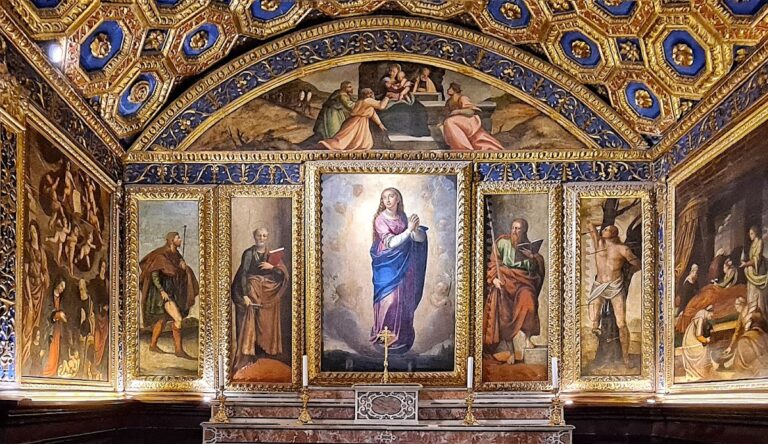
The church also contains twentieth-century works by Giorgio Ascione, a friar of the Neapolitan Friars Minor, depicting episodes from the life of Francis of Assisi. A sculptural work from a Calvary group, representing the Crucifixion of Jesus and related figures, was formerly kept in the Church of Saint Anthony before that building was destroyed by bombing in 1944. The group was carried in procession. A sixteenth-century painting from the Neapolitan school, possibly by a Dominican, formerly stood in the Church of Saint Sebastian and includes symbols of the sun and moon above it.
Convent and cloister
The convent facade has a portico containing antiquarium remains, an archaeological collection awaiting transfer to the Civic Museum of Fondi. The cloister is formed by pointed arches and rib vaults. Its courtyard piers are built from piperno, a dark volcanic stone widely used in parts of southern Italy, and end in capitals decorated with palm-leaf motifs.
Inside the church, the wooden choir is arranged in thirteen stalls, possibly expressing the symbolic number of the twelve Apostles together with Jesus. The choir, cloister, portico, and surviving church furnishings preserve the connection between the religious life of the convent and the architectural fabric of San Francesco.