Reinberg Village Church: A Brick Gothic Church in Germany


Site at a Glance
- Rating
- 4.4
- Popularity
- Very Low
- Country
- Germany
- Primary era
- Medieval
- Eras represented
- Medieval, Early Modern, Modern
- Civilizations
- Duchy of Pomerania, Holy Roman Empire
- Site type
- Religious
- Remains
- Church
On this page14 sections
History
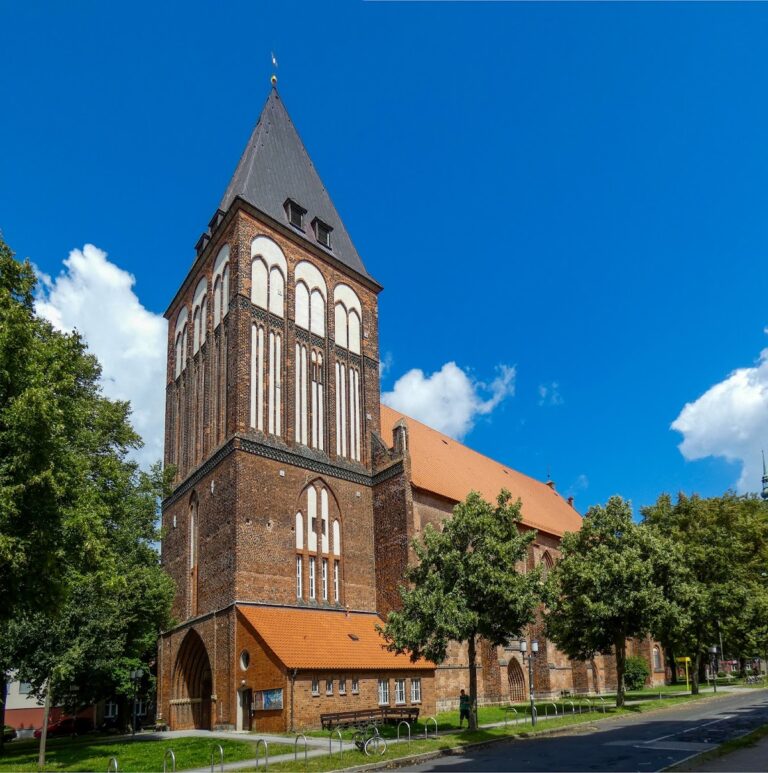
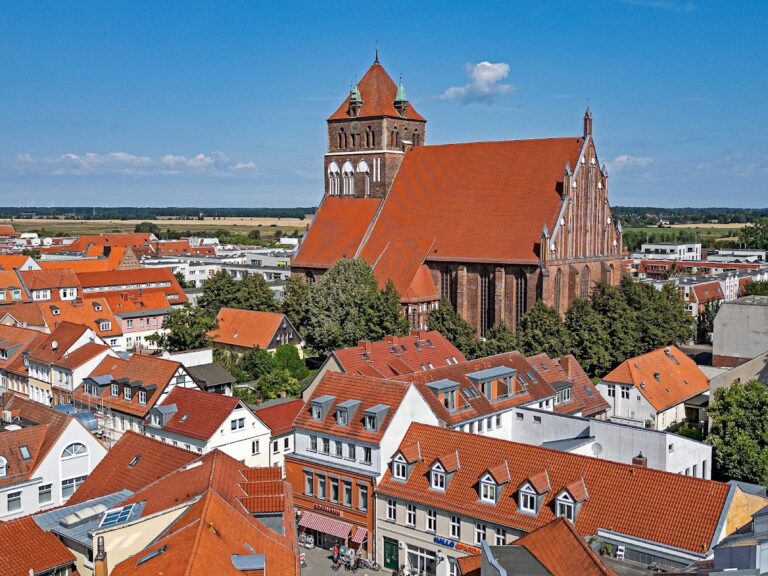
Reinberg Village Church is a medieval church in Reinberg, Germany, within the municipality of Sundhagen. Built in the Brick Gothic tradition, its construction began in the mid-13th century with the chancel. The lost consecration document means that the precise date of consecration is unknown.
Medieval construction
The nave was added during the first half of the 14th century. A western tower followed between the end of the 14th century and the beginning of the 15th century, while a sacristy was attached to the north side of the chancel during the 15th century. The church therefore took shape through several medieval building phases rather than as a single campaign.
In 1456, the city of Greifswald granted the church’s patronage to its university. Patronage, the right to oversee or support a church and its appointments, returned to the city after 1570. The church’s two bells also belong to the medieval period, with one dating from the 14th century and the other from the middle of the 15th century.
Restoration and later history
Extensive restoration took place between 1973 and 1989. During this work, medieval wall paintings in the chancel were uncovered. The altar was dismantled and placed in the church attic, where it remained for about two decades. Steffen Czirnia of Leipzig recorded its condition, and a donation made it possible for the restorer Reinhard Labs to stabilize the work. Since 2005, the altar has stood against the church’s south wall.
The church remains associated with the Evangelical Lutheran Church in Northern Germany. Beside it stands the Reinberg lime tree, estimated to be about 1,000 years old and probably older than the church itself.
Remains
Medieval structure
Chancel
The church is a three-aisled brick building with a narrower, square, single-bay chancel made of fieldstone. The chancel is covered by a cross-rib vault and is encircled by a round-arched corbel frieze, a horizontal decorative band supported by projecting blocks. Its eastern brick gable contains three stepped windows, a stepped pointed-arch blind panel, and an ascending round-arched frieze.
Nave and tower
The nave forms a two-bay hall and has a flat ceiling of wooden planks prepared for the later insertion of a vault. Pointed-arch arcades stand between octagonal pillars. Along the longitudinal walls, corner lesenes, which are shallow vertical strips of masonry, are combined with buttresses. At the west end, a square brick tower approximately as wide as the central nave survives as a distinct part of the medieval structure.
Sacristy and wall paintings
The 15th-century sacristy on the north side of the chancel has a star vault. The chancel also preserves medieval wall paintings from the 14th century. One painting on the chancel ceiling presents Christ as the Judge of the World. A sword and a lily emerge from his mouth, with the lily representing grace and the sword referring to the Last Judgment.
Furnishings and later interior work
Altar and baptismal font
The baptismal font dates from the 14th century. The altarpiece was made in 1726 and 1727 by the Stralsund sculptor Elias Keßler, probably with assistance from his workshop. J. Pieron of Stralsund painted its decoration. The ornament was extensively damaged, and some of the wood had been weakened by woodworm. After stabilization, the altarpiece was reinstalled against the church’s south wall.
Pulpit and organ
The pulpit and its sounding board were made in 1722. Its basket rests on brackets decorated with volutes, acanthus, and angel heads. Biblical inscriptions on the pulpit concern hearing and the permanence of Christ’s words, while the sounding board carries an angel representing the Last Judgment.
The organ gallery was built in 1838. An earlier organ positive, assembled from pipes taken from the old organ of St. Nicholas Church in Greifswald, had become unplayable by 1867. It was replaced that year by the present organ, built by Barnim Grüneberg as his opus 97. The instrument has one manual and nine stops.
Pews and grave slabs
Patronage pews date from the first half of the 17th century and from 1818. Other pews also belong to the first half of the 17th century. Several grave slabs inside the church date from 1759, 1760, 1765, and 1769.
Churchyard memorial
Atonement stone
An atonement stone stands in the churchyard. Such medieval memorials were erected at the site of a killing as part of penitential or commemorative obligations, often naming the victim and requesting prayers for the dead. The Reinberg stone dates from the middle of the 15th century and commemorates Hayno van der Barke, who was killed in a homicide. Several legends are associated with the deed.
The stone is approximately 2.20 metres high and 60 centimetres wide. The murdered Hayno appears in the lower left, while the crucified Christ, accompanied by the sun and moon, occupies the centre. A cross shaped like an Iron Cross fills the circular upper section. Hayno addresses Christ with the words miserari mei do[mino], meaning “Lord, have mercy on me.” A band around the cross bears the prayer orate pro hayno van der beken, meaning “Pray for Hayno van der Beken.”