Église Saint-Gilles: A Romanesque Parish Church in Liège

Site at a Glance
- Rating
- 4.8
- Popularity
- Very Low
- Country
- Belgium
- Primary era
- Medieval
- Eras represented
- Medieval, Modern
- Civilizations
- Holy Roman Empire
- Site type
- Religious
- Remains
- Church
On this page8 sections
History
Église Saint-Gilles is a Roman Catholic parish church in Liège, Belgium, whose origins lie in a Romanesque abbey church founded in 1124 by Albéron I of Louvain, the medieval prince-bishop who combined episcopal authority with political and administrative power in the principality of Liège. Albéron dedicated the church and secured burial there. Its Romanesque architecture belongs to the tradition associated with the historic regions around the Meuse and Rhine rivers.
Abbey origins
The church began as the centre of a monastic foundation in the Saint-Gilles district. Over the centuries, the building was altered repeatedly, while its religious role continued through changing institutional circumstances. A commemorative monument to Albéron I of Louvain, dated 1646, preserves the memory of the founder within the church.
Suppression and parish use
The abbey was suppressed under French rule, and the church was disused from 1786 to 1803. In 1803, it became the official parish church for the inhabitants of Saint-Gilles, Saint-Nicolas-en-Glain, and Sainte-Gertrude. The latter two communities were associated with chapels that have since disappeared, so the church assumed a wider parish role.
Mining damage and restoration
Coal extraction beneath Publémont severely affected the building. The monks had initially mined coal in the area, while nineteenth-century operations by the Piron and La Haye coal companies became more systematic. Ground settlement and landslides caused by this activity led to further damage, and the church was repaired several times during the nineteenth century.
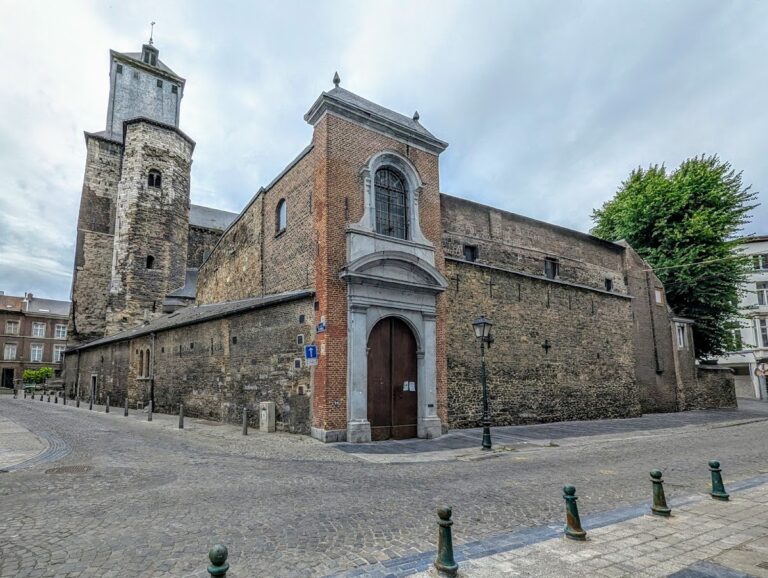
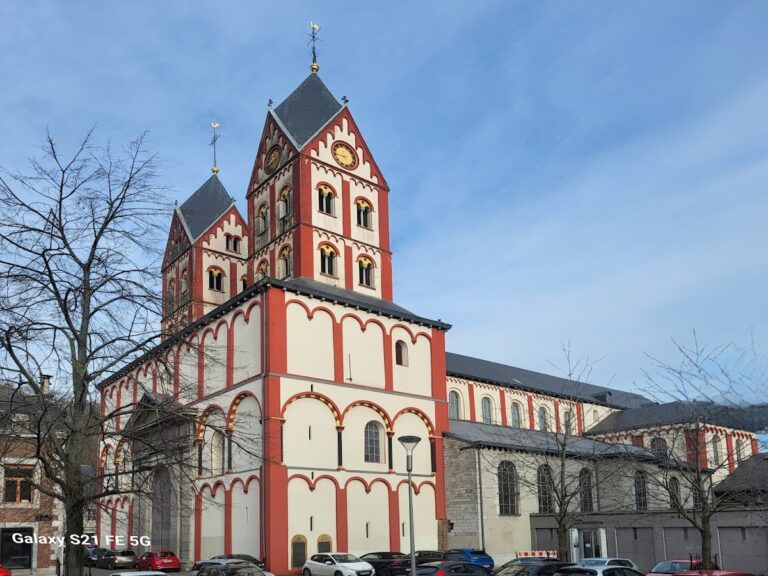
Between 1885 and 1900, parish priest Hyacinthe Demaret commissioned the Ghent architect Auguste Van Assche, known for restoring medieval churches, to carry out a comprehensive intervention. The work aimed to consolidate, restore, and enlarge the church for a growing population. The resulting building combines older Romanesque fabric with a neo-Romanesque extension integrated into the earlier walls. Wallonia protected Église Saint-Gilles as classified heritage in 1936.
Later religious memory
Since 30 June 2024, the church has housed the tomb of Blessed Eugénie Joubert, a French Catholic religious figure and catechist who taught catechism in the parish. A chapel is dedicated to her. Joubert was born in Haute-Loire, France, on 11 February 1876, and died in Liège on 2 July 1904.
Remains
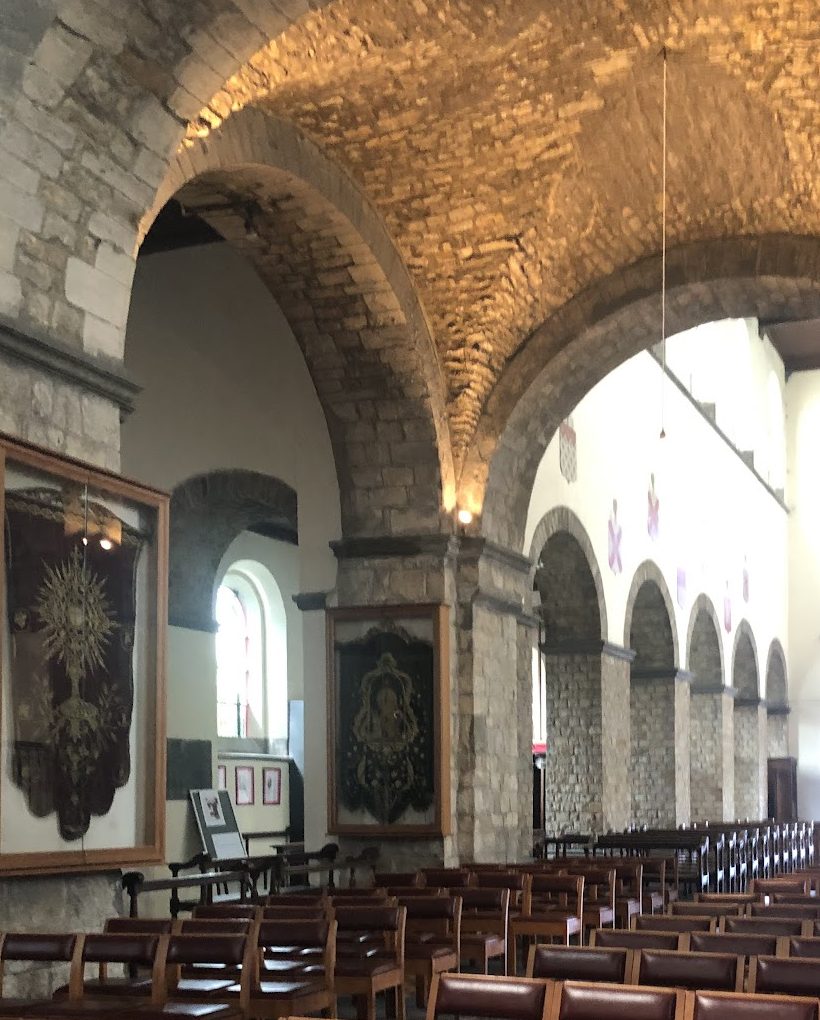
The surviving church has a Latin-cross plan and combines Romanesque architecture of the Meuse-Rhine tradition with a neo-Romanesque section added during the nineteenth-century intervention. Its masonry uses sandstone quarried locally at Publémont, including schistose sandstone and coal sandstone. The original design included a massive tower over the crossing, the central junction of the arms of the cross-shaped plan. Centuries of modification and Van Assche’s enlargement have shaped the present architectural arrangement.
Sculpture and religious images
The church’s sculpture includes a statue of Saint Giles dating from approximately 1301 to 1310. Later works include Saint Leonard by N. Decharneux, dated 1866, and an unidentified priest from approximately 1741 to 1760. Two Adoring Angels date from approximately 1751 to 1775. Other images include an undated Madonna and Child, Christ on the Cross, and Saint Lawrence, together with a Madonna and Child from approximately 1770. A Sedes Sapientiae, an image of Mary seated with the Christ Child as the seat of divine wisdom, dates from approximately 1891 to 1910.
Paintings and funerary memorials
A Calvary with Mary Magdalene, painted by Englebert Fisen in 1710, is among the church’s paintings. Other works depict an abbot of Saint-Gilles and the Thorette family before Christ on the Cross. Funerary slabs commemorate several figures connected with the church and its community, including Baudouin de Hanèche, abbot of Saint-Gilles, dated 1352; Wauthier de Breda, abbot, dated 1541; Simon Dalem, dated 1583; Toussaint de Visé, also called Prosset, dated 1642; and Gilles de Fize, dated 1685.
Later slabs commemorate Lambert Leruitte, abbot of Saint-Gilles, dated 1738; Gérard H. de Jennet, abbot of Saint-Gilles, dated 1754; Hubert Duchateau, also called Tixhon, abbot of Saint-Gilles, dated 1760; and Jean Fastré Lombart, abbot of Saint-Gilles, dated 1761. Together with the sculptures, paintings, and the monument to Albéron I, these memorials preserve successive layers of the church’s religious and institutional history.