Callan Augustinian Friary: A Fifteenth-Century Monastic Foundation in Ireland


Site at a Glance
- Rating
- 4.4
- Popularity
- Very Low
- Country
- Ireland
- Primary era
- Medieval
- External website
- Open
- Eras represented
- Medieval
- Civilizations
- English
- Site type
- Religious
- Remains
- Church
On this page7 sections
History
Callan Augustinian Friary is a late fifteenth-century Augustinian monastery in Ireland, established by Edmund MacRichard Butler and developed by his son James Butler. The friary stood at Abbey Meadow in the north-east of Callan, beside the Kings River, and became an important centre for the reforming observant movement within the Augustinian order.
Foundation and observant reform
In 1461, Edmund MacRichard Butler petitioned Pope Pius II, who was head of the Catholic Church from 1458 to 1464, for permission to establish the friary. Edmund died in 1462, after which his son James Butler erected the monastic buildings and came to be regarded as the monastery’s founder. The foundation is commonly dated to 1471, although it probably took place two or three years earlier, in 1468 or 1469.
The Augustinians are a Catholic religious order whose communities follow a rule traditionally associated with Saint Augustine of Hippo. In 1472, the Callan friary became observant, adopting a stricter discipline promoted by a reform movement then spreading through Augustinian communities across Europe. In 1479, it became the centre of the Irish Observant Congregation.
Dissolution and later Augustinian presence
Henry VIII’s government dissolved the friary in 1540 and confiscated its lands. Henry VIII was King of England from 1509 to 1547, and his government carried out the dissolution of many religious houses during the 1530s and 1540s. The lands at Callan subsequently passed to the Earls of Ormond.
The history of the Augustinians in Callan between 1540 and 1766 is only partly known. Members of the order nevertheless returned to the monastery, and records place Augustinian friars in Callan from the middle of the seventeenth century. A new Augustinian monastery was founded in Callan in 1766. It closed at Easter 2001, leaving the original friary inactive.
Remains
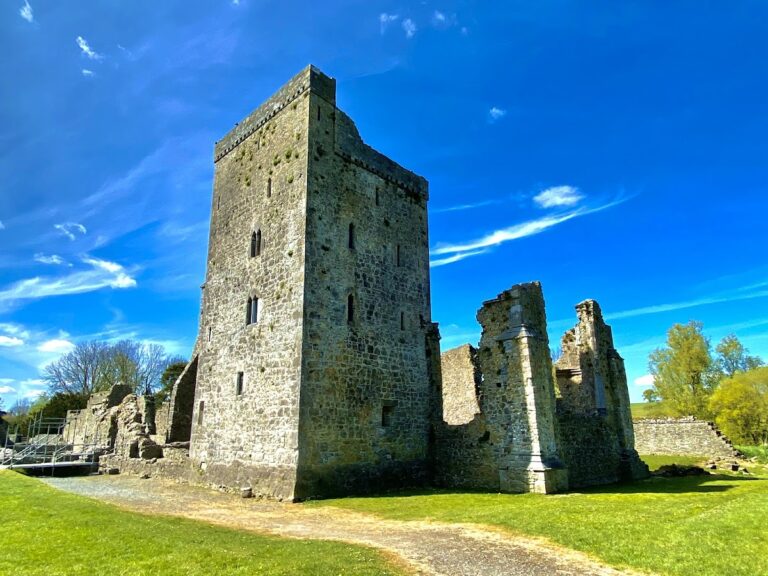
The surviving remains are centred on the long rectangular friary church and Saint Augustine’s Well, also known as the Abbey Well. The church stands within the former abbey grounds at Abbey Meadow, while the well lies at the southern end of the site, with its water channel directed toward the Kings River.
Church and well
Friary church
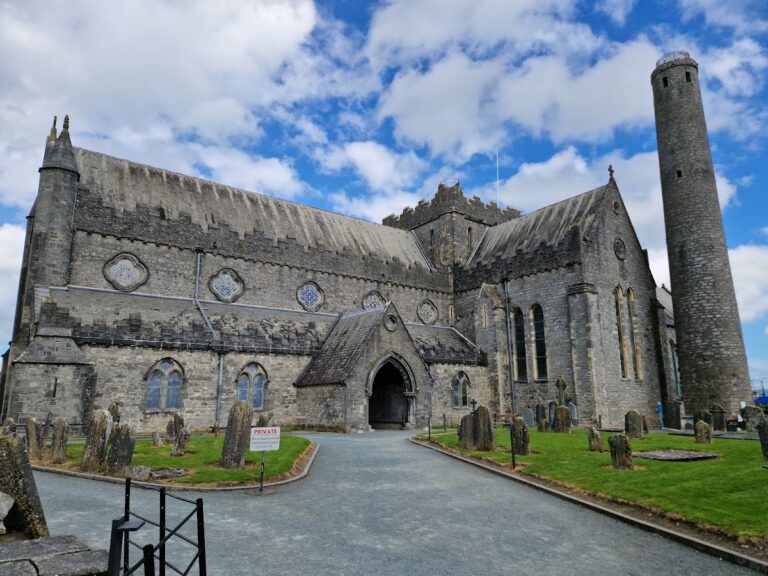
The friary church is a long rectangular building with a bell tower placed at its centre. At the eastern end, the choir is lit by an east window. A sedilia, a built-in seat near the sanctuary for clergy officiating at religious services, occupies part of the south wall. This seat is regarded as one of the finest examples in Ireland.
Saint Augustine’s Well
Saint Augustine’s Well occupies a rectangular area approximately 1.2 to 3 metres in size and is enclosed by a wall. An opening on the southern side allows the water to flow toward the Kings River. The enclosure also contains a limestone gutter-spout that may have formed part of the abbey. The well is listed in Ireland’s Record of Monuments and Places under record number KK026-010018-.
Local folklore held that water from the holy well could cure swellings and strains. The Callan-born poet John Locke described the well in his 1885 poem The Old Abbey Well, which presented its water as refreshing and magical.