Karja Church: A Medieval Lutheran Church in Estonia


Site at a Glance
- Rating
- 4.6
- Popularity
- Low
- Country
- Estonia
- Primary era
- Medieval
- Eras represented
- Medieval
- Civilizations
- Crusader, Holy Roman Empire
- Site type
- Religious
- Remains
- Church
On this page8 sections
History
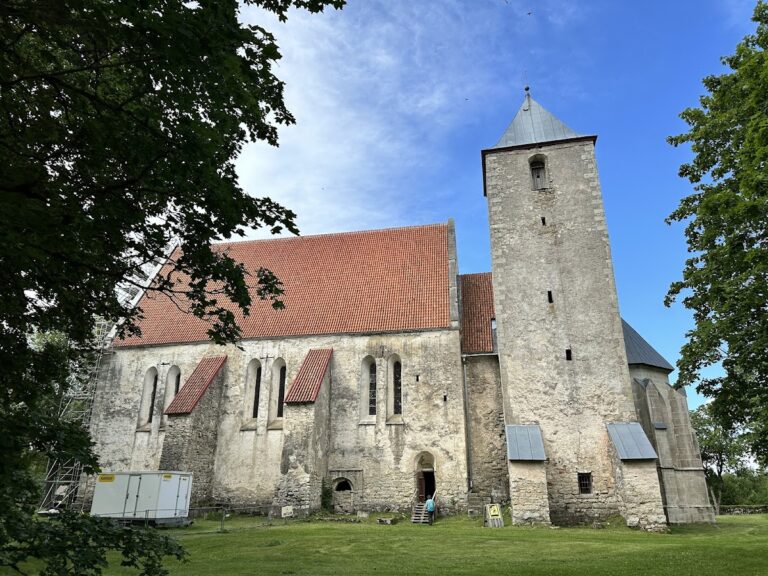
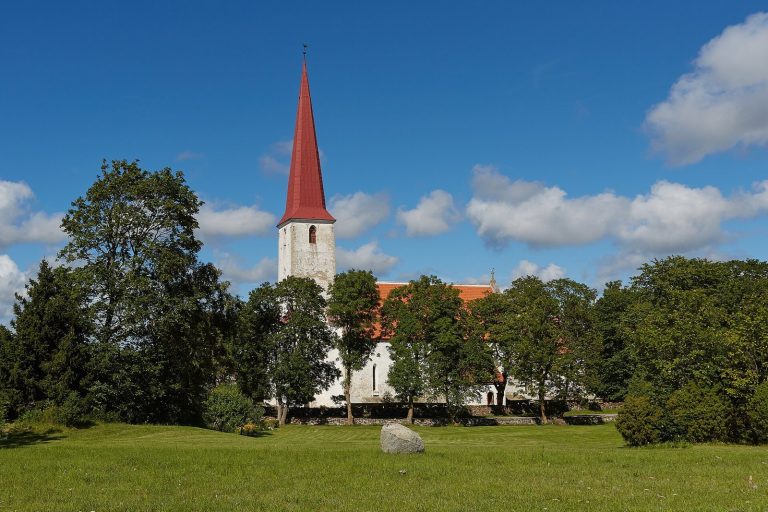
Karja Church is a medieval Lutheran church in Linnaka village on Saaremaa island, Estonia, probably built between the late 13th and early 14th centuries in the Romanesque-Gothic transition. A chronicle mentions a small wooden church on the site in 1254, while the present stone building was apparently constructed in the late 13th century by Swedish masters from Gotland.
Medieval origins
The church was originally dedicated to St. Catherine and St. Nicholas. It later became known as St. Catherine’s Church in Karja. The site may have held sacred associations before the stone church was built. The nearby Kalmu field probably contained stone graves, suggesting that the church stood within an older landscape of burial and religious importance.
Karja Church was planned for more than regular worship. From the beginning, its design included a role as a place of refuge during danger or war. In later periods, the rooms above the vestry may have sheltered Scandinavian pilgrims travelling to Livonia. This possible use has been offered as one explanation for the unusually rich decoration within a comparatively small church.
Parish life and later history
The parish community was formed mainly by Baltic Germans until 1896. That year, Karl Wermann became the first clergyman of Estonian origin to serve the parish, remaining in office until 1926. Worship at the church has continued for more than 700 years, linking its medieval foundation with the religious life of later communities.
Karja Church is protected as an architectural monument of Estonia. Its surviving structure and furnishings preserve evidence of medieval worship as well as later Lutheran use, including changes made to the interior over several centuries.
Remains
Building and setting
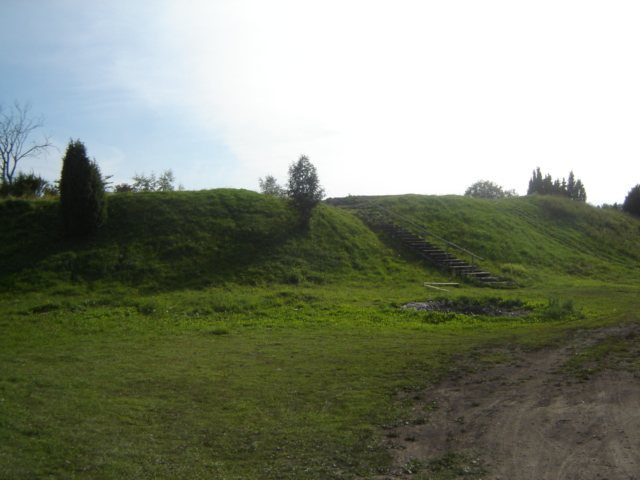
Karja Church is a comparatively small and simple Romanesque-Gothic building made of Saaremaa dolomite. It has thick walls, a single nave, a simple choir, and a vestry, but no bell tower. The nave is covered by high, whitewashed vaults, or masonry ceilings, divided into two bays. The church stands on a higher plateau, with a small body of water at the foot of the rise. Eighteenth-century maps also show this water feature, while the Kalmu field lies north of the church.
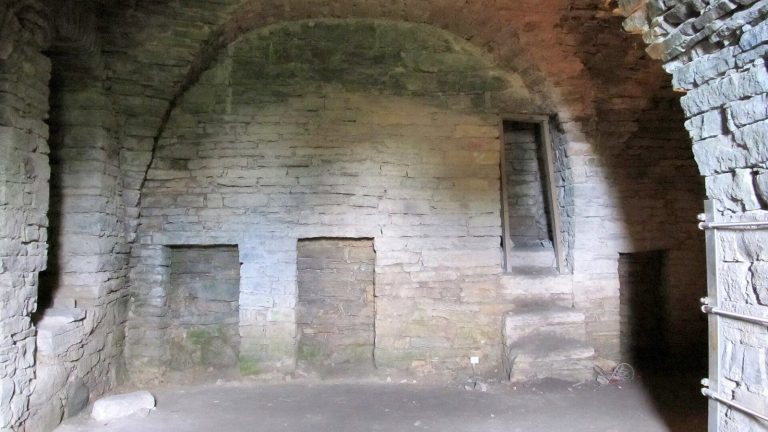
The rooms above the vestry contain fireplaces and were difficult to reach. Their position and arrangement are consistent with a possible refuge function, allowing the building to serve as a place of shelter as well as worship. The austere exterior contrasts with the much more elaborate interior decoration.
Medieval paintings
Relatively well-preserved medieval mural paintings survive on the walls and ceiling. Their subjects include decorative designs, a triskelion, which is a three-part rotational symbol, a pentagram, or five-pointed star, grotesque devils, and other symbols whose meanings are uncertain. Some of these motifs may have pagan origins, although their precise significance within the church remains unclear.
Stone carving and sacred imagery
Carved stone sculpture is concentrated on the portals, brackets, and vault bosses. The forms range from Romanesque through Gothic and High Gothic, a developed phase of Gothic design. Foliage and biblical scenes appear among the carvings, while a Calvary group stands beside the south portal.
The Calvary group represents Christ’s Crucifixion with Mary and John mourning beside him and the two robbers on the cross. One robber repented after hearing Jesus, while the other mocked him. Their souls, shown as small children leaving their bodies, are received by an angel and taken by the Devil respectively. The church also contains a sculpture of St. Catherine holding a book and a prominent image of St. Nicholas accompanied by a monk holding a ship. St. Catherine is identified as the patron saint of scholars, while St. Nicholas is identified as the patron saint of fishermen.
Furnishings and churchyard stones
The baptismal font dates from the 14th century, and the crucifix from the 15th century. The pulpit was made in 1638 by Balthasar Raschky, a local craftsman from Kuressaare. A Neo-Gothic organ made by Gustav Norman was installed in 1882, adding a later layer to the medieval interior.
Three gravestones from the 14th or 15th century stand in the churchyard. Their decoration includes Maltese and Greek crosses, extending the medieval carved tradition beyond the church walls.