Heilig Hüsli: A Historic Pilgrimage Chapel on Lake Zürich
Site at a Glance
- Rating
- 4.6
- Popularity
- Very Low
- Country
- Switzerland
- Primary era
- Early Modern
- Eras represented
- Early Modern, Modern
- Civilizations
- Swiss
- Site type
- Religious
- Remains
- Chapel
On this page9 sections
History
Heilig Hüsli is a Catholic chapel in Rapperswil-Jona, Switzerland, whose present stone building was erected in 1551. Administered through the Diocese of Chur and the Rapperswil parish, it stands beside the historic crossing of the upper Lake Zürich and preserves the memory of a medieval route linking Rapperswil with Hurden.
Medieval bridge and pilgrimage route
A wooden bridge chapel at the crossing was first mentioned in 1485 as a prayer house or pilgrims’ chapel. A chapel may already have existed when the first lake bridge was built around 1360, although that earlier foundation remains probable rather than certain. The crossing formed part of pilgrimage routes associated with the Way of St. James, a network of Christian journeys leading toward Santiago de Compostela in northwestern Spain. Regional paths connected Wattwil, the Ricken Pass, Schmerikon, Lachen, Buechberg, the upper lake shore, St. Meinrad Pass, and Einsiedeln. Another route ran through the Töss Valley, the former Rüti Abbey, Kempraten, and Rapperswil before crossing the lake toward St. Meinrad Pass and Einsiedeln.
The drowning of Katharine Scheuchzer
In 1563, Katharine Scheuchzer, the last superior of the Wydenchlösterli, was accused of witchcraft after an epidemic broke out in the Rapperswil hospital. The Wydenchlösterli was a small Beguine nunnery on the Jona River shore, founded by the House of Rapperswil, the medieval ruling noble family associated with its establishment. After cruel torture, the town council sentenced Scheuchzer to death. She was bound, placed in a sack, and drowned in the upper lake beside Heilig Hüsli.
The episode followed a legal dispute over pasture belonging to the nunnery. In 1543, the Tagsatzung, the assembly of cantonal representatives in the Old Swiss Confederacy, had issued a verdict in favor of the Wydenchlösterli. Its property was later transferred to the hospital, linking the chapel’s surroundings with a conflict over land, jurisdiction, and institutional power.
Destruction of the old crossing and later care
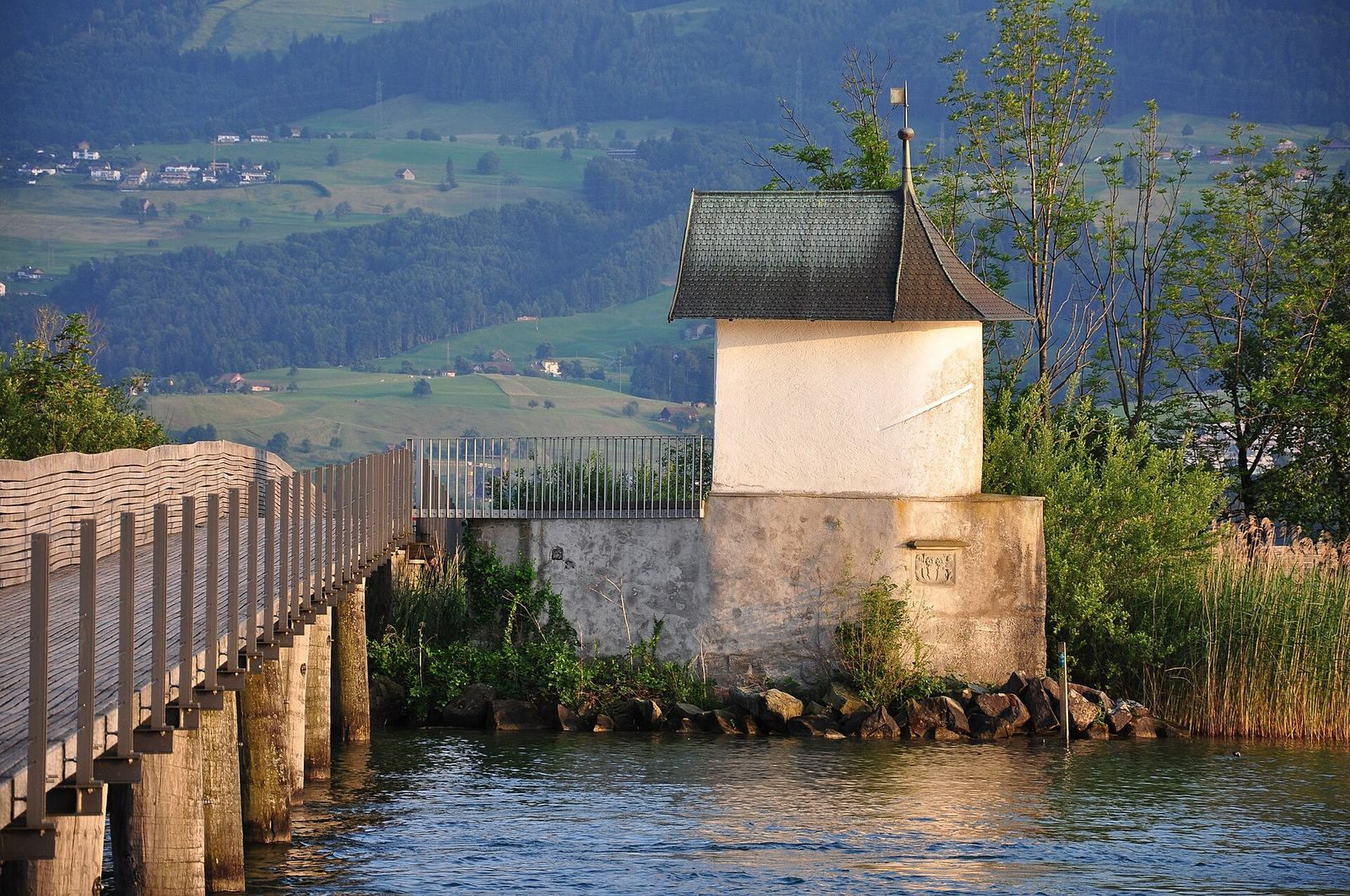
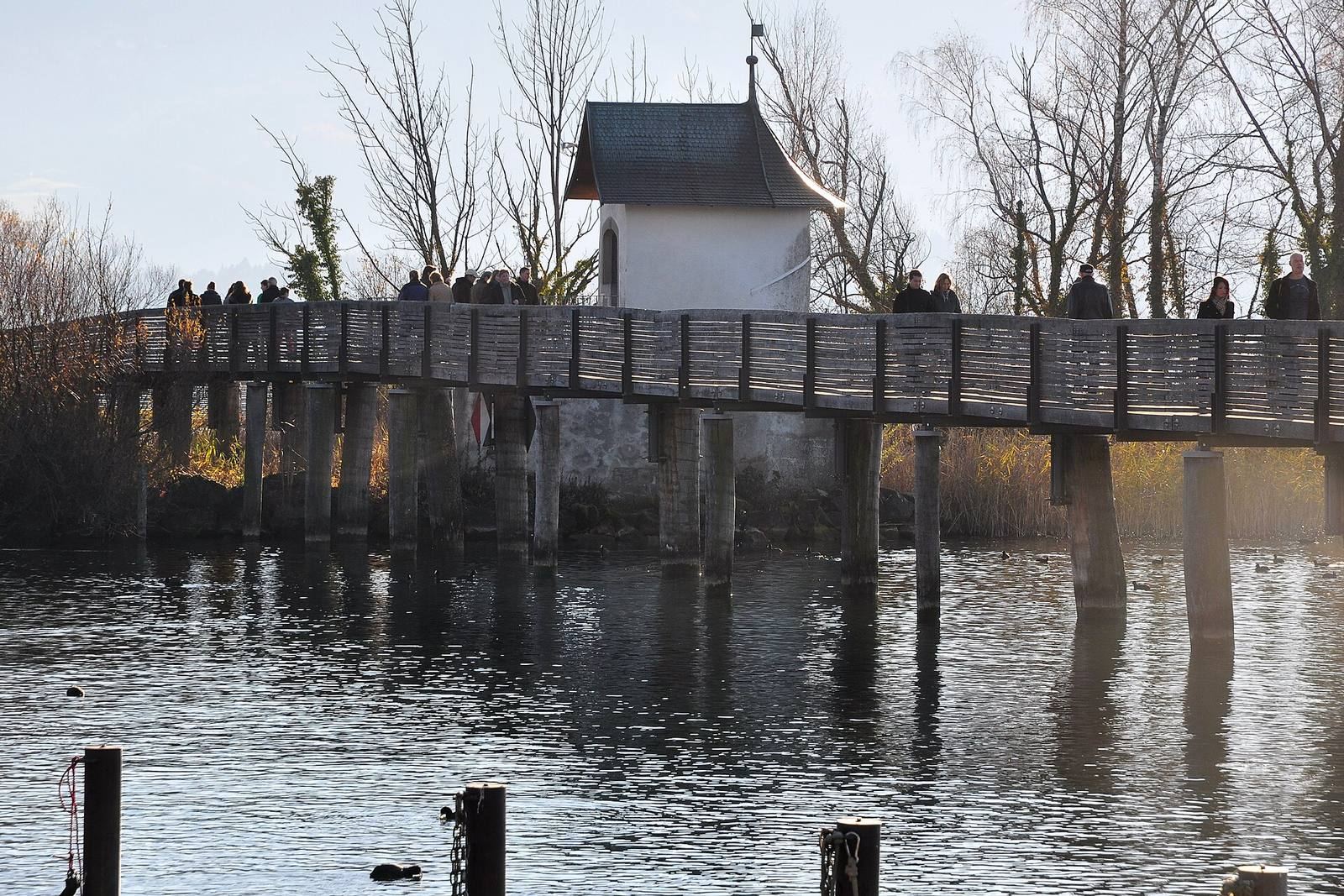
The construction of the Seedamm road and railway crossing in 1878 brought the historic wooden bridge to an end. Heilig Hüsli became the only visible surviving structure of the former crossing and stood isolated in the lake. It remained accessible only by water until the historic wooden bridge between Rapperswil and Hurden was reconstructed and opened in 2001.
Partial renovation or restoration took place in 1908, 1930, 1957, during the early 2010s, and in 2015. A new interior image was inaugurated and blessed in April 2011, restoring the chapel’s devotional function. The building has been protected since 1907 and is listed in the Swiss inventory of cultural property as a Class B object of regional importance. It is owned by the local civic community of Rapperswil-Jona.
Remains
Island setting and structure
Heilig Hüsli occupies the eastern part of a small, elongated island in the upper Lake Zürich, east of the Seedamm and near Rapperswil railway station. The chapel is approximately 100 metres from the Seedamm and 55 metres from the Rapperswil shore, while the pedestrian wooden bridge passes about three metres away. Built on a base roughly four metres high, the structure measures about two by three metres and has eaves approximately 3.5 metres above the ground. Its compact stone form preserves the scale of a small bridge and pilgrimage chapel.
Apse and former altar
The chapel has a west-facing apse (a rounded or polygonal end of a sacred building). A miraculous fresco formerly occupied this area, and the outline of its former altarpiece remains visible inside. The historical altarpiece, dating from the second half of the sixteenth century, is preserved in the Stadtmuseum Rapperswil-Jona. The former fresco was replaced by a replica wall painting by the Swiss artist Marlies Pekarek. Installed on the west wall, it depicts the crowned Virgin Mary holding the infant Jesus.
Images and interior installations
A painted wooden sculpture of the Virgin Mary holding the body of Christ, dating from around 1500, is also preserved in the Stadtmuseum Rapperswil-Jona. The chapel’s interior can be viewed through the latticed east side, and pilgrims traditionally throw coins inside. A Plexiglas floor installation depicts pilgrims in historical clothing carrying walking staffs. Designed in the manner of an old woodcut, it repeatedly presents the same two pilgrims facing in opposite directions.
Geological setting
The island, together with the nearby islands of Ufnau and Lützelau, consists of harder conglomerate and sandstone layers left by glacial erosion. These rocks belong to sedimentary formations associated with the geological formation of the Alps and provide the natural foundation for the small chapel island.