Saint Lawrence Church: Former Parish Church of Falkenberg
Site at a Glance
- Rating
- 4.5
- Popularity
- Very Low
- Country
- Sweden
- Primary era
- Medieval
- Eras represented
- Medieval, Early Modern, Modern
- Civilizations
- Danish, Swedish
- Site type
- Religious
- Remains
- Church
On this page8 sections
History
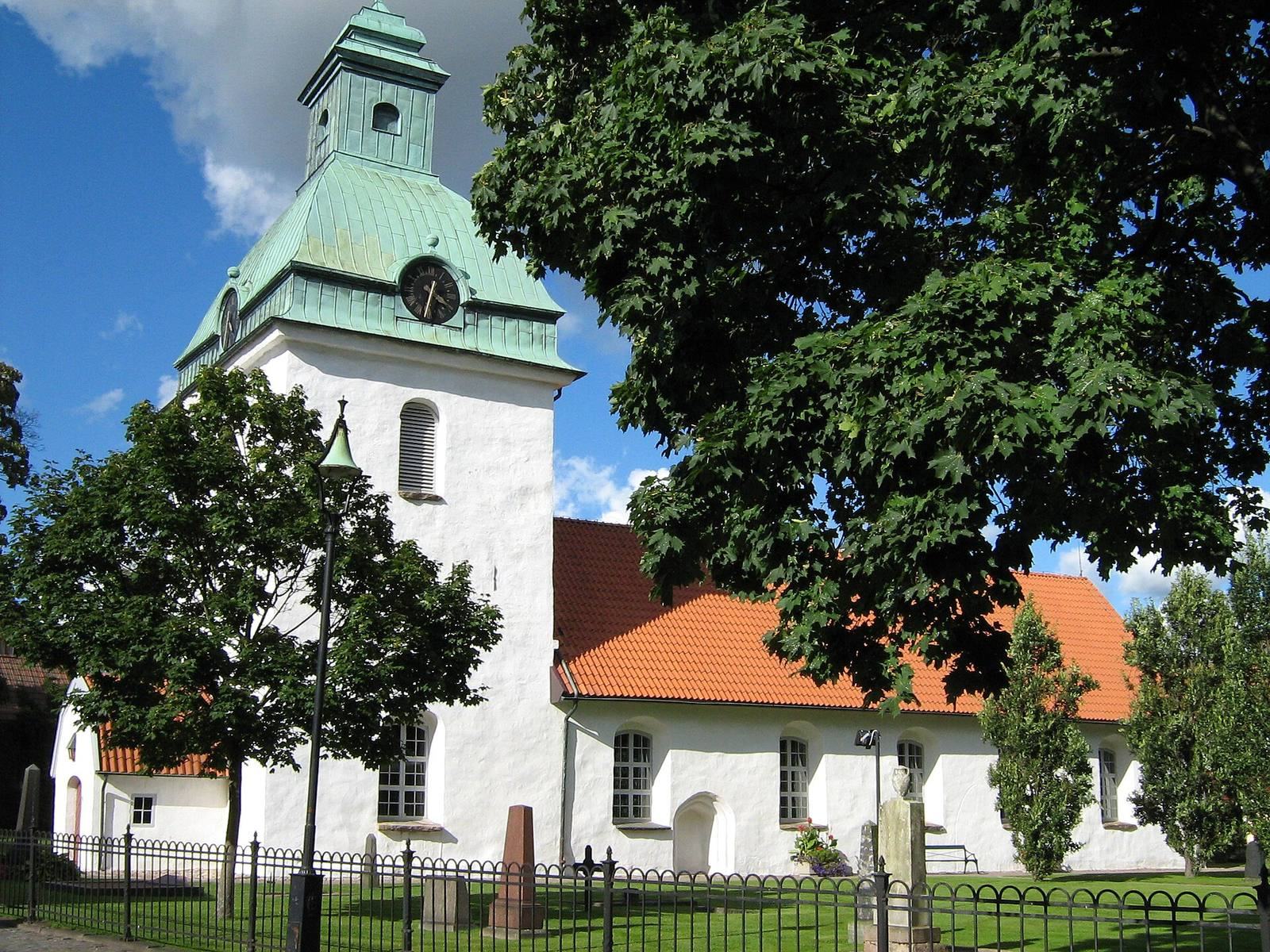
Saint Lawrence Church is a former parish church in Falkenberg, Sweden, probably built around 1300 during the medieval period. Also known as Sankt Laurentii kyrka and Falkenberg’s Old Church, it is dedicated to Saint Lawrence of Rome, a third-century Christian deacon and martyr whose name was widely used for church dedications. The church is associated with Falkenberg Parish in the Church of Sweden, Sweden’s Lutheran national church, and the Diocese of Gothenburg.
Medieval origins and wartime damage
The original church was substantially smaller than the building that survives. Its nave, the principal space for the congregation, was enlarged during the late medieval period, possibly in the fifteenth or sixteenth century. The walls, approximately one meter thick, retain evidence of this earlier structure and its later expansion.
During the Northern Seven Years’ War of 1563–1570, a conflict fought across Scandinavia and the Baltic region, the church was burned. In 1586, the parishioners received permission to use Falkenberg’s Crown toll and excise revenues to rebuild it, linking the church’s recovery to the town’s public finances.
Later alterations
A major renovation took place in 1668. The ceiling was vaulted in 1739, and in 1787 the earlier wooden tower was replaced by the present stone tower. An armory was added during the same year. These changes gave the medieval building much of the form associated with its later history.
Saint Lawrence Church remained Falkenberg’s town parish church until 1892, when a new church was built for the growing town. The old church was abandoned and deconsecrated rather than demolished, then converted into a school gymnasium because the school lacked one. Its interior furnishings were sold. The building was also used for concerts, lectures, film screenings, and air-rifle practice. After the school obtained its own gymnasium in 1922, restoration was decided upon.
Restoration and renewed religious use
Restoration during the 1920s, completed in 1928 under the architect Hakon Ahlberg, returned the building to religious use and culminated in its rededication. New pews were installed because the original pews could not be found, and an altar and altar rail were added. Sixteenth-century chalk paintings were found beneath wall plaster in 1924. In 1926, the removal of the ceiling covering revealed paintings made in 1753–1754 by Paul Christopher Linkmeyer.
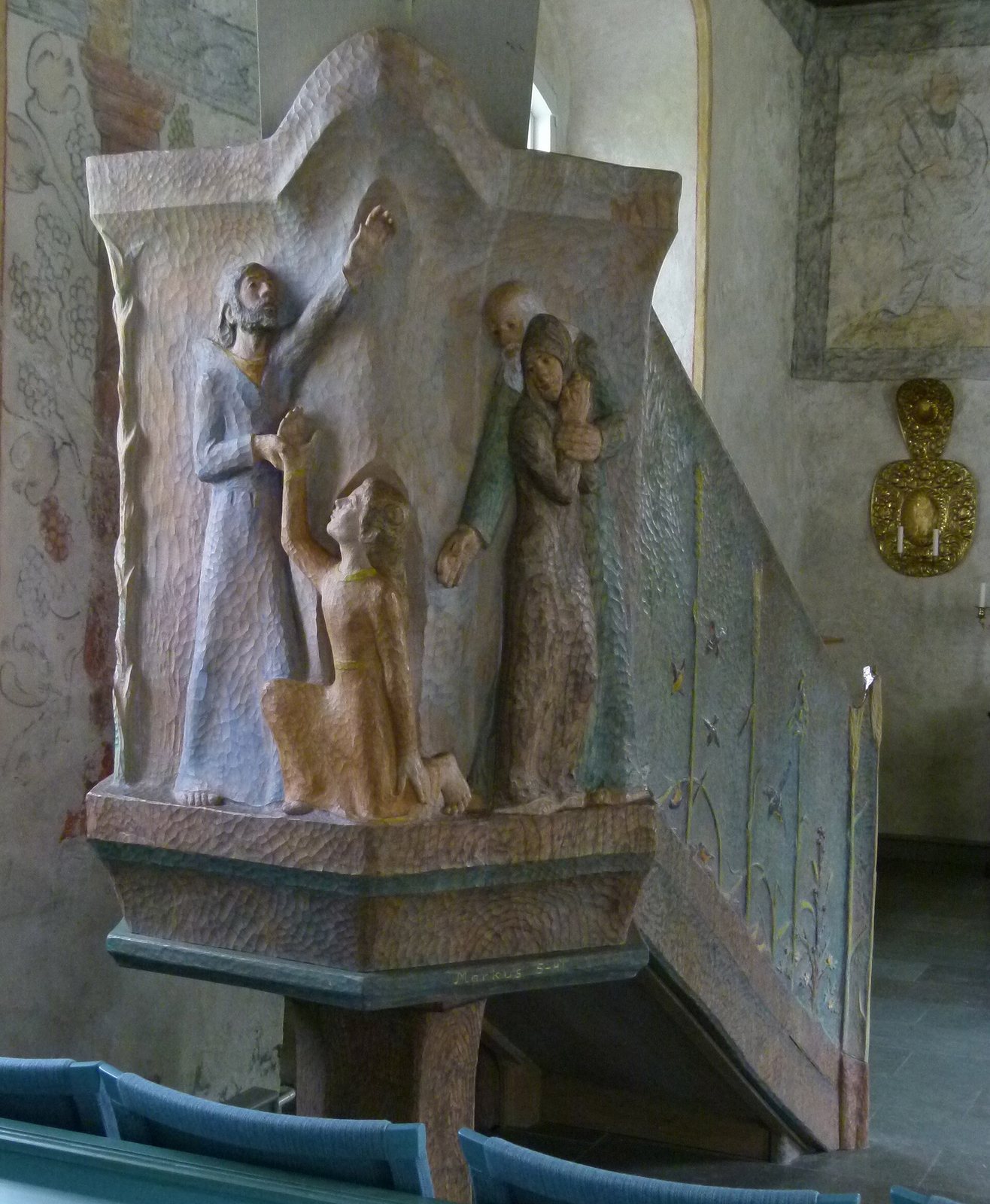
New church bells were acquired in 1935 after a public collection. A renovation under Harald Wadsjo in 1941 introduced a new color scheme and pulpit. In 1978, a further pulpit carved by the Falkenberg artist Tore Heby was installed, and a new organ was built by Hammarbergs Orgelbyggeri.
Remains
Layout and medieval fabric
Saint Lawrence Church stands in the center of old Falkenberg, opposite Laurentii Park. Its thick walls preserve evidence of the smaller fourteenth-century building, while the enlarged nave reflects the church’s late medieval development. The building has a straight-ended eastern chancel, the area around the altar. An eastern window that had been bricked up became visible again in 1954, and traces of an entrance sealed in 1903 remain in the south facade.
Tower and painted interior
The present tower is a stone structure from 1787. It has a distinctive copper hood and a weather vane, replacing the earlier wooden tower. Inside, the vaulted ceiling is covered by a large-scale painting with several biblical themes, while parts of the side walls and chancel wall are also painted. The chancel wall above the altar carries a depiction of King David, the biblical ruler traditionally associated with the united kingdom of Israel and Judah and with the Psalms. The figure was probably first intended to represent God the Father in human form, but a harp was apparently added so that it could be understood as King David. This prominent depiction of an Old Testament king in a Christian church is described as exceptional.
Furnishings and musical equipment
The wooden baptismal font consists of an oak trunk with painted decoration. It probably dates from the sixteenth century and may be older. The 1978 pulpit was carved from locally sourced ash by Tore Heby, and the church contains a wooden altar crucifix from Oberammergau. A ship model donated in 1974 hangs above the nave.
The organ installed in 1978 was built by Hammarbergs Orgelbyggeri. It has 17 stops, each a set of pipes with a particular sound, distributed between two manuals, the keyboards played by the hands, and a pedalboard played by the feet. The previous organ, made in 1954, was sold.