Saint Adalbert Church in Domasław: A Historic Parish Church in Poland
Site at a Glance
- Rating
- 4.5
- Popularity
- Very Low
- Country
- Poland
- Primary era
- Modern
- External website
- Open
- Eras represented
- Medieval, Early Modern, Modern
- Civilizations
- Holy Roman Empire
- Site type
- Religious
- Remains
- Church
On this page10 sections
History
Saint Adalbert Church in Domasław is a historic church in Poland whose origins lie in a thirteenth-century foundation, although its exact foundation date is unknown. Older traditions associate the foundation with Peter Wlast, a twelfth-century Silesian magnate linked with major religious foundations in the Wrocław region. The church probably already existed when Duke Henry I moved a market to Domasław in 1214. It may have served as the mother church of the surrounding area and the seat of an early parish.
Medieval origins and early parish history
The first recorded reference to a priest of Domasław appears in a report sent to Thomas II, bishop of Wrocław, in 1284. A visitation report from 1677 named Hedwig of Andechs, canonized in 1267 and also known as Saint Hedwig of Silesia, as the donor of the church’s formerly extensive landed property. These traditions associate the church with the religious institutions and patrons that shaped medieval Silesia.
A new church building was erected in the sixteenth century. In 1552, Hanns Kulmann, a councillor of Wrocław, bequeathed Domasław to Saint Bernard Hospital in Wrocław. The hospital held manorial lordship over the village until the nineteenth century. The earlier estate endowment, known as Warusche or Karlau, had passed to the collegiate foundation of the Holy Cross at Wrocław Cathedral before the Reformation and became private property after secularization in 1810.
Reformation and confessional change
During the Reformation, the Protestant city council of Wrocław appointed a Lutheran clergyman at Domasław. With an interruption, the church then served the local German population as the Evangelical Lutheran parish church of Saint John the Baptist until the end of the Second World War in 1945.
The restitution edict of the Bohemian ruler in 1652 returned the church to Catholic use. The Evangelical congregation regained it in 1707 under the Convention of Altranstädt, an agreement that restored a number of churches in Silesia to Protestant congregations during the religious and political conflicts of the period. The congregation nevertheless lost its income and its branch church at Klein-Tinz. Domasław subsequently served numerous surrounding Evangelical congregations as a refuge church.
Domasław was one of four regional churches of Wrocław, together with Riemberg, Schwoitsch, and Herrnprotsch. These churches served wider communities under a special administrative arrangement, and the city magistrate held the patronage. Wiltschau left the parish in 1743 and Sillmenau in 1805, after which both established their own churches. A new wooden parsonage was built at Domasław in 1708. The magistrate later acquired a deteriorated farm and gave it to the church as a parsonage endowment, property whose income supported the parish clergy.
Language, renovation, and wartime destruction
In 1780, Sunday services were held in both Polish and German. A Wednesday sermon during Lent was delivered only in Polish, while sermons on feast days during Passiontide were delivered only in German. Later, services were conducted exclusively in German. A Prussian government decree of 19 February 1835 permanently attached the surrounding guest congregations to Domasław. The church belonged to the Wrocław-Land church district before 1945.
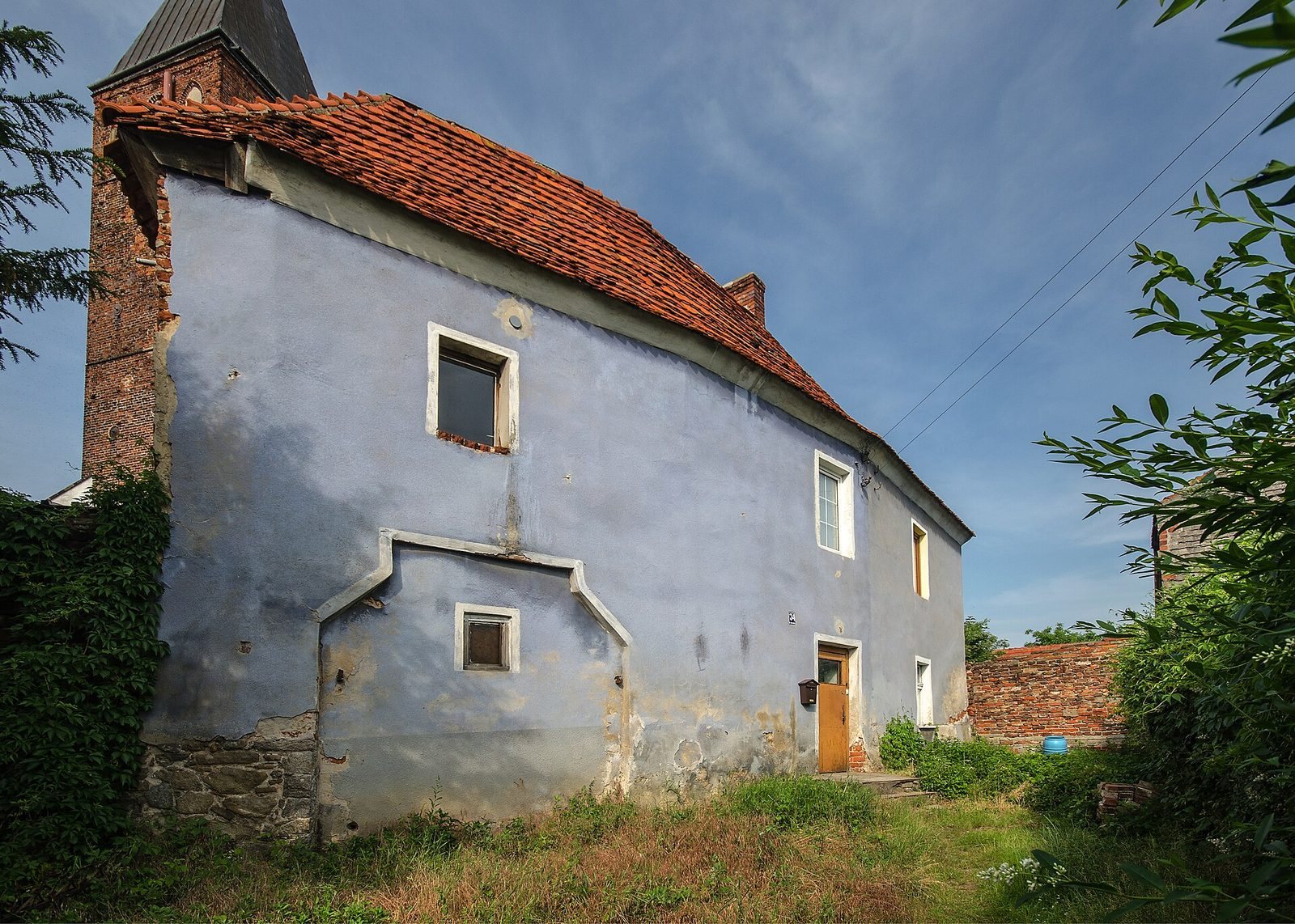
A severe storm led to a complete renovation of the church in 1863. During the Second World War, the church was destroyed except for its Gothic tower, and its Baroque furnishings were lost. The nave was rebuilt after the war in modern architectural form. Excavated finds show that people had settled at Domasław since the Early Bronze Age. The present Roman Catholic parish was founded in 2006 and belongs to the Wrocław-Krzyki deanery, an administrative subdivision grouping several parishes within a diocese.
Remains
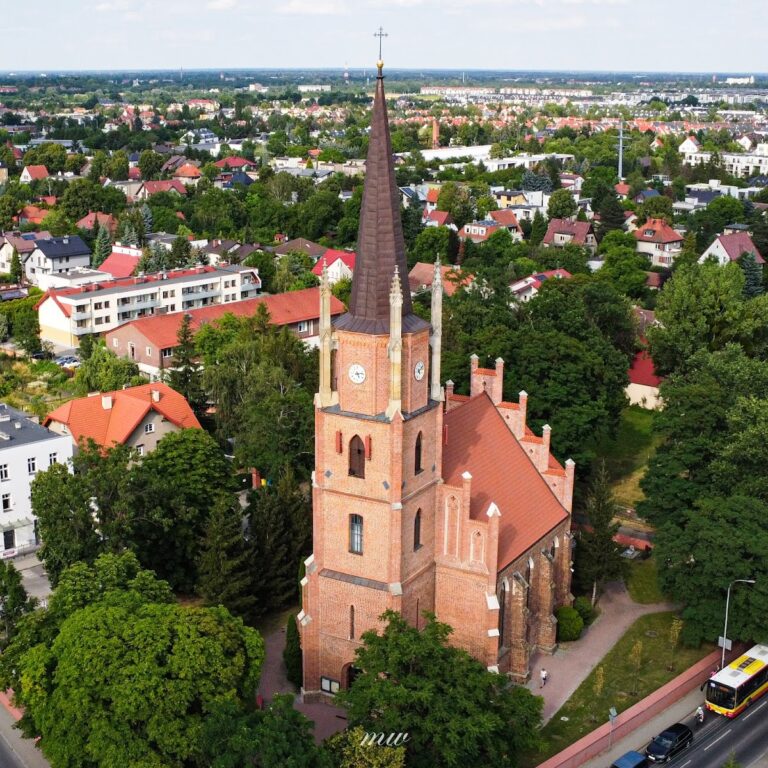
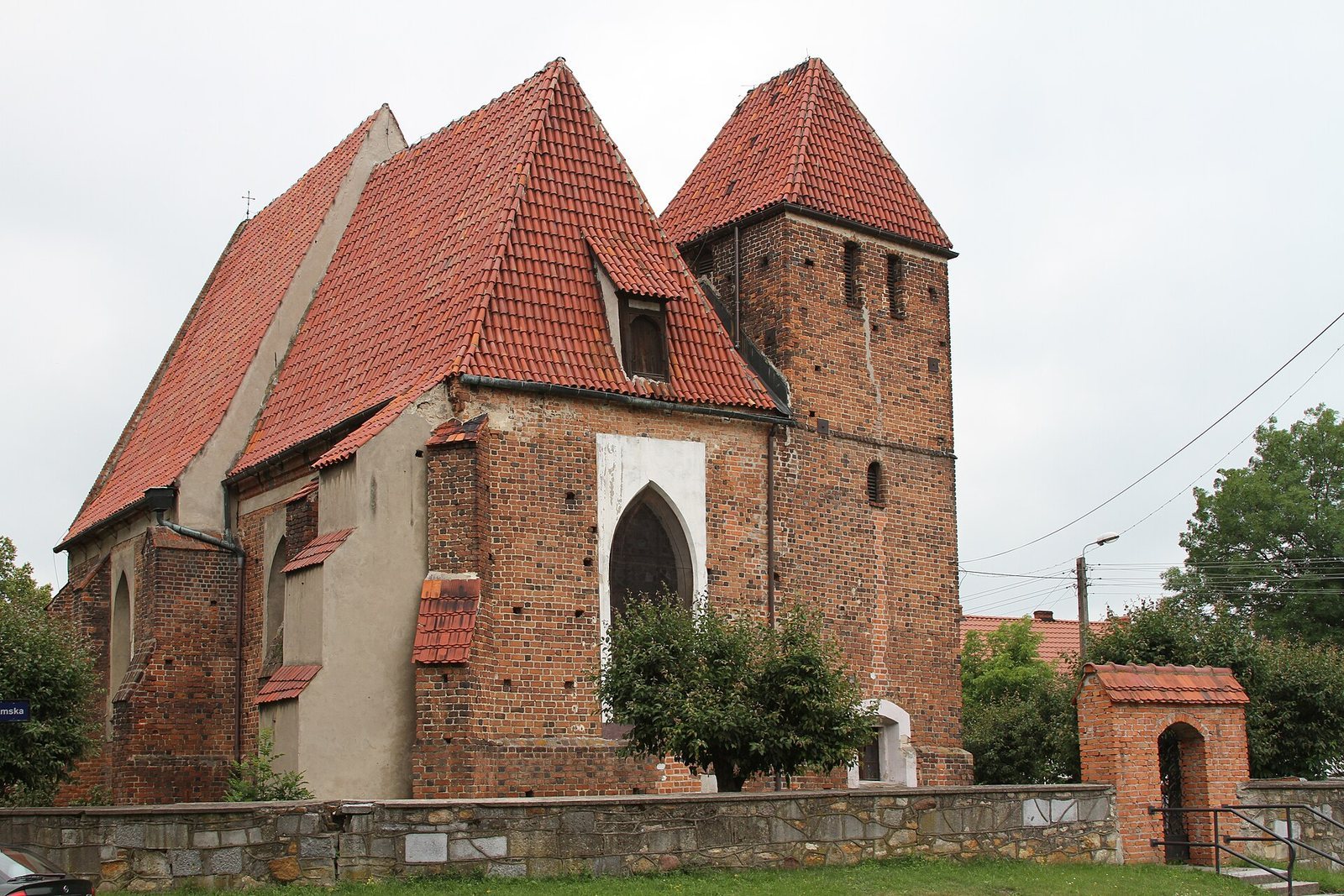
The surviving church complex combines a medieval Gothic tower, a postwar modern nave, and a cemetery enclosed by a perimeter wall. An old gate building provides the cemetery entrance. The tower and gate are protected as historic monuments, while the later nave reflects the rebuilding that followed wartime destruction.
Church buildings and historic furnishings
Gothic tower
The tower dates from the middle of the fourteenth century and is the principal surviving part of the medieval church complex. It remained standing when the rest of the church was destroyed during the Second World War and is now protected as a historic monument.
Postwar nave
The sixteenth-century church building did not survive the war apart from its tower. Its nave was reconstructed after 1945 in a modern architectural form, creating the present contrast between the medieval tower and the later body of the church.
High altar and bells
The high altar was completed in 1519 and shows that the earlier church had three patron saints. Sculptures of those patrons are now held by the National Museum in Wrocław. The former bell installation consisted of three bells. Jacob Getz cast the large bell in 1606; it carried the names Daniel Heseler of Wangeren and Polocowietz and an inscription beginning, “Remain with us, Lord Jesus Christ; evening has now come.” The middle bell dates from 1592 and bears the name George Gintzell, together with an invocation to God and the eternal Word. The smaller bell carries a Latin inscription calling people to holy teachings and referring to Paul Holtzbecher, Balthas. Herrmann, Mathias Butschky, Namsla, and Ecclesiast Domslav.
Cemetery entrance
The cemetery surrounding the church is enclosed by a perimeter wall. Its old gate building, dated to the period from the sixteenth to the eighteenth century, served as the entrance and is protected as a historic monument together with the Gothic tower.