Village church Bötzow: An Evangelical St. Nicholas Church in Germany
Site at a Glance
- Rating
- 4.9
- Popularity
- Very Low
- Country
- Germany
- Primary era
- Medieval
- External website
- Open
- Eras represented
- Medieval, Early Modern
- Civilizations
- Holy Roman Empire, Margraviate of Brandenburg
- Site type
- Religious
- Remains
- Church
On this page14 sections
History
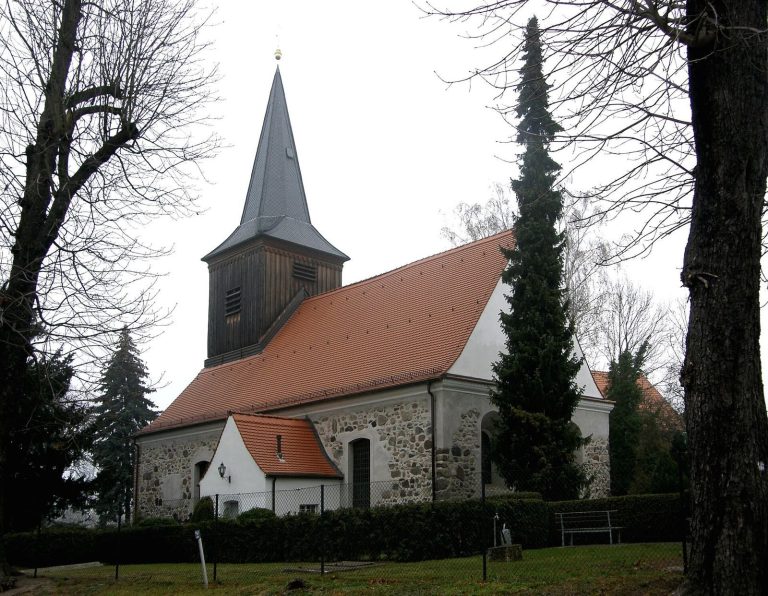
Village church Bötzow is an Evangelical church in Bötzow, Germany, dedicated to Nicholas of Myra and therefore also known as St. Nicholas Church Bötzow. A village church was built there in the first half of the fifteenth century, during a period when the settlement lay on a trade route from Berlin through Ruppin and the Prignitz to Hamburg. A pilgrimage route to the Church of the Holy Blood in Bad Wilsnack also passed through the area. These connections helped make the church larger and more elaborate than comparable churches in the surrounding region.
Medieval origins and the von der Gröben family
Bötzow was first recorded as Cotzebant in 1355. Before 1375, the village belonged to the von der Gröben family of Kotzeband, a Brandenburg noble family whose residence stood in Bötzow by 1394 at the latest. The church’s roof timber has been dated by dendrochronology, the comparison of annual tree-ring patterns, to 1429. The congregation gives 1380 as the building date, which may point to an earlier church on the site.
The parish’s resources reflected the settlement’s development. In 1450, Bötzow contained 64 hides, historical units of land whose size varied by region. The parish priest held three hides and the church held one. By 1480, the priest’s holdings had risen to four hides, but they had returned to three by 1624. Church patronage, meaning the right to influence or appoint the pastor and manage related privileges, belonged to the von der Gröben family from before 1540 until 1694.
Patronage, Baroque alteration, and later use
After 1694, patronage passed to the Elector or the state treasury. An Elector was a ruler entitled to participate in choosing the Holy Roman Emperor. At the beginning of the eighteenth century, the church underwent a Baroque transformation. The windows were enlarged, new pews were installed, and a new altar was created in 1726. The tower received a hipped tent roof with a lantern in 1757, giving the building a total height of 33 metres.
The church’s later history also preserved links with the route through Bötzow. Johannes Christoph Grabe, a merchant and timber dealer, died while travelling along it in 1716 and was buried at the church. His epitaph remains associated with this episode. The congregation belongs to the Upper Havelland Church District of the Evangelical Church Berlin-Brandenburg-Silesian Upper Lusatia.
Repairs and historical memory
Wall paintings dating from around 1430 were uncovered during repairs in the 1930s. They are considered part of a continuous pictorial programme. Extensive interior renovation followed in 2009 and 2010, including the installation of heating for the front pews. A monument in the churchyard commemorates those killed in the world wars.
Remains
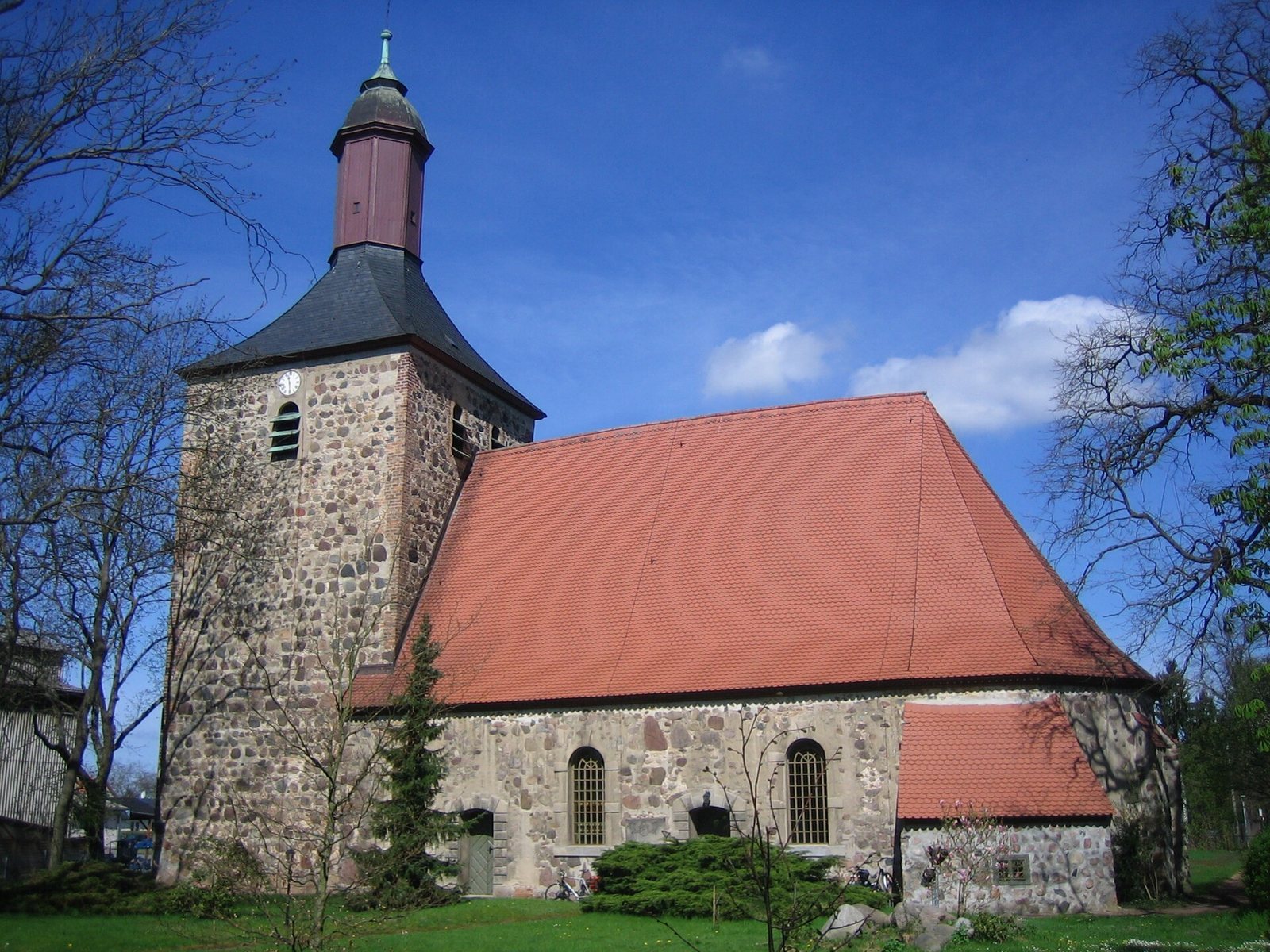
The church stands on an elevated, fenced plot north of Wansdorfer Chaussee, which enters Bötzow’s historic centre as Dorfaue. The churchyard surrounds a building constructed chiefly from fieldstone. In the tower area, the stones were relatively carefully dressed and arranged in regular courses. Elsewhere, the masonry is rougher and partly filled with mixed material.
Medieval and Baroque exterior
Choir and sacristy
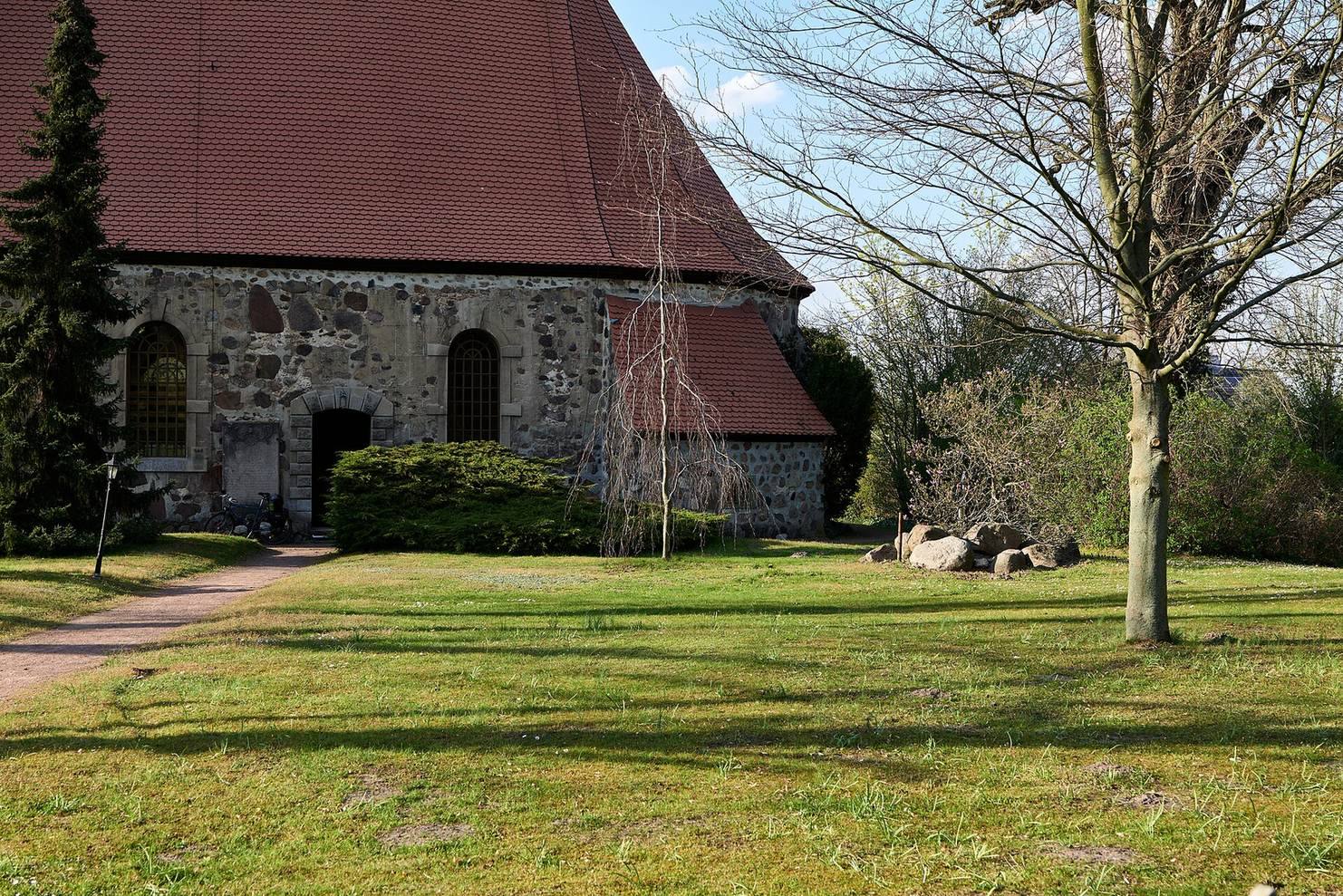
The choir ends in a five-eighths termination, a polygonal apse formed from five sides of an imagined octagon, and is not recessed from the rest of the building. Its east and northeast sides each contain a large round-arched window with reveals emphasized by applied plaster. A small sacristy is attached to the south and southeast sides. Its west side contains the entrance door.
Nave
The nave has a rectangular plan. Three large round-arched windows punctuate both its north and south sides, with plaster decoration around the openings. On the south side, a depressed segmental-arched doorway lies between the middle and eastern windows. An epitaph stands to the left of this entrance.
Tower
The square tower occupies almost the full width of the nave and is entered through a large western portal. An oculus, or round opening, is set above the portal, with a rectangular sound opening higher up. Further sound openings occur on the north and south sides, while the east side has two. A clock is mounted on the south face below the hipped tent roof. Above it are the lantern, finial ball, and weather vane.
Interior furnishings and memorials
Altarpiece and organ gallery
The wooden altarpiece was made in 1706 and incorporates a pulpit basket with side galleries. The enclosed preaching platform stands between columns decorated with vine leaves and acanthus ornament. Its predella, the lower section beneath the principal imagery, depicts the Last Supper. Above it is a crown-shaped sounding board, the canopy that projects speech into the church, flanked by angels.
A Baroque horseshoe gallery supported by Tuscan columns carries an organ built by Joachim Wagner in 1743. Wagner was an eighteenth-century German organ builder. The nave has a plain plaster ceiling.
Baptismal font and wall paintings
A sandstone baptismal font donated in 1579 stands inside the church. Its bowl is decorated with coats of arms and diamond-shaped blocks. The interior also preserves a Late Gothic sacrament niche. The wall paintings include a Coronation of the Virgin with a bishop figure on the north wall and a saint figure on the south wall.
Tombstones, epitaphs, and bells
A figural tombstone for Ludwig von der Gröben, a member of the Brandenburg noble family, dates from around 1600 and stands in the tower hall. The south side of the church carries the epitaph of Johannes Christoph Grabe, who died in 1716. Its inscription includes the lines, “I, Grabe, shall indeed be buried in a foreign place, / Yet here too the earth of the Lord must refresh me.”
At least four bells hang in the tower. One dates from 1418 and bears the name of its donor, Werner von der Gröben. A second bell dates from 1500, a third from 1593, and the date of a fourth has not yet been determined.
Churchyard monument
The churchyard’s south side contains the monument commemorating those killed in the world wars.