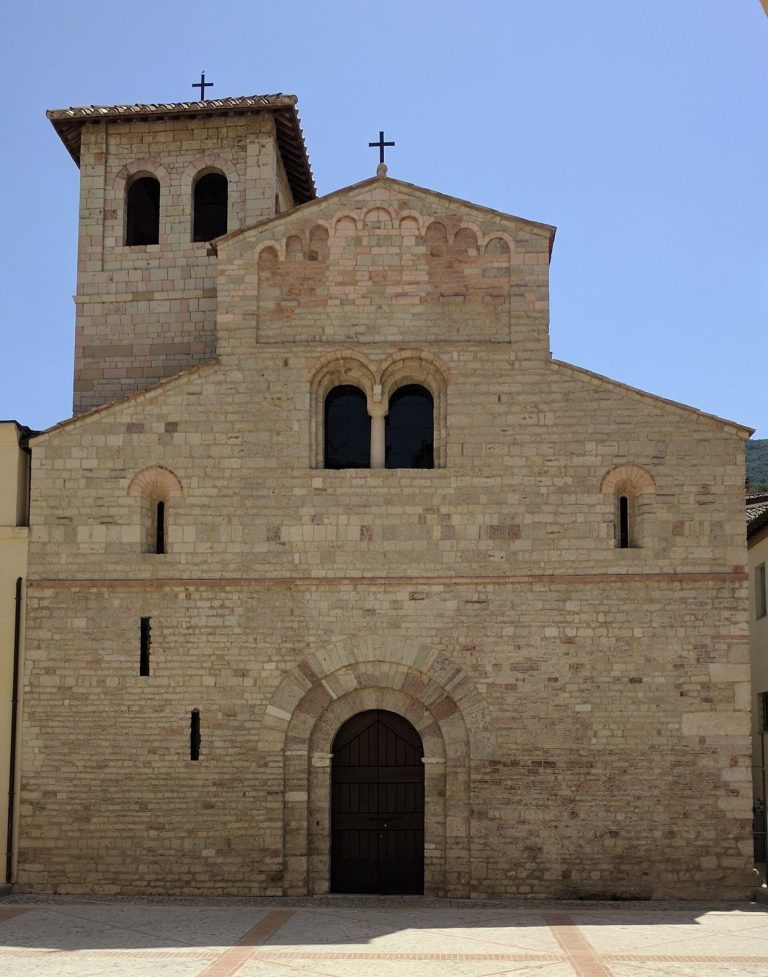
Basilica of San Salvatore, Spoleto: A Lombard Church in Italy
Site at a Glance
- Rating
- 4.3
- Popularity
- Very Low
- Country
- Italy
- Primary era
- Medieval
- Eras represented
- Classical, Medieval
- Civilizations
- Lombard, Roman
- Site type
- Religious
- Remains
- Basilica
On this page8 sections
History
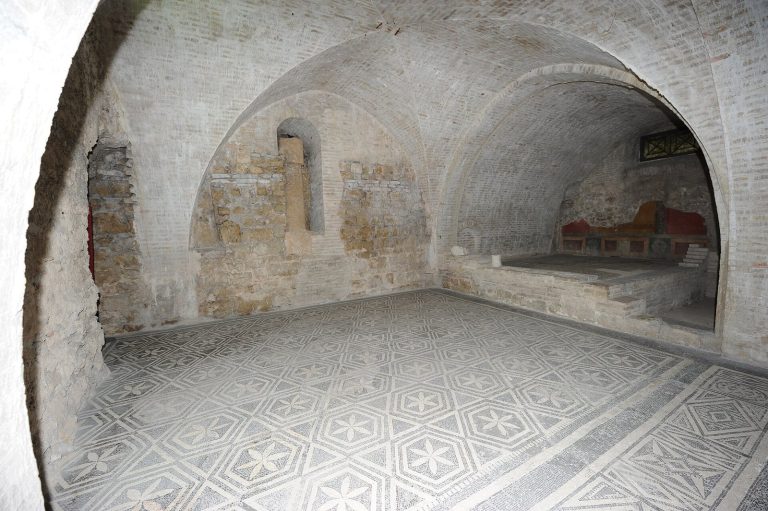
The Basilica of San Salvatore, Spoleto, in Italy, is an Early Christian church whose major eighth-century rebuilding by the Lombards made it a defining example of Lombard architecture in Langobardia Minor, the Lombard-ruled territory of central and southern Italy. Its original construction is generally placed between the late fourth and early fifth centuries, probably on the site of a Roman villa, and it was associated with the burial of early Christian martyrs, including Saint Concordius.
Early Christian origins
The church was initially dedicated to Saint Concordius. Its early history included a restoration by the Lombards after a damaging event whose date and nature are not specified. The building’s probable funerary origin or function connects it with the Christian burial practices of the period, although that interpretation remains uncertain.
Lombard rebuilding
The principal reconstruction took place in the eighth century under the dukes of Spoleto. This campaign gave the church a monumental form and expressed the ambitions of the Lombard rulers. San Salvatore is consequently viewed as a work that marks the transition from Late Antiquity to the European Middle Ages. In 814, its dedication changed to San Salvatore, while the associated monastery retained the name Monasterium Sancti Concordii.
Later dedications and restoration
The dedication to Saint Concordius returned during the eleventh century. In the sixteenth century, the apse received frescoes depicting the Crucifixion. In 1600, the church became known as the Church of the Crucifix after a crucified Christ was placed on its altar. Its present dedication was restored during the twentieth century.
Restoration campaigns in 1906, 1919 to 1921, 1938, and 1950 removed later alterations and reinstated features attributed to the Early Christian phase. The basilica stands within Spoleto’s monumental cemetery on Ciciano Hill, outside the city’s medieval walls. The cemetery was designed by Ireneo Aleandri in 1836 and 1837. San Salvatore also forms part of the UNESCO World Heritage property Longobards in Italy: Places of Power (568–774 A.D.), inscribed in 2011 under cultural criteria (ii), (iii), and (vi). The serial property includes seven sites connected with Lombard architectural, pictorial, and sculptural heritage.
Remains
Plan and spatial organization
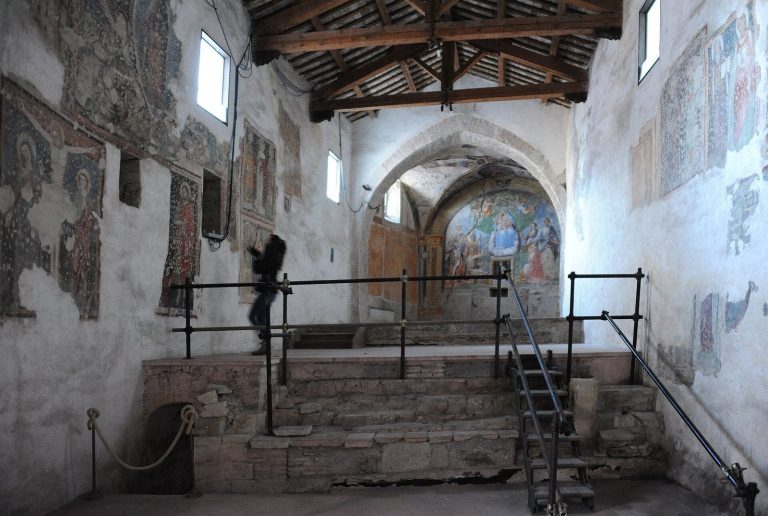
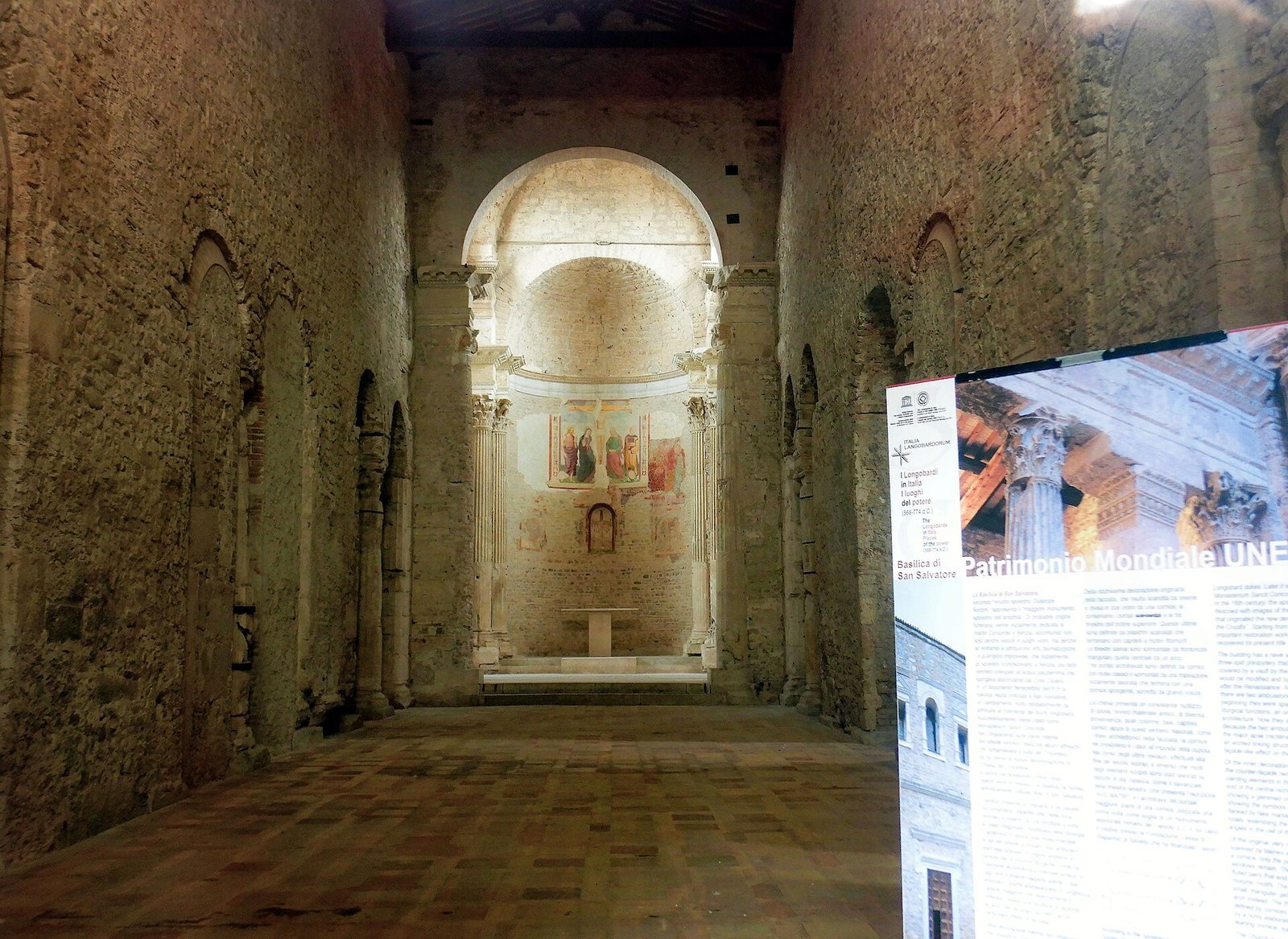
The basilica follows a three-nave plan. Its central nave is high and elongated, ending in a semicircular apse that is externally enclosed by a straight wall. The presbytery is divided into three parts and covered by a vault with an octagonal base. Two apsidal rooms flank the main apse, each with a cross vault. This arrangement combines Early Christian planning with eastern architectural elements.
Columns and entablature
The nave and presbytery retain a richly articulated entablature, the horizontal architectural assembly carried above the columns. Its Doric frieze, a rhythmically divided band associated with the Doric order, is supported by Doric columns in the nave and Corinthian columns in the presbytery. The columns appear to have been reused from ancient Roman buildings, continuing the building’s use of Roman architectural models.
Facade and portals
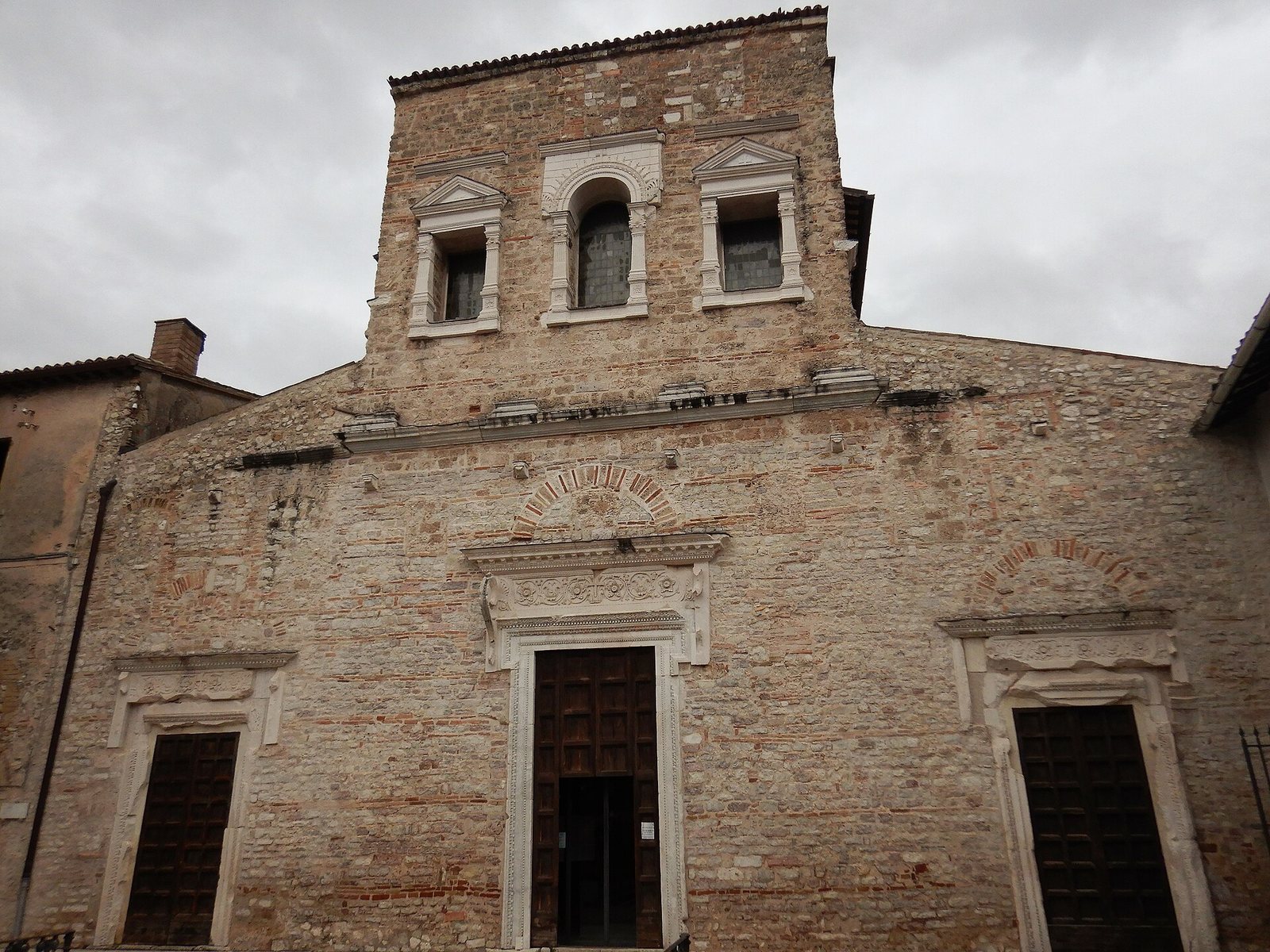
The eighth-century facade was organized by pilasters and separated into two levels by a cornice. Its window surrounds and three portals survive. The portals are carved with classical motifs and include a relief vegetal scroll. They incorporate spolia, architectural elements or building materials reused from earlier Roman structures. Together with the colonnades, these features give the basilica a coherent classicizing character rooted in Roman decorative traditions.