Basilica di Santa Giulia: A Romanesque Church in Bonate Sotto


Site at a Glance
- Rating
- 4.5
- Popularity
- Low
- Country
- Italy
- Primary era
- Medieval
- Eras represented
- Medieval, Early Modern
- Civilizations
- Holy Roman Empire, Italian
- Site type
- Religious
- Remains
- Basilica
On this page10 sections
History
Basilica di Santa Giulia is a Romanesque church in Italy, located at Bonate Sotto and founded in the early twelfth century within the inhabited settlement of Lesina, also called Lisina. The settlement stood near a stream of the same name, and the church probably served the community’s religious and liturgical needs. The precise date of construction, its patron, and the reasons for its foundation remain unknown.
The twelfth-century foundation
The church is mentioned indirectly in a letter issued by Pope Honorius II on 14 May 1129 to Ambrose, bishop of Bergamo, and the chapter of Sant’Alessandro. The letter refers to “the church of Lesina, not yet consecrated.” Other official acts confirm that the basilica existed during the first half of the twelfth century, placing it within the religious life of the local settlement.
Local tradition attributes the foundation to either Saint Julia or Theodelinda, the Lombard queen. Saint Julia was a Christian martyr associated traditionally with North Africa, while Theodelinda belonged to the sixth and seventh centuries. Neither tradition accords with the basilica’s early twelfth-century date and Romanesque character. Theodelinda lived several centuries before its construction, and Saint Julia never came to Italy.
Decline and later use
Medieval upheavals caused the community of Lesina to disappear and disperse. The basilica then declined, with its deterioration reaching a culmination in the fourteenth century. The abandoned building was subsequently treated as a source of construction materials. It is now incorporated into the municipal cemetery of Bonate Sotto, and its central apse serves as a cemetery chapel.
Remains
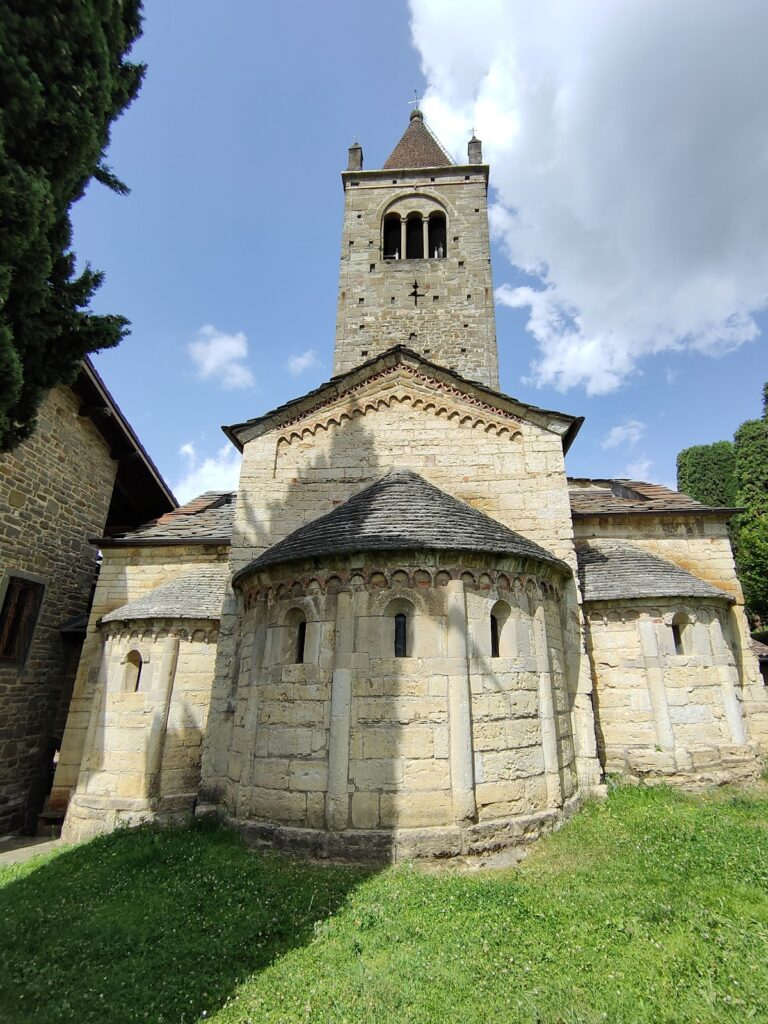
The surviving church preserves a Romanesque basilica layout centered on a nave with two aisles and three terminal apses, the semicircular spaces at the ends of the longitudinal divisions. The interior was arranged in five bays, or structural sections, and the surviving remains include the bay before the apses, the three apses, and portions of the perimeter walls. The present roofs are later than the original building. Within the cemetery, the surviving section is accompanied by burial mounds, graves, and funerary inscriptions.
Apses and architectural decoration
Apse structure
An eighteenth-century restoration raised the central apse by about one metre and replaced its stone roofing with terracotta tiles. This work altered the roof pitch, and the raised portion remains visibly distinct from the earlier masonry. The central apse received frescoes in 1795 from Vincenzo Angelo Orelli, working with his brother Baldassarre Orelli. The frescoed space continues to function as the cemetery chapel.
Exterior ornament
The outer faces of the apses are articulated by small double-splayed windows, set between string courses or half-columns. A frieze of small arches runs along the base of the apse roofs, with some arches ending in small heads. Together, these surviving elements show the refinement of the church’s original architectural decoration.
Carved capitals and funerary evidence
Sculpted capitals
The surviving capitals carry finely carved zoomorphic, anthropomorphic, and geometric designs, representing animals, human figures, and abstract forms. Some of the ornament recalls the Cluniac style, associated with the artistic influence of Cluny, the major medieval Benedictine monastic center. This decoration has also been interpreted as anticipating the Gothic style linked with Cluny.
Roman cremation urn
A Roman cremation urn stands on the column in front of the first nave. It helped inspire the tradition that Theodelinda founded the basilica to commemorate one of her daughters, but the object is much older than the church and its date is uncertain. The urn held the remains of a girl named Tiziana, approximately twelve years old, along with small gold objects that may have belonged to her clothing. Part of its inscription reads “RO…. TI…NAE QUAE VIXIT ANN. XII. M.VII D. XIII,” while another surviving fragment preserves “TI…NAE QUAE VIXIT.” The formula quae vixit, meaning “who lived,” is followed by the girl’s age and additional months and days. The urn is Roman rather than Lombard and reflects Roman funerary practice.