San Paolo in Campo Marzio, Verona: A Neoclassical Parish Church
Site at a Glance
- Rating
- 4.6
- Popularity
- Very Low
- Country
- Italy
- Primary era
- Early Modern
- External website
- Open
- Eras represented
- Medieval, Early Modern
- Civilizations
- Holy Roman Empire, Venetian
- Site type
- Religious
- Remains
- Church
On this page9 sections
History
San Paolo in Campo Marzio, more correctly the Church of the Conversion of Saint Paul, is a Roman Catholic parish church in Verona, Italy. The present building reflects an eighteenth-century Neoclassical refashioning of an older medieval church, while its chapels and altarpieces preserve works associated with Verona’s Renaissance artistic tradition. The church belongs to the Diocese of Verona and the Vicariate of Verona Centro, follows the Roman rite, and is dedicated to the Conversion of Saint Paul.
Medieval foundation and rebuilding
A Romanesque church stood on the site by the eleventh century. Romanesque architecture used heavy masonry, rounded arches, and massive forms, and the early church was initially under the jurisdiction of the Canons of Verona Cathedral. Its dedication was then to Saints Peter and Paul.
Major construction or rebuilding began in 1188. An inscription formerly placed on the entrance portal stated that Bishop Riprando and the parish priest Rainaldo held office when the work commenced. The rebuilding has also been associated with the Umiliati, a medieval Catholic religious order founded in northern Italy and linked with communal religious life and charitable work. Further important work took place in 1289, including the expensive construction of the campanile, or bell tower.
Renaissance artistic patronage
The church acquired an important Renaissance chapel near the presbytery in the early sixteenth century through the patronage of the Marogna family. Renaissance architecture revived classical principles, and the chapel’s decoration brought together major painters active in the artistic culture of Verona and northern Italy. Paolo Farinati was commissioned to paint its frescoes, while Paolo Veronese created its altarpiece.
Other works added to the church included Giovanni Caroto’s altarpiece for the apse, signed and dated 1513, and paintings by Girolamo dai Libri, Felice Brusasorci, and Francesco Bonsignori. These commissions connected the church’s religious furnishings with the changing artistic practices of Renaissance Verona.
Neoclassical transformation and wartime reconstruction
The church underwent its principal transformation between 1740 and 1768. Alessandro Pompei, an eighteenth-century Veronese architect, directed the refashioning carried out in 1763, giving the building its Neoclassical character. Neoclassicism adopted a systematic classical vocabulary based on architectural orders, pediments, and formal horizontal entablatures.
An aerial bombardment on 8 March 1945 almost completely destroyed the church during the Second World War. The facade, part of the right wall, and the apse area survived the attack. The Civil Engineering Corps rebuilt the church in 1948 according to its previous forms, and worship resumed on 24 April of that year.
Remains
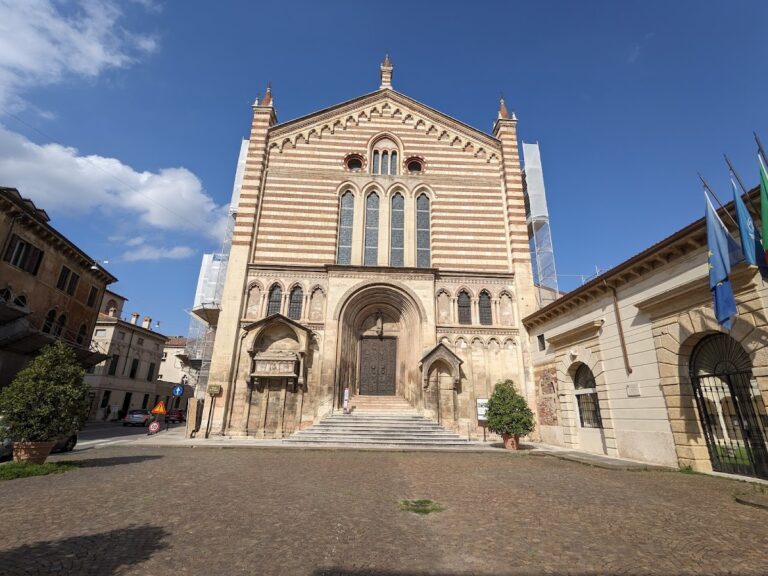
The church presents a Neoclassical composition organized around a gabled facade, a square-plan bell tower, and a rectangular single-nave interior. Its surviving and reconstructed fabric preserves the formal arrangement created during the eighteenth-century transformation, together with chapels and artworks linked to earlier phases of the building.
Facade and bell tower
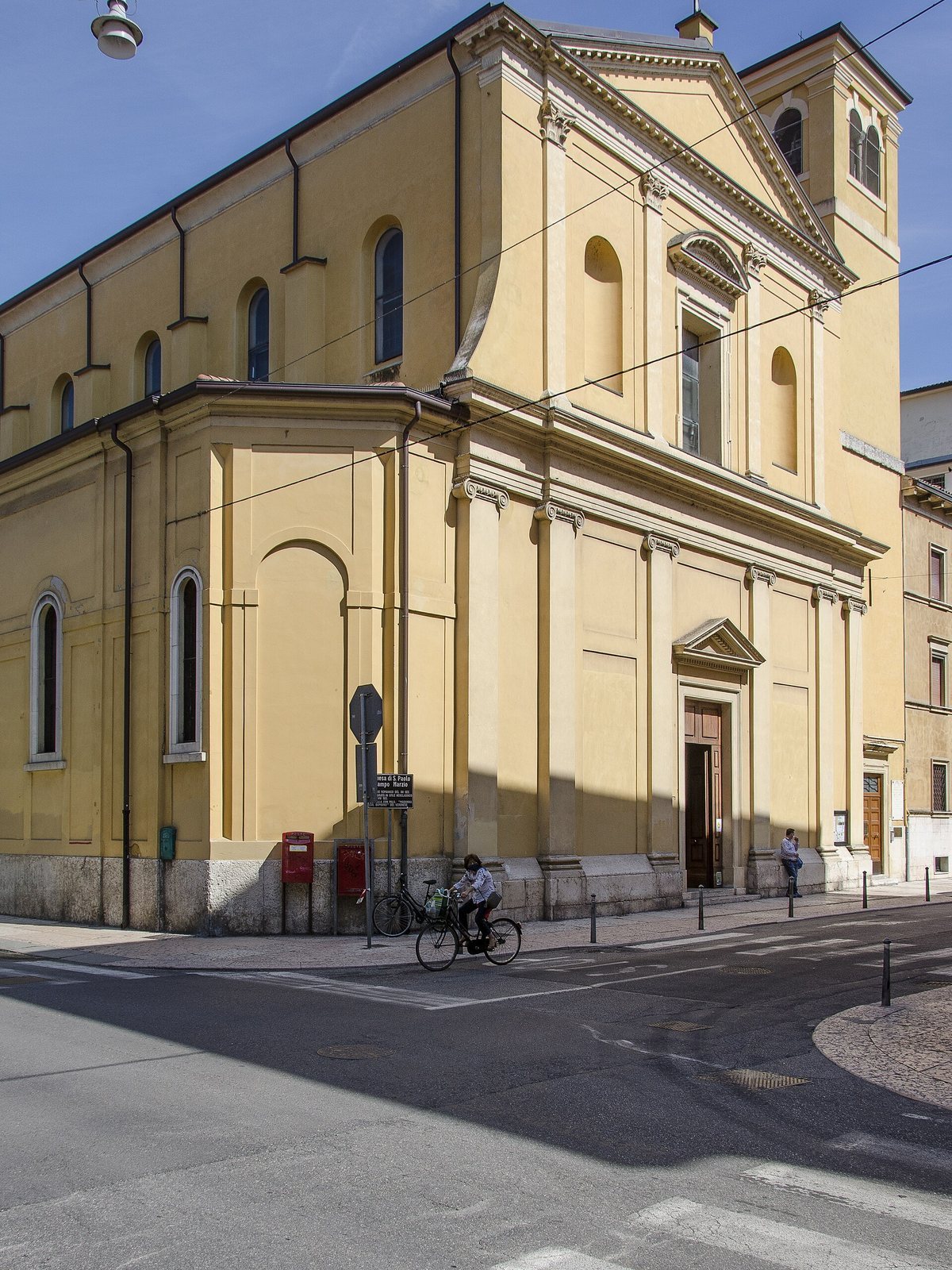
The gabled facade is divided into two horizontal zones by a substantial entablature, the horizontal architectural element carried by columns or pilasters. The lower zone rests on a stone base and contains six Ionic pilasters with an entrance portal crowned by a small pediment. Four Corinthian pilasters organize the upper zone, supporting a dentilled entablature and a larger pediment. A broad central window lights the interior, while two side niches formerly held statues of Saints Peter and Paul by Giovanni Angelo Finali.
The square bell tower stands beside the facade. Approximately 20 metres high, it has a relatively squat, plastered shaft and a belfry emphasized by the surrounding stonework. A stone band marks its lower edge, while a moulded stone cornice defines the top. Each side of the belfry contains a biforate window, a two-part opening divided by a central vertical support.
Nave, presbytery, and chapels
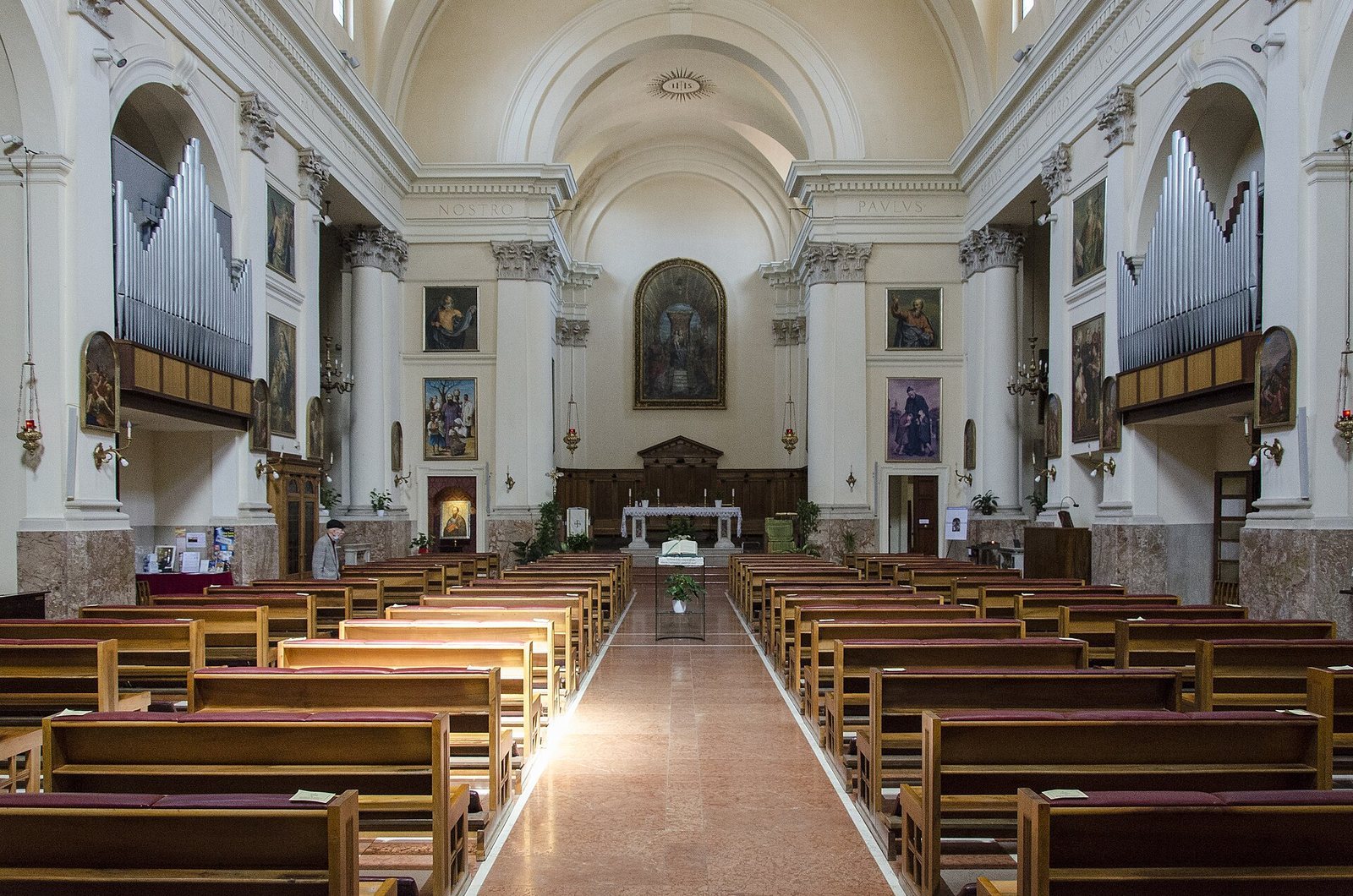
Inside, a rectangular single nave leads to a presbytery raised three steps above the main floor. Ten chapels open from the side walls, arranged as five on each side. Round arches frame their entrances, and Corinthian pilasters support the upper entablature. The larger side chapels are the Giusti Chapel on the left and the Marogna Chapel on the right.
Ribbed barrel vaults cover the nave and presbytery, with lunettes corresponding to the openings below. The vaults were made with reed and plaster, a construction method that forms part of the church’s interior fabric.
Marogna Chapel
The Renaissance Marogna Chapel is entered through a rectangular vestibule with a balustrade and two Corinthian columns. Beyond it, a monumental triumphal arch made of soft stone opens into the chapel, which occupies two vaulted bays. The arrangement provides a distinct architectural setting for the chapel’s sixteenth-century paintings.
On the rear wall is Paolo Veronese’s so-called “silver” altarpiece, painted in 1565. Its predominantly grey and brown tones explain the descriptive name. The painting shows the Madonna, John the Baptist, and Saint Anthony of Padua, who presents the two Marogna donors. Paolo Farinati painted the frescoes on the chapel walls and vaults in 1569. Their treatment recalls or was influenced by the work of Michelangelo and Parmigianino.
Altarpieces and sacristy paintings
The flat apse contains Giovanni Caroto’s altarpiece, signed “MDXIII Joannes,” the equivalent of 1513. It depicts the Madonna enthroned with the Child on her knees, accompanied by Saints Peter and Paul beneath a Renaissance portico rendered with pronounced perspective.
The second altar on the right holds Girolamo dai Libri’s painting of Saints Anne and Joseph with the young John the Baptist before the Madonna, together with two donors. On the left, the second altar contains Paolo Farinati’s 1588 canvas of the Madonna in Glory with Saints Nicholas and Francis, while the fourth altar holds Felice Brusasorci’s canvas of Saint Francis of Paola. Francesco Bonsignori’s painting of the Madonna with Saint Anthony Abbot and Mary Magdalene is preserved in the sacristy.