Little St Mungo’s Chapel: Late-medieval chapel and former municipal hospital site on Dowhill, Scotland


Site at a Glance
- Rating
- 4.4
- Popularity
- Low
- Country
- United Kingdom
- Primary era
- Unclassified
- External website
- Open
- Eras represented
- Unclassified
- Civilizations
- Unclassified
- Site type
- Religious
- Remains
- Chapel
History
Little St Mungo’s Chapel in Scotland was a small late-medieval chapel built in 1500, standing on Dowhill, a site long linked with the missionary St Kentigern, known as St Mungo. It mattered locally as a place of worship set beyond the east gate of medieval Glasgow and later as a focus for communal care when municipal authorities converted it for charitable use.
The place carried a deep early association with St Kentigern, who is said to have returned to the Glasgow area about the year 600 and preached to King Redrath and his followers on an elevated spot called Dowhill. Two traditional versions describe that he either spoke from a small rise known as Dowhill or that the ground itself rose to form the elevation at the moment of his sermon. These stories preserved the site’s link with Glasgow’s founding saint.
The chapel building recorded on Dowhill was erected in 1500 by David Cunningham, at that time archdeacon of Argyll and provost of the Collegiate Church of Hamilton. Cunningham endowed the chapel with lands and rents, providing it with a formal economic base. Some time before 1593 the property and its burial ground came into the hands of Archibald Lyon, and subsequently ownership passed to the city’s Provost and Magistrates, who ordered repairs and directed that the building be repurposed as a hospital for the poor.
During the period of the Scottish Reformation the chapel appears to have suffered from the wider anti-clerical fervour of the time. The municipal hospital provision established at the site seems to have been intended as a place outside the city walls for isolating lepers and victims of plague, rather than as an inner-city almshouse. The structure is mentioned for the last time in 1603 and then drops out of the written record, while burials in the adjoining kirkyard (churchyard) continued into the early eighteenth century.
By the middle of the eighteenth century the former chapel site had become overgrown and locally regarded as an eerie place to avoid after dark. In 1754 the Provost and Magistrates resolved to redevelop the ground for a modern coaching inn. Robert Tennent contracted to clear the site and in 1755 opened the Saracen’s Head Inn there, which served as Glasgow’s principal inn for roughly thirty years.
Remains
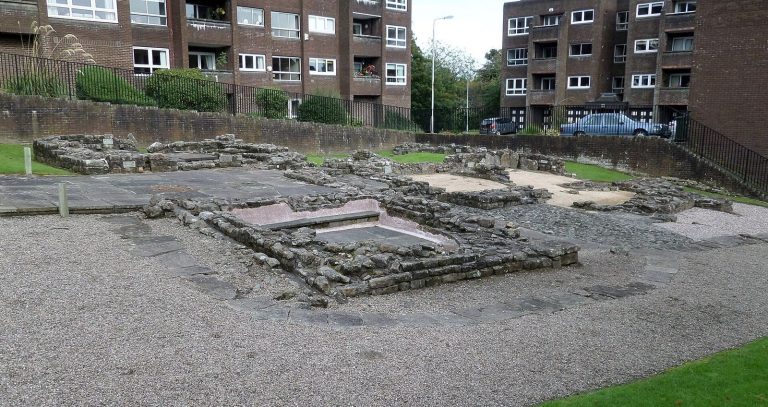
The site lay on Dowhill and consisted of a single small rectangular chapel surrounded by a compact graveyard. The burial ground was ringed by a substantial stone dyke, and the wall included boles, locally noted features associated with interment. Trees that grew around the burial plot were known as St Mungo’s Trees, and a nearby spring carried the name St Mungo’s Well; that well was recorded as surviving into the twentieth century.
A ground plan published in 1872 recorded measurements that allow a rough reconstruction of the layout: the chapel measured about 53 feet by 23 feet (16.2 by 7.0 metres), while the churchyard measured approximately 95 feet by 79 feet (29 by 24 metres). The building itself ceased to be mentioned after 1603 and the cleared site was levelled in 1755 to permit construction of the Saracen’s Head Inn. The graveyard saw burials until the early 1700s, and elements of the site’s landscape, notably the well and the named trees, persisted in local memory into later centuries.