Basilica di Agliate: A Romanesque Church in Carate Brianza, Italy
Site at a Glance
- Rating
- 4.7
- Popularity
- Low
- Country
- Italy
- Primary era
- Medieval
- External website
- Open
- Eras represented
- Medieval, Modern
- Civilizations
- Holy Roman Empire, Italian
- Site type
- Religious
- Remains
- Basilica
On this page8 sections
History
The Basilica di Agliate is a Catholic church in Agliate, part of Carate Brianza, Italy. Dedicated to Saints Peter and Paul, it follows the Ambrosian rite, the distinct liturgical tradition of the Archdiocese of Milan named after Saint Ambrose. The building was long considered a ninth-century Carolingian foundation, but it was probably constructed in several phases between the late tenth and eleventh centuries within the Ottonian tradition, the architectural culture linked to the German emperors of the tenth and early eleventh centuries.
Medieval development
The church developed as a Romanesque place of worship, with its present three-nave arrangement reflecting the medieval architectural tradition of massive masonry, relatively small windows, rounded structural forms, and restrained exterior decoration. An octagonal dome was added in the twelfth century. The adjacent baptistery is contemporary with the basilica and formed part of the same religious complex.
Later reconstruction and restoration
The basilica was consecrated in 1731. During the nineteenth century, the church underwent extensive reconstruction, while the present bell tower was created through demolition and rebuilding late in that century. Modern restoration campaigns have affected both the basilica and the baptistery. The pipe organ, built in 1883, was restored in 1986.
Remains
Church layout and exterior
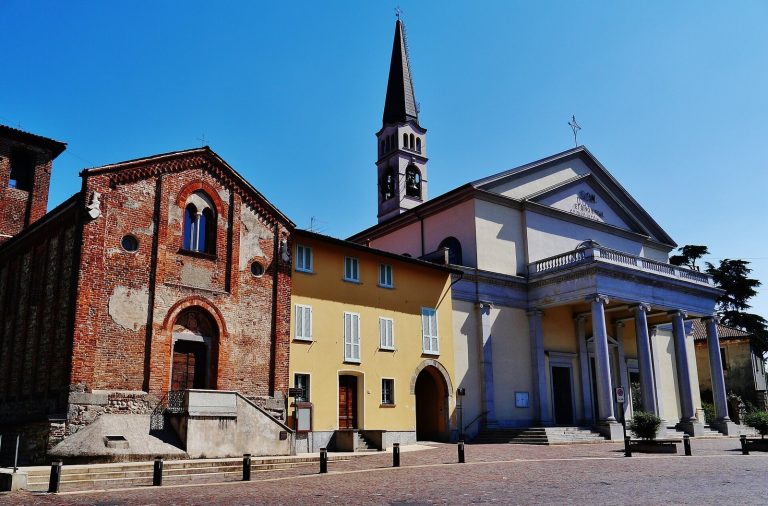
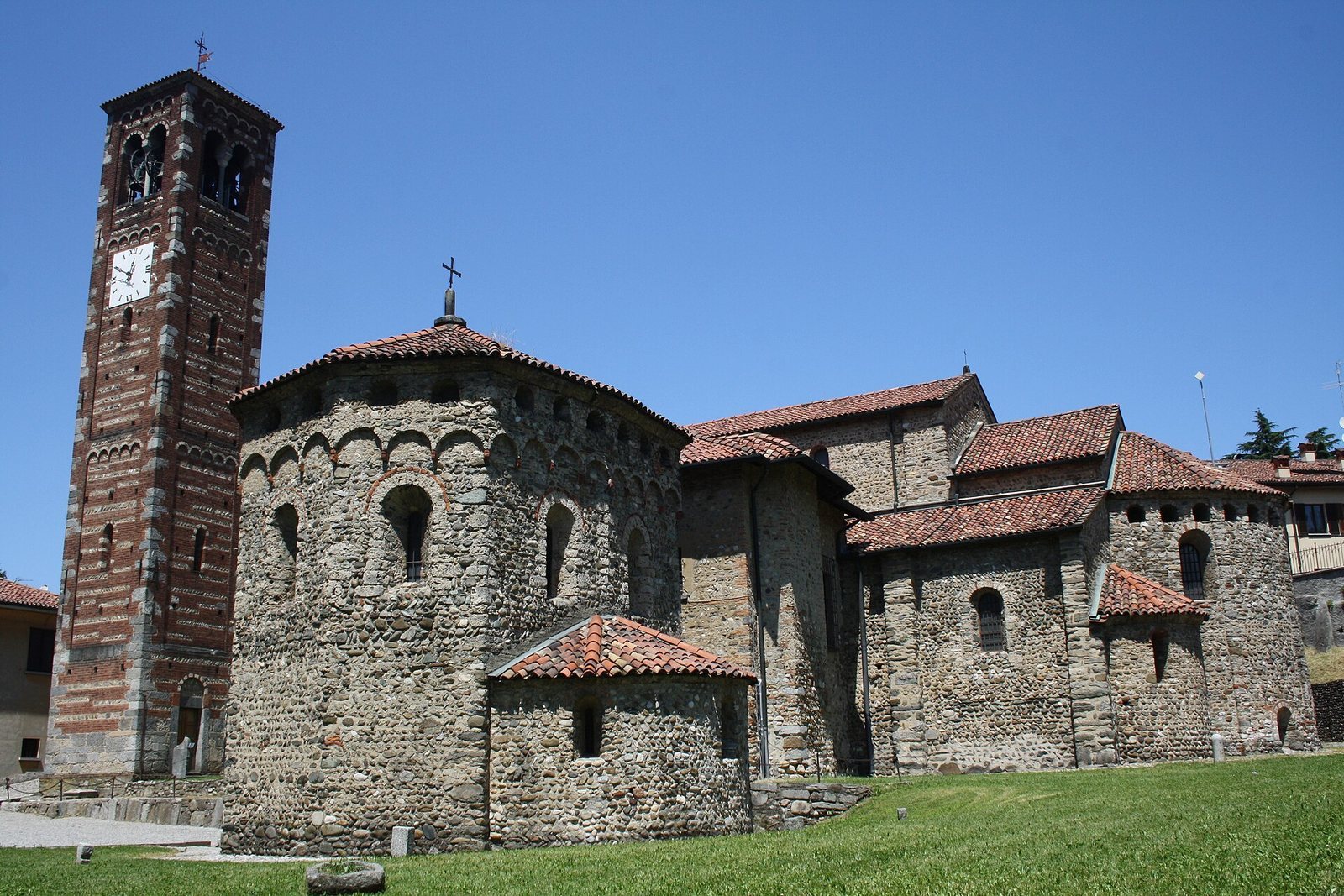
The basilica is a Romanesque church with three naves. Its simple pitched façade mirrors this internal arrangement: the central nave rises above the two side aisles, and each of the three divisions has its own entrance and apse. The apses contain splayed single-light windows and upper arcaded galleries. Decoration around the central portal largely results from restoration, while the two jambs with interlaced ornament are original.
The late-nineteenth-century bell tower is built with horizontal courses of brick and pebbles, contrasted by angular inserts of stone. Its materials and appearance distinguish the reconstructed tower from the medieval fabric while preserving it as part of the church complex.
Interior and medieval decoration
Two rows of reused Roman columns and capitals divide the three interior naves. The second column on the left is a Roman milestone, and its original inscriptions remain visible. Small windows admit limited light, while the broad masonry surface of the clerestory, the upper nave wall pierced by windows above the aisles, reinforces the church’s vertical character.
The clerestory was once covered by a fresco cycle that is now extensively damaged and almost entirely concealed. Surviving fragments show the Creation of Eve, the Annunciation, the Visitation, the Nativity, and Jesus among the Doctors of the Temple. Other decoration includes a fresco of the Madonna Lactans, an image of the Virgin Mary nursing the infant Jesus, and mosaics of Saint Paul, Christ, and Saint Peter in the lunettes above the right, central, and left entrances respectively.
Presbytery, crypt, and organ
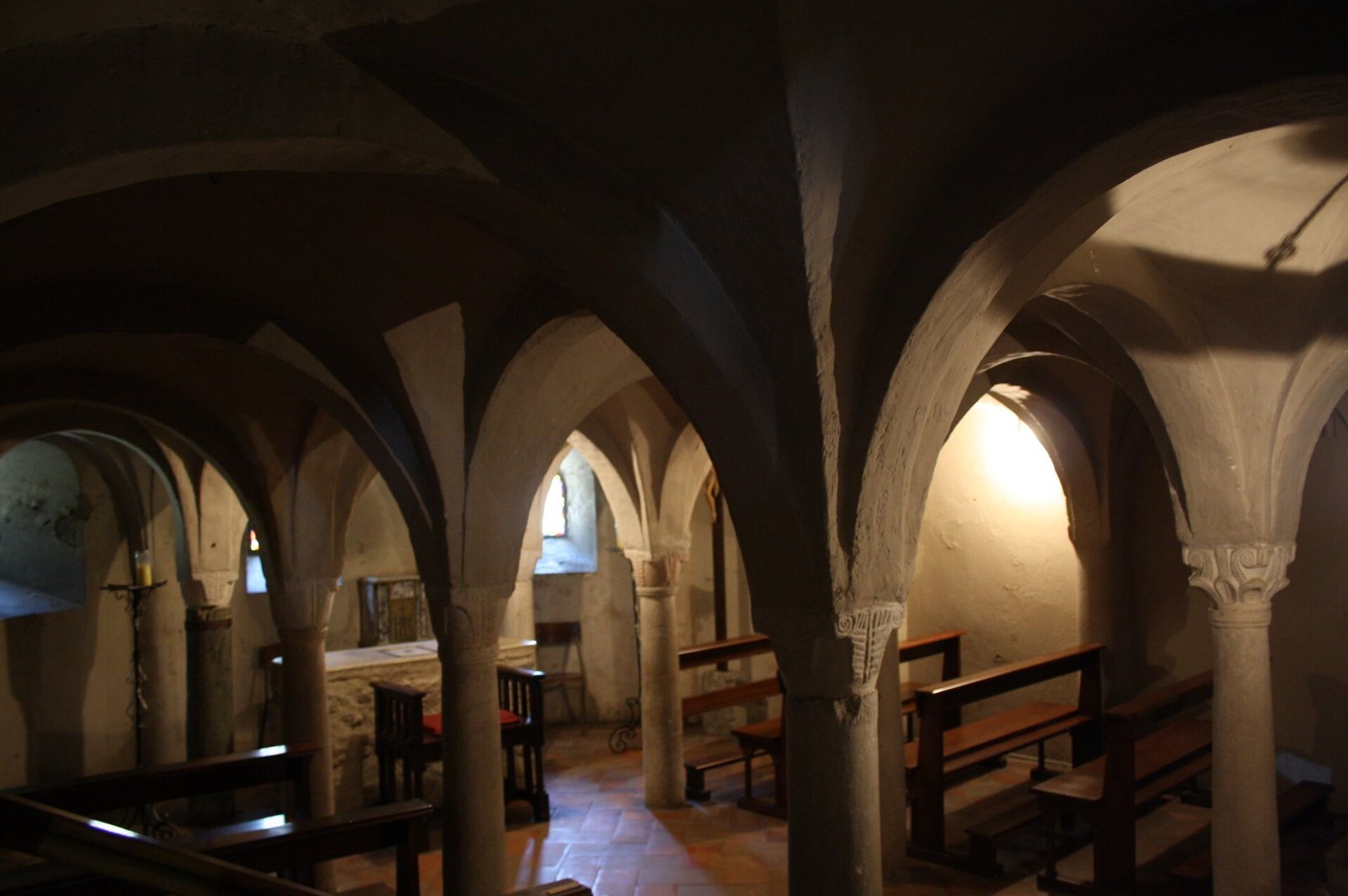
The presbytery is raised above the nave and reached by a staircase of eight steps. Beneath it lies an oratory crypt, a chamber below the main floor associated with worship, burial, or the veneration of sacred remains. The crypt has three naves and four bays covered by groin vaults, which are formed by the intersection of two barrel vaults. It opens toward the nave through two biforias, or two-light openings divided by a central support. Its small columns have capitals that appear to stylize elements of the Corinthian type, a classical form traditionally decorated with acanthus leaves.
At the counterfaçade, the choir loft holds a pipe organ built in 1883 by Giuseppe Bernasconi and restored in 1986 by Alessandro Corno. The instrument is enclosed in a wooden case with three pipe towers arranged across three fields. Its console has one 58-note keyboard and a 17-note pedalboard, both with an extended chromatic first octave, and its action is entirely mechanical.
Adjacent baptistery
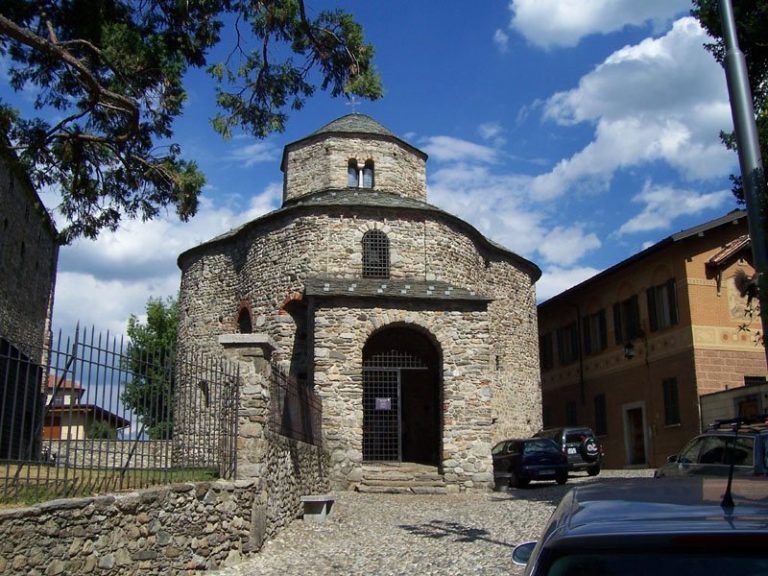
The Romanesque baptistery beside the basilica is contemporary with the church. It has a nine-sided plan, with an apse occupying two sides, and a simple vault divided into eight segments. Within it stands a seven-sided immersion baptismal font. The baptistery also preserves badly damaged remains of its original fresco decoration, including a fourteenth-century Deposition, a scene showing the removal of Jesus’s body from the cross, together with earlier frescoes.