Holy Trinity church in Witów: A Gothic Parish Church in Poland
Site at a Glance
- Rating
- 4.2
- Popularity
- Very Low
- Country
- Poland
- Primary era
- Medieval
- Eras represented
- Medieval, Early Modern, Modern
- Civilizations
- Kingdom of Poland
- Site type
- Religious
- Remains
- Church
On this page10 sections
History
Holy Trinity church in Witów is a fifteenth-century Gothic church in Poland, built during the first half of the fifteenth century. Its earliest recorded predecessor appears in the Peter’s Pence registers for 1325–1327, while Jan Długosz later described the village’s first church as a brick building dedicated to Saint Hedwig.
Medieval parish and Gothic rebuilding
During the medieval period, the parish at Witów served a broad surrounding area. Its territory included Górka, Jewszyce, Morsko, Sokołowice, Strzelce Małe, Strzelce Wielkie, and the town of Koszyce. The church at Koszyce functioned as a filial church, meaning that it depended on the principal parish at Witów rather than possessing full independent parish status.
The present church was erected in the first half of the fifteenth century and remodeled in 1546–1547. At the end of the sixteenth century, Witów was the seat of a deanery in the Diocese of Kraków. A deanery is an administrative district containing several parishes.
Religious change and later parish history
In the second half of the sixteenth century, the church became an Arian church for ten years. In early modern Poland, the term referred commonly to members of the Polish Brethren, a Christian movement associated with a theology that denied the full equality of Christ with God the Father. After the church returned to Catholic control, it was reconsecrated and dedicated to the Holy Trinity, the Christian doctrine of one God existing in three persons: the Father, the Son, and the Holy Spirit.
The parish territory changed after 1815, when the Congress of Vienna reorganized European borders after the Napoleonic Wars. Villages across the Vistula were removed from the parish because they now lay beyond a state border. The parish was reduced further when Koszyce became an independent parish. It subsequently retained Witów, Morsko, and Kępa, with no more than 500 parishioners.
Repairs and ecclesiastical status
The church was repaired in 1914 and 1949 after wartime damage. A wooden porch-bell tower was added to the western elevation in 1921. The parish now belongs to the Kazimierz deanery of the Kielce Diocese, within the Kraków ecclesiastical province. An ecclesiastical province is a larger grouping of dioceses under a metropolitan archdiocese.
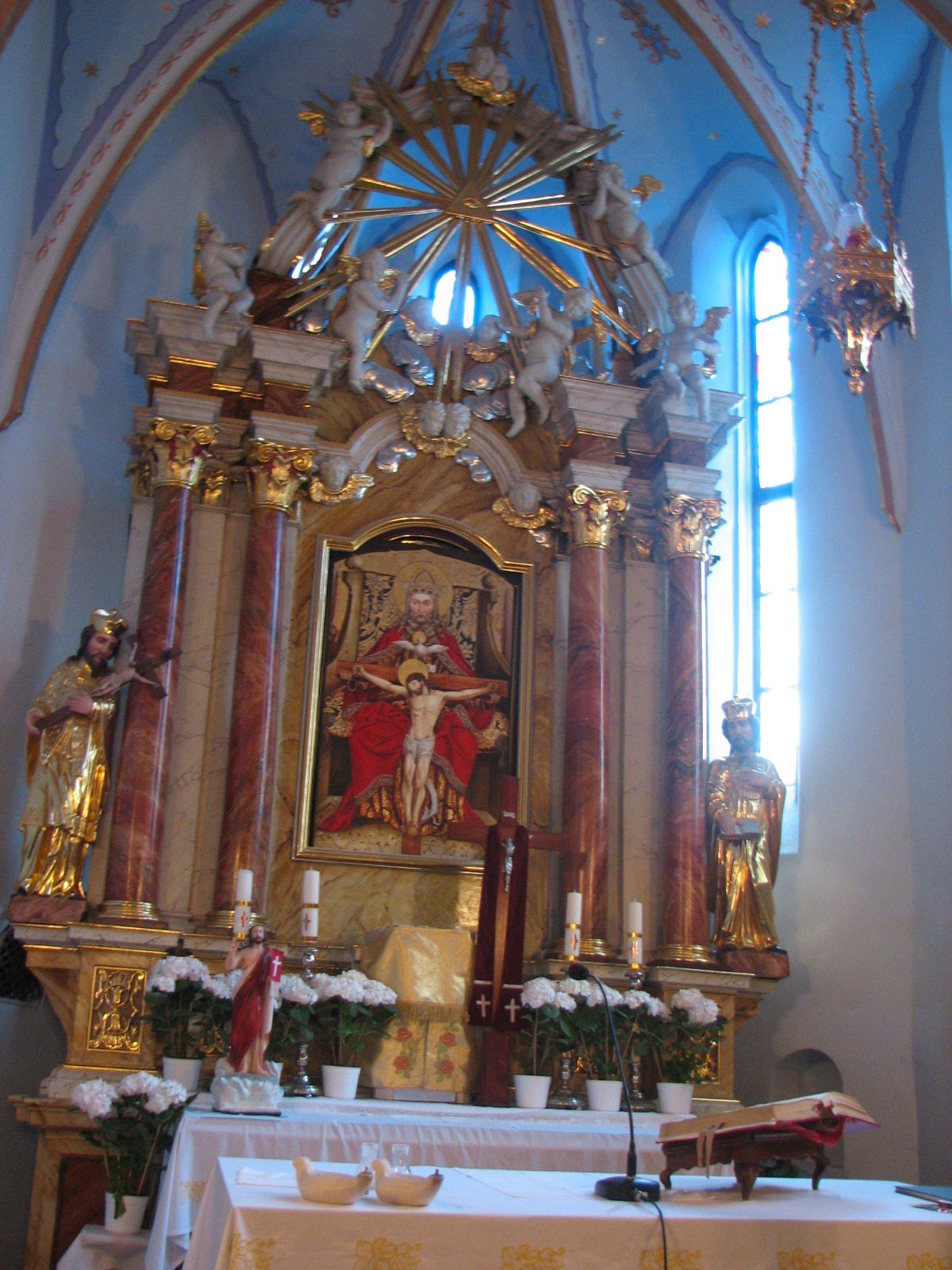
Holy Trinity church is listed in Poland’s heritage register under the earlier number A-238 and the newer number A-1096/M. The entry is dated 8 January 1957. A valuable late-Gothic painting, Throne of Grace, from the beginning of the sixteenth century was transferred to the Diocesan Museum in Kielce in 2006. A faithful copy remains in the church.
Remains
Layout and construction
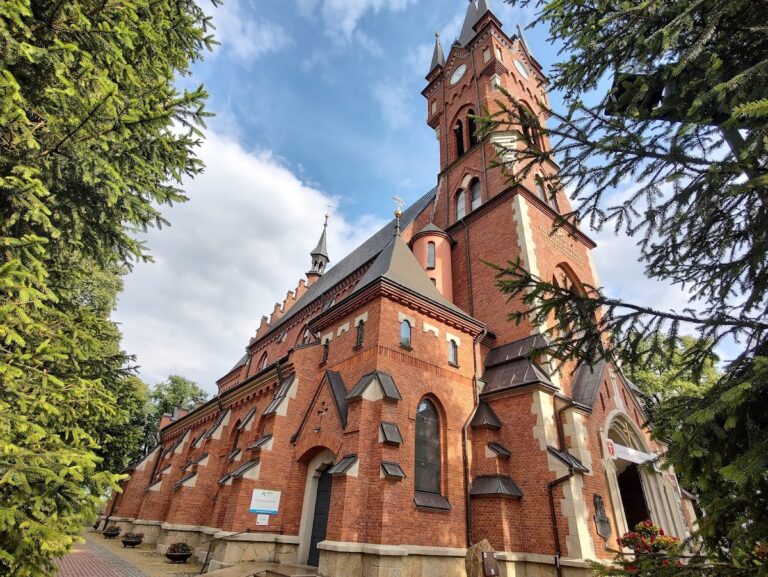
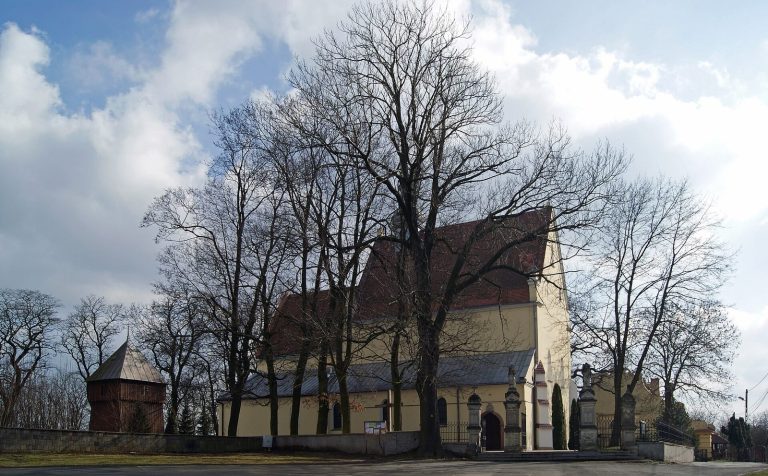
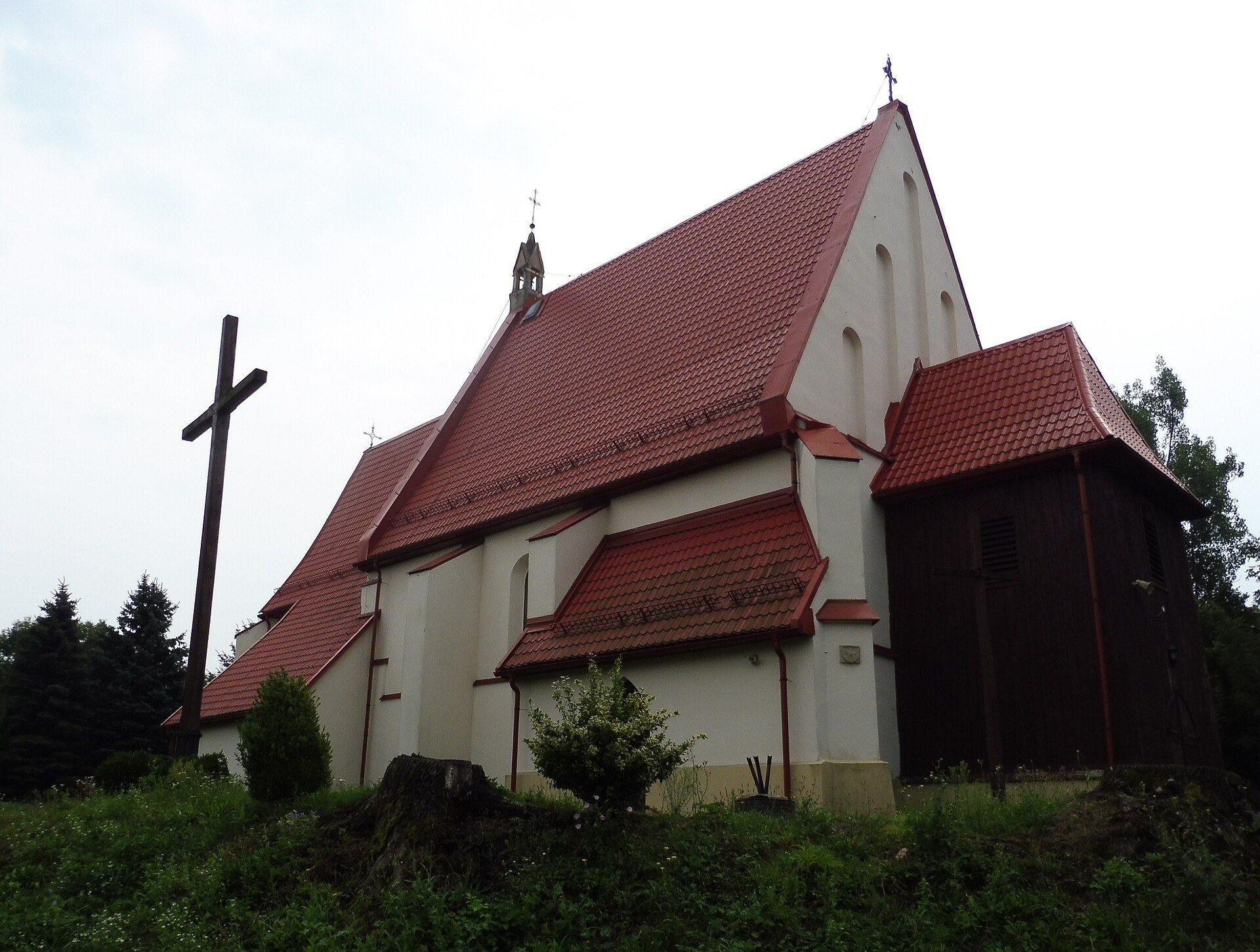
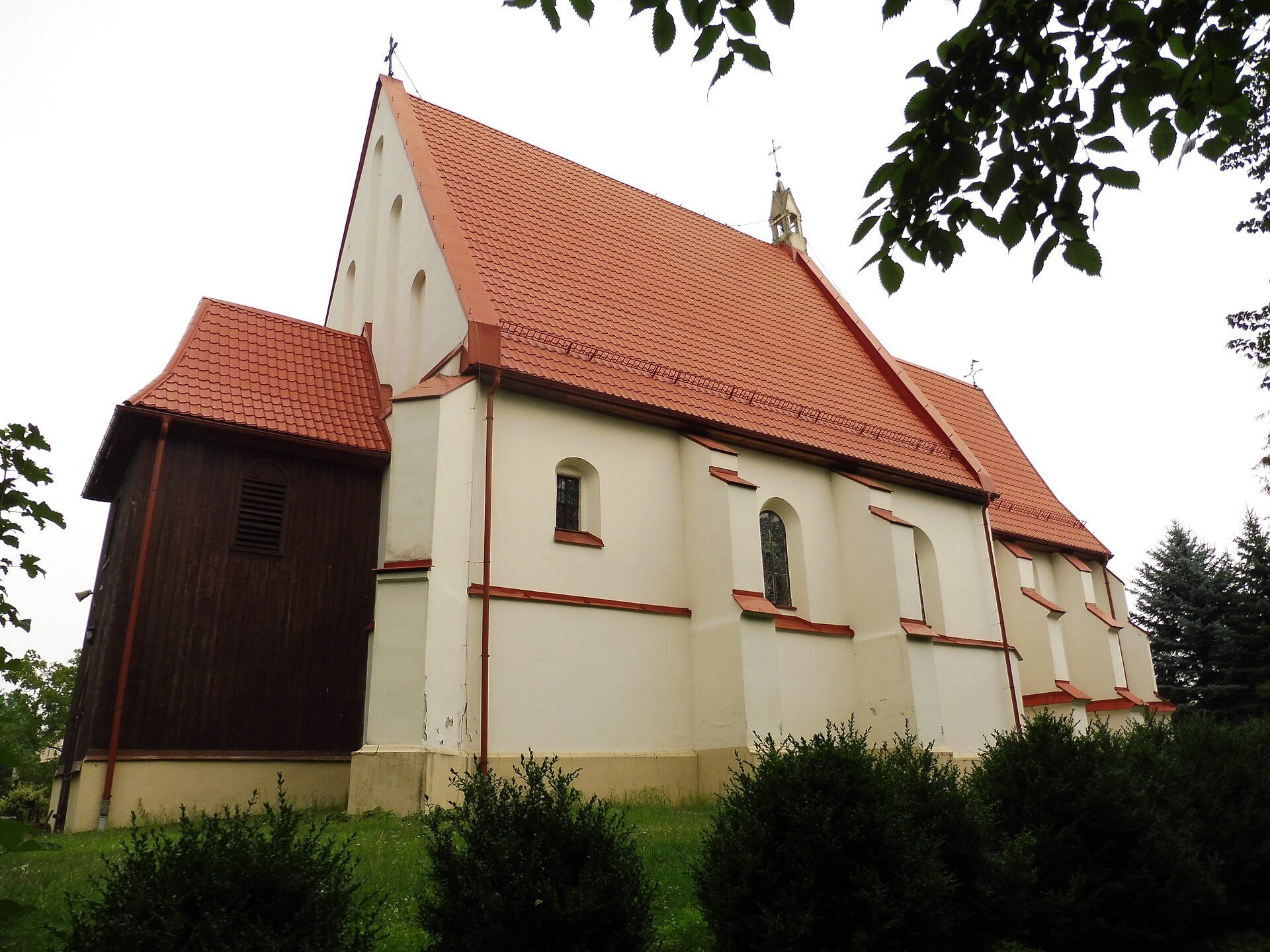
The church stands on a high Vistula escarpment beside Koszyce. It is organized as a single nave followed by a narrower, lower chancel, the part of the church containing the main altar and used by the clergy. The chancel ends in a polygonal form, and a sacristy adjoins it on the north side. The exterior walls are plastered, although an interwar description by Jan Wiśniewski stated that the building was made of unfaced brick.
Nave, chancel, and sacristy
The nave has a flat ceiling, while the chancel is covered by a ribbed cross vault. This type of vault is formed by intersecting vaulted sections supported by masonry ribs. The sacristy has a barrel vault. Very steep, gabled roofs cover the main parts of the building, and the western gable is divided by round-arched niches dating from the sixteenth century.
Wooden porch-bell tower
The porch-bell tower attached to the western facade was added in 1921. It has a post-and-frame structure standing on a masonry foundation. From about 1.50 metres above ground level, its exterior is covered with wooden planks. The tower has two levels: the ground floor serves as a porch, while the upper floor contains the bell chamber.
Painting
Throne of Grace
The late-Gothic Throne of Grace painting dates from the beginning of the sixteenth century. It was formerly kept in the church and was moved to the Diocesan Museum in Kielce in 2006. The church’s present image is a faithful copy of the original.