Saint Anthony of Padua Church in Strzelniki: A Gothic Filial Church in Poland

Site at a Glance
- Rating
- 4.8
- Popularity
- Very Low
- Country
- Poland
- Primary era
- Medieval
- External website
- Open
- Eras represented
- Medieval, Early Modern, Modern
- Civilizations
- Habsburg, Holy Roman Empire, Kingdom of Prussia
- Site type
- Religious
- Remains
- Church
On this page9 sections
History
Saint Anthony of Padua Church in Strzelniki, Poland, is a Gothic brick-and-stone church built in the second half of the thirteenth century. It was first mentioned in 1376 and was formerly dedicated to Saint Lawrence. Today it is a Roman Catholic filial church, a subsidiary church served by a larger parish, belonging to the Parish of Saint John the Baptist in Łosiów within the southern Brzeg deanery of the Archdiocese of Wrocław. Its dedication to Saint Anthony of Padua, a thirteenth-century Franciscan friar and preacher, is commemorated on 13 June.
Medieval origins and religious change
The church served as a place of worship through the later medieval period, when its interior received extensive painted decoration. From 1534 to 1945, it was an Evangelical church. After 1945, it became a Roman Catholic filial church and resumed its present dedication.
Alterations from the seventeenth century
Major changes took place during the seventeenth century. In 1618, the church was renovated on the initiative of Marcin Bittner, parish priest of Brzeg. Wooden galleries were installed in 1654, and between 1658 and 1680 the nave was raised while the ridge-line level was lowered. A wooden music gallery supported by two Ionic columns was added between the existing galleries in 1710. The sacristy door preserves the date 1658, linking one surviving detail to this period of alteration.
The quadrangular tower was added in 1688. The porches were modified around the turn of the eighteenth and nineteenth centuries, the tower roof was relaid in 1844, and the windows were enlarged during a renovation in 1853. Medieval polychrome paintings were discovered during renovation in 1958. They were later uncovered and displayed between 1966 and 1979. The church was entered in the register of immovable monuments of Opole Voivodeship under number 708/64 on 2 March 1964. It also lies on the Brzeg Polychrome Trail, which links churches with polychrome decoration in 18 localities around Brzeg.
Remains
Layout and exterior
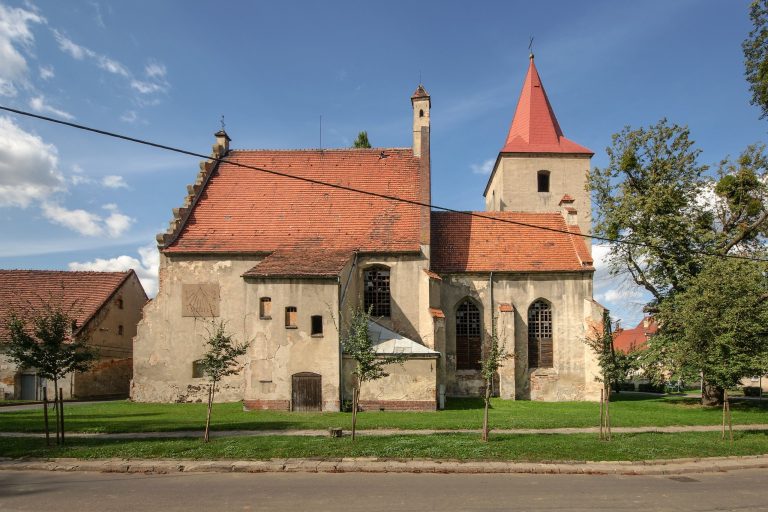
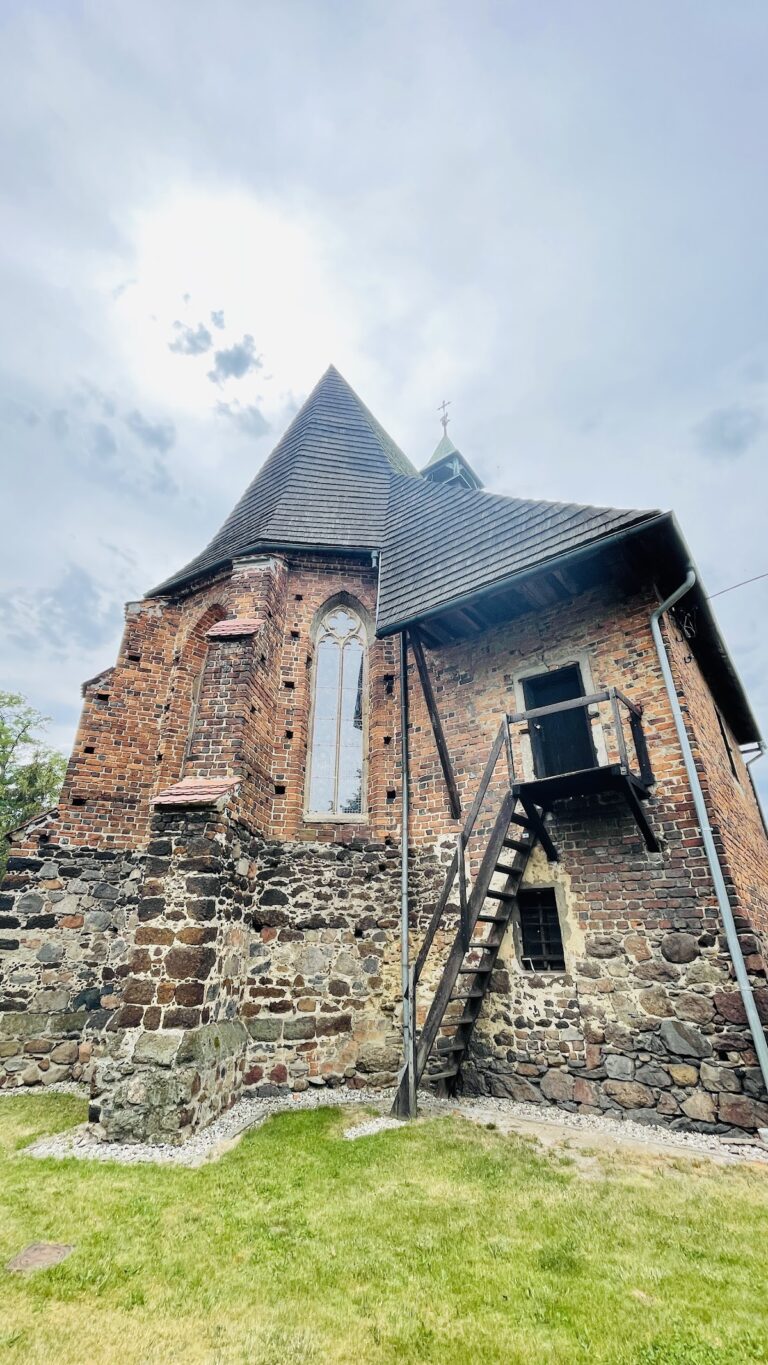
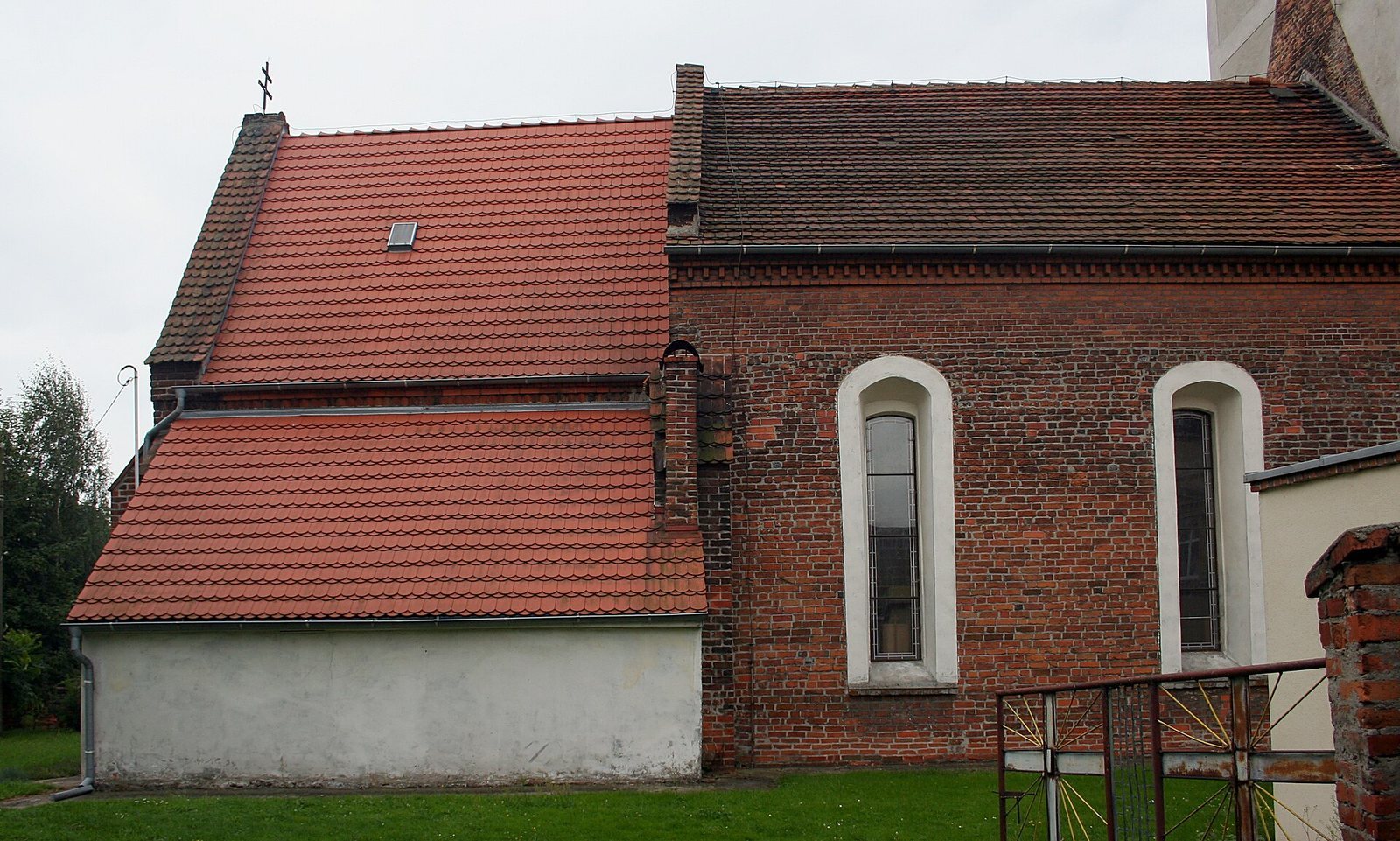
Saint Anthony of Padua Church is a single-nave Gothic building enclosed by a brick-and-stone wall. Its plan consists of a two-bay nave with a porch, a distinct chancel with a sacristy, and a single tower. The building has a gabled roof, while the tower is crowned by a helmet roof with a lantern, a raised structure that admits light above a roof. The tower facade preserves the trace of the nave’s earlier roofline from before the rebuilding.
Vaults, galleries, and fittings
The nave has a ceiling, while the chancel is covered by a ribbed cross-vault, whose intersecting ribs form the framework supporting the vaulted surfaces. The sacristy has a barrel vault, a continuous tunnel-shaped ceiling. Inside the nave, the wooden galleries rest on four profiled, baluster-shaped posts. The later wooden music gallery is supported by two Ionic columns. Decorative iron fittings survive on the sacristy door beside the date 1658.
Painted interior
Chancel paintings
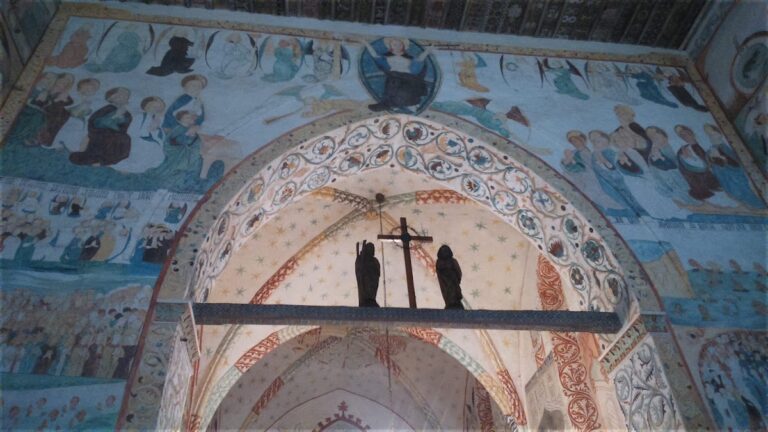
Medieval polychromes cover the interior. The paintings in the chancel date from the first half of the fourteenth century. On the eastern chancel wall, a scene attributed to the Master of the Adoration of the Magi was painted between 1418 and 1428. It includes Christ teaching in the Temple and representations of the Arma Christi, symbolic images of the instruments associated with Christ’s Passion.
Nave and porch paintings
The nave paintings date from about 1428, while those in the porch belong to the sixteenth century. The painted subjects include Christ displaying his wounds, the Veil of Saint Veronica, the martyrdom of Saint Lawrence, the Adoration of the Magi, and the Annunciation. Saint Lawrence and the Virgin Mary appear beside the Annunciation. A lay donor kneels among clergy in the representation of Mater Misericordiae, or “Mother of Mercy,” an image presenting the Virgin Mary as a protective intercessor for supplicants.