San Gennaro all’Olmo, Naples: A Former Roman Catholic Church
Site at a Glance
- Rating
- 4.7
- Popularity
- Very Low
- Country
- Italy
- Primary era
- Early Modern
- External website
- Open
- Eras represented
- Medieval, Early Modern, Modern
- Civilizations
- Byzantine, Italian, Kingdom of Naples, Spanish
- Site type
- Religious
- Remains
- Church
On this page13 sections
History
San Gennaro all’Olmo is a former Roman Catholic church in Naples, Italy, founded in the seventh century and later transformed into a Baroque church. Dedicated to Saint Gennaro, the patron saint of Naples and a Christian martyr traditionally associated with the city, it formed part of the city’s charitable and religious life. The building is now deconsecrated and serves as one of the seats of the Fondazione Giambattista Vico, as well as a venue for cultural events.
Seventh-century foundation
The church’s documented foundation is attributed to Sant’Agnello, the thirteenth bishop of Naples, who served from 680 to 701. He established it in honour of Saint Gennaro on the site of one of Naples’s seven diaconiae. A diaconia was a church institution in which a deacon administered charitable assistance, especially alms for poor people and widows. The church was originally known as San Gennaro ad Diaconiam, a name that referred to this charitable office. The hospital associated with the diaconia continued to function until the fifteenth century.
A tradition identifies the church as one of six Greek-rite churches founded during the reign of Emperor Constantine I, the Roman emperor associated with the legalization and imperial patronage of Christianity in the early fourth century. This connection remains a tradition rather than a securely documented foundation date. Greek and Latin rites were both celebrated at San Gennaro all’Olmo until the fourteenth century, when Naples adopted the Latin rite.
Armenian relics and changing dedications
During the eighth century, Armenian nuns fleeing the Byzantine Iconoclasm found refuge at the church. The conflict concerned the religious use and veneration of sacred images in the Byzantine world. The nuns brought with them relics of Saint Gregory the Illuminator, the Christian missionary traditionally credited with converting Armenia to Christianity, and the skull of Saint Blaise, a bishop and martyr traditionally invoked against throat ailments.
Devotion to Saint Blaise later led to the incorporation of a chapel dedicated to him into the adjacent Church of San Biagio Maggiore in 1631, when a larger place of worship was required. The church itself was restored in 1583 at the initiative of the abbot Agnello Rosso. During that work, a marble urn containing the relics of Saint Nostrianus, bishop of Naples from 444 to 461, was discovered beneath the high altar. The relics were later transferred to the Church of Santi Filippo e Giacomo and displayed publicly from 1612. San Gennaro all’Olmo was subsequently placed under Saint Nostrianus’s dedication.
Parish church and Baroque transformation
In the late sixteenth century, the church was ceded to the Congregazione dei 72 Sacerdoti, whose name means the Congregation of the 72 Priests. It was also known as the Church of San Michele Arcangelo. At the beginning of the seventeenth century, it became a parish church. After the earthquake of 1688, it underwent restoration that added substantial stucco decoration. Giambattista Vico, the Italian philosopher and historian known for his philosophy of history, was baptised there. Further Baroque work continued during the eighteenth century.
The parish congregation moved to the nearby Church of Santi Filippo e Giacomo in 1944. During the second half of the twentieth century, San Gennaro all’Olmo was closed, stripped of its works of art, and eventually sealed behind a walled-up entrance. Water infiltration and neglect destroyed much of the Baroque stucco and caused the small cupola over the presbytery to collapse.
Restoration and present status
Following the 1980 earthquake, anchoring devices were inserted into the masonry to secure the building. The Fondazione Giambattista Vico then undertook its recovery. The first restoration phase reconstructed the decoration of the nave, while a second phase rebuilt the presbytery and its small cupola and recovered the chapels. The foundation was promoted by Gerardo Marotta and presided over by Vincenzo Pepe.
Recent studies and discoveries have identified part of the site as an ossuary associated with Saints Blaise and Gregory. Giambattista Vico’s father was buried there. San Gennaro all’Olmo and the adjacent Church of San Biagio Maggiore form a single monumental complex within the Historic Centre of Naples, a UNESCO World Heritage property since 1997. The church’s history therefore brings together early Christian charitable organization, Armenian religious migration, changing rites, later parish life, and the recovery of a damaged historic building.
Remains
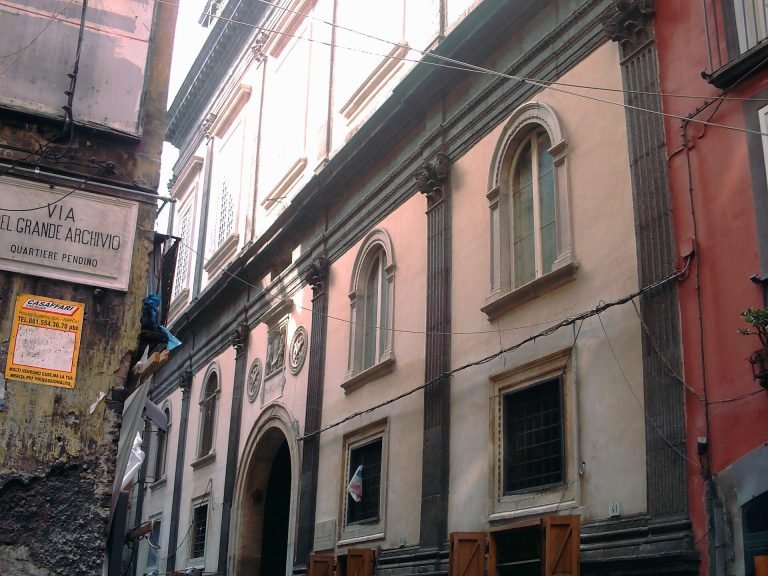
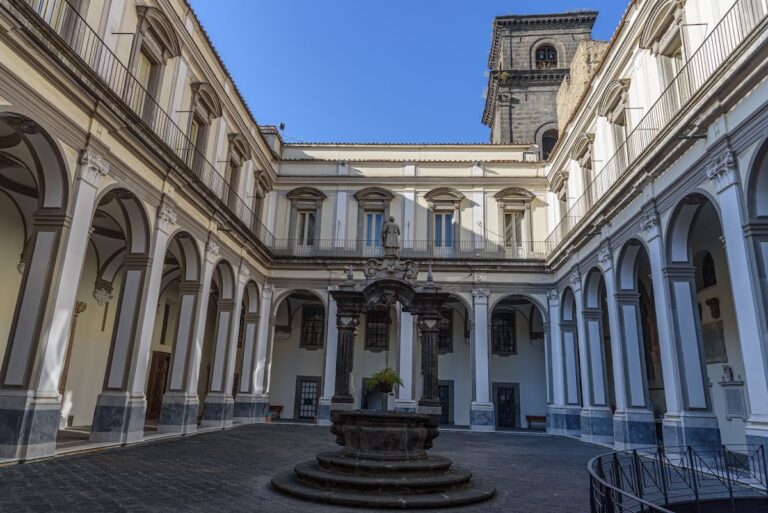
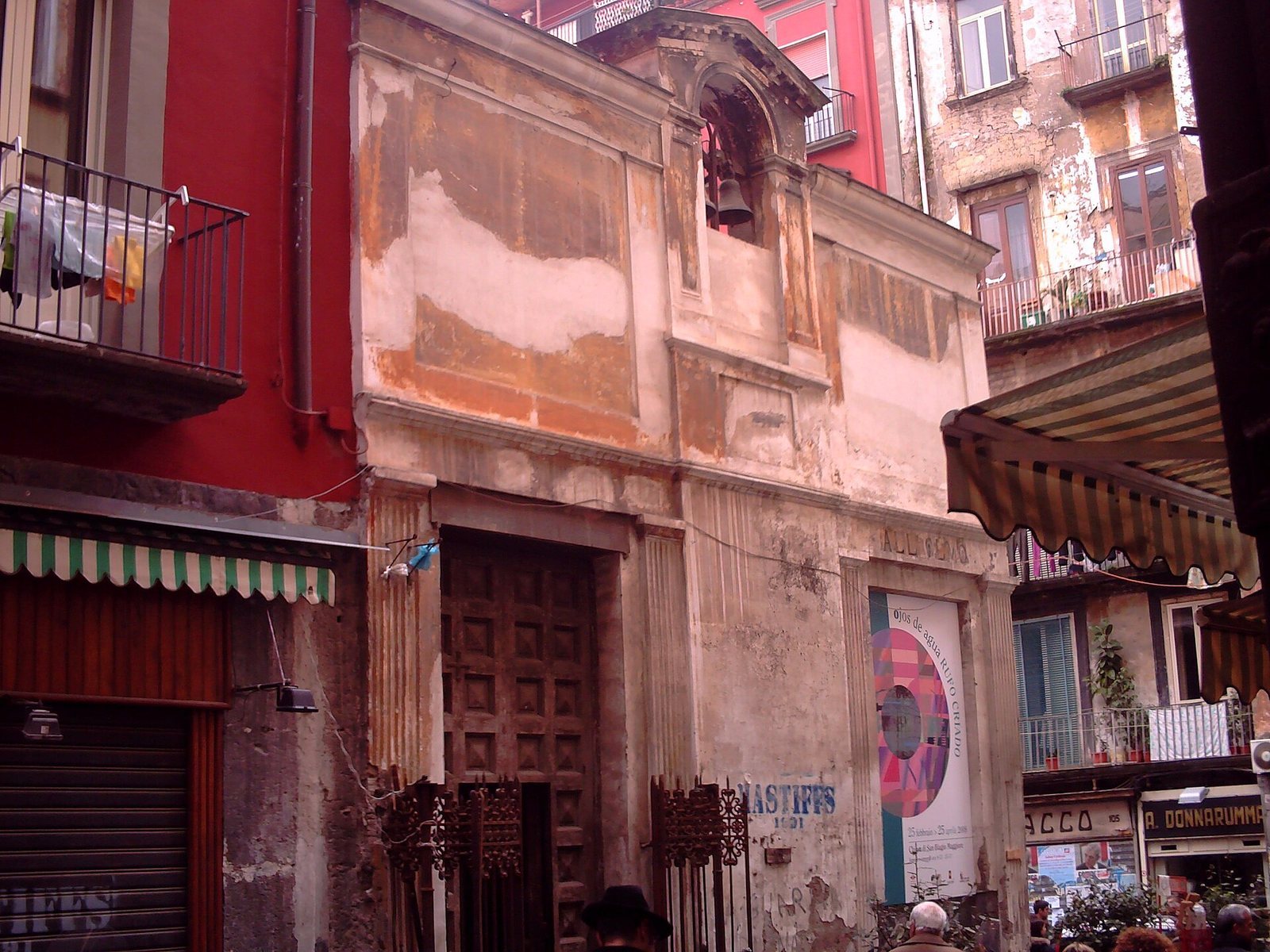
San Gennaro all’Olmo stands at the intersection of Via San Gregorio Armeno and Via San Biagio dei Librai in Naples’s historic centre, within the area known as Spaccanapoli. It is contiguous with San Biagio Maggiore, forming a unified monumental complex. The building is a Baroque church with later alterations extending into the early twentieth century. Its surviving fabric includes the church interior, below-ground spaces, Early Christian columns, and elements connected with the relics and burials associated with the site.
Exterior and interior fabric
Facade and entrance
The facade was altered during a restoration in 1908. According to the architectural historian Roberto Pane, the work advanced the facade over the former entrance staircase and incorporated the old steps into a small vestibule. This reduced the exterior space and changed the former square-like character of the area in front of the church. The name “all’Olmo” recalls a large elm that once stood in the nearby small square. The prize for the winner of the local cucagna, a climbing-pole game, was hung from the tree.
Nave and altars
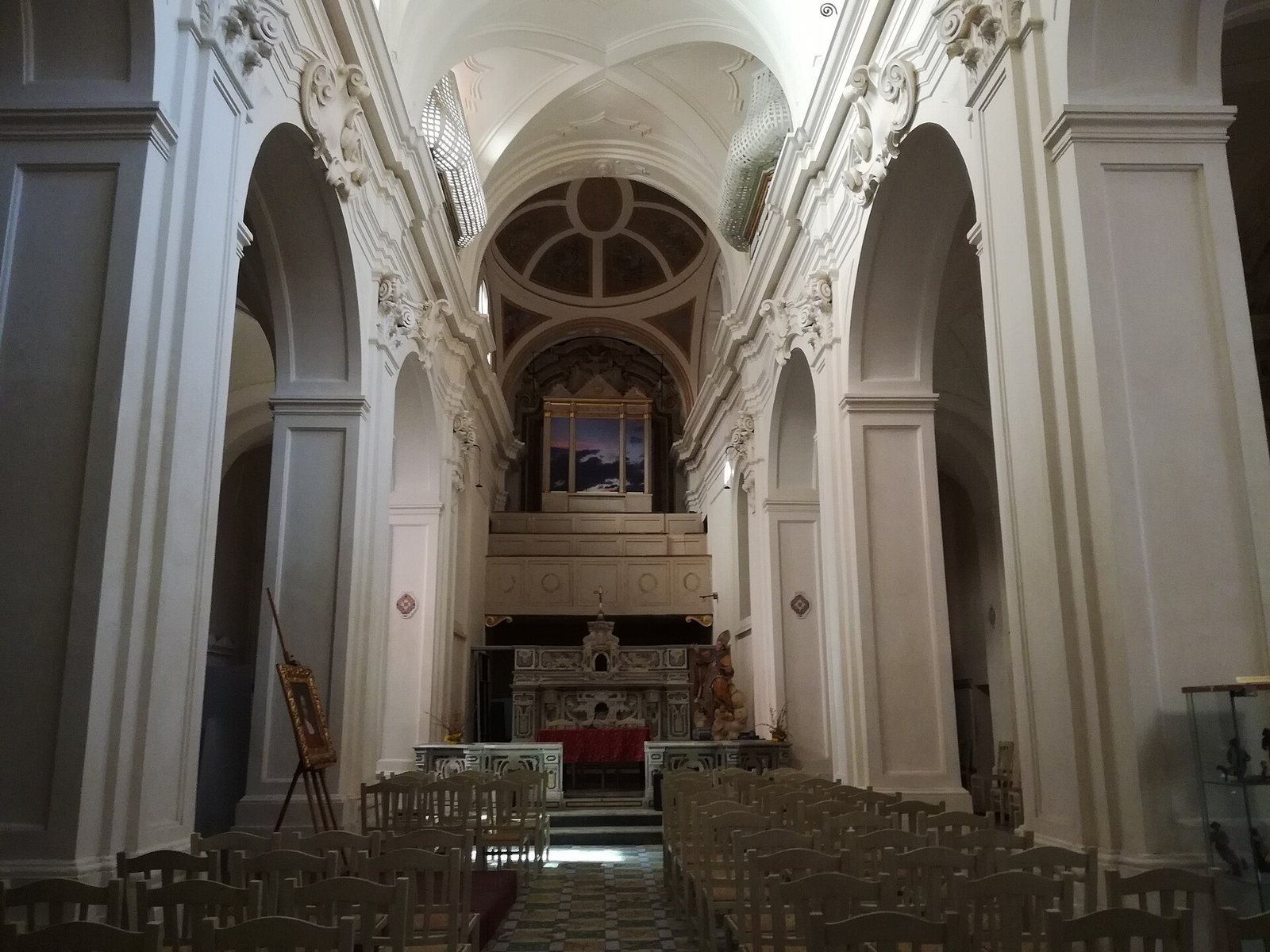
The early nineteenth-century restoration ordered by the parish priest Adinolfi replaced the pavement with maiolica tiles, a form of tin-glazed decorated earthenware. The walls were painted blue and white after previously carrying faux-marble decoration. Eighteenth-century work produced the high altar and side altars, including a marble commesso, or opus sectile, balustrade made by fitting shaped pieces of coloured stone or marble into an ornamental surface.
Presbytery and chapels
The presbytery formerly had a small cupola, which collapsed during the church’s period of deterioration. The later restoration rebuilt the presbytery and reconstructed the cupola, while also recovering the chapels. Much of the Baroque stucco that once enriched the interior had been destroyed by water infiltration and neglect before these works.
Below-ground spaces and early remains
Lower church and crypt
Beneath the church lies another church and a small crypt containing burials of several members of the Neapolitan population. These spaces extend the building’s history below the principal interior and preserve evidence of its use as a place of burial as well as worship.
Ossuary and relics
Part of the site has been identified as an ossuary associated with Saints Blaise and Gregory. The church also preserves several Early Christian columns. The Armenian religious community brought the skull of Saint Blaise and relics of Saint Gregory the Illuminator to the church in the eighth century. The relics of Saint Nostrianus, found beneath the high altar in 1583, were later transferred to another church.