Pfarrkirche Mariä Himmelfahrt: A Rococo Parish Church in Türkenfeld, Germany
Site at a Glance
- Rating
- 4.4
- Popularity
- Very Low
- Country
- Germany
- Primary era
- Early Modern
- External website
- Open
- Eras represented
- Medieval, Early Modern, Modern
- Civilizations
- Duchy of Bavaria, Electorate of Bavaria, German, Holy Roman Empire
- Site type
- Religious
- Remains
- Church
On this page13 sections
History
Pfarrkirche Mariä Himmelfahrt is a Catholic parish church in Türkenfeld, Germany, whose present building was begun in 1489 in late Gothic forms. It later became a rural Bavarian church with an elaborate Rococo interior, shaped especially by the Rosary Brotherhood established in Türkenfeld in 1718.
Late Gothic origins and Rococo transformation
The church originated in the late fifteenth century. By about 1670, the earlier building was regarded as outdated and was adapted in the Baroque manner. Between 1756 and 1766, this work was substantially revised in the Rococo style, an eighteenth-century fashion known for delicate ornament, flowing forms, asymmetry, and light decorative effects. The two side chapels were added at a later date.
The church’s furnishings and painted decoration reflect the Rosary Brotherhood’s devotional purpose. The Rosary is a Catholic form of prayer involving repeated prayers and meditation on episodes from the lives of Jesus and Mary. This association gave the frescoes and other artworks a predominantly Marian and Rosary-centered character.
Nineteenth-century changes
Renovations took place in 1843 and 1867, followed by a westward extension in 1888 and 1889. The latter restoration also altered and harmonized the colors of the ceiling paintings. Further maintenance and renovation followed in 1909, 1953, 1957, and 1975, with the 1975 work concentrating on the exterior.
Modern conservation
The interior underwent comprehensive renovation between 2002 and 2004. Parish priest Georg Kapfer played a major role in this work during his service in Türkenfeld and Zankenhausen from 1990 to 2006. Earlier and later interventions left a building in which the late Gothic structure, the eighteenth-century transformation, the nineteenth-century extension, and the historic furnishings can be read together.
Devotional associations
A processional banner from 1796 records a local thanksgiving during the Napoleonic Wars. The isolated farmstead of Burgholz was spared, and the painted scene shows its inhabitants kneeling before the Virgin Mary while enemy soldiers ride away after failing to see the farm in dense fog. A second contemporary banner presents Saint Sylvester as a patron of livestock. Both works carry extensive inscriptions on their backs.
Remains
Exterior and plan
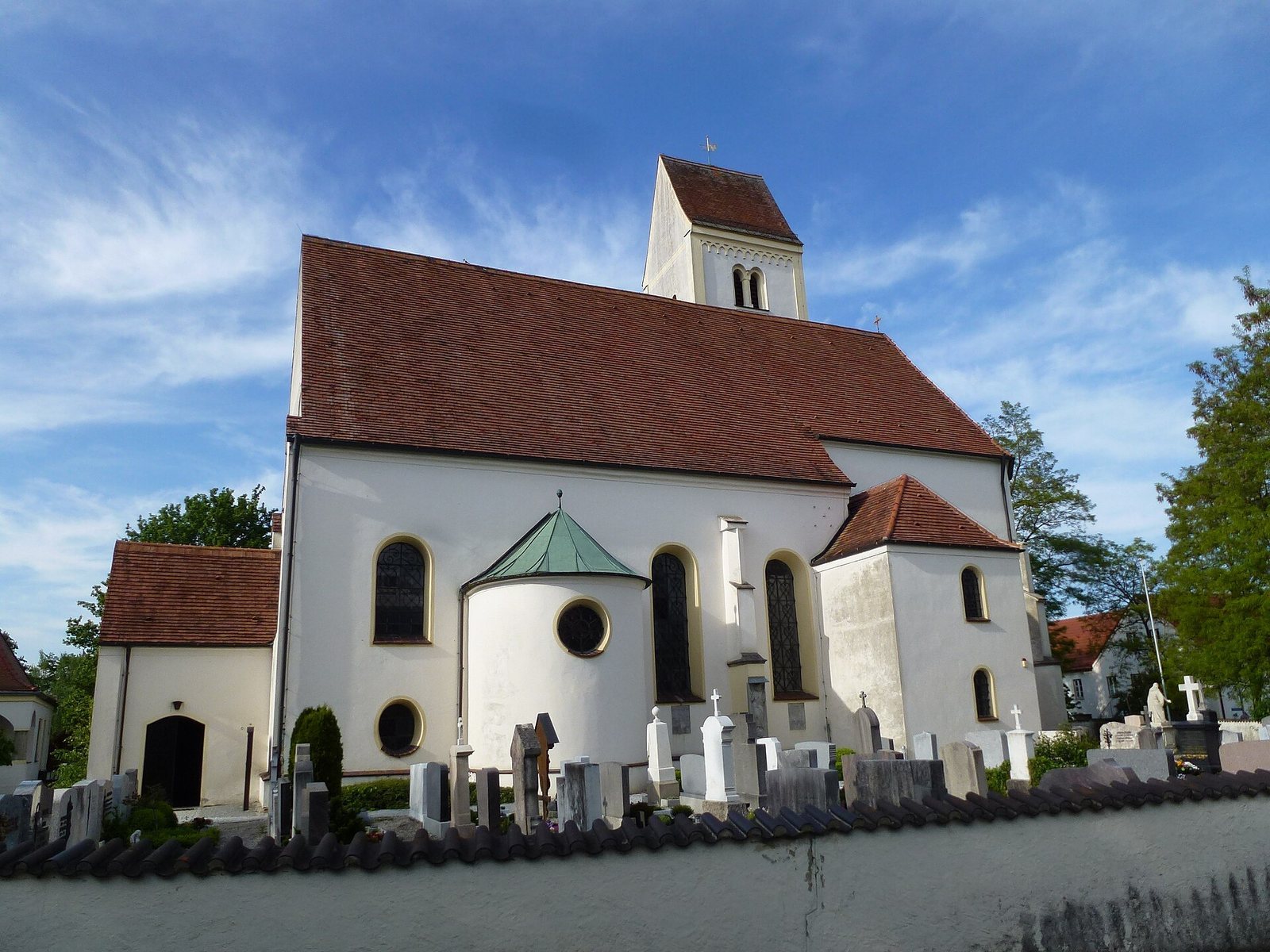
Pfarrkirche Mariä Himmelfahrt is a simple rural church enclosed by a walled cemetery. Its late Gothic origins remain visible in the stepped buttresses on the choir and on the south side of the nave, with simple round-arched windows between them. The choir is narrower and set back from the nave, while both parts lie beneath one tiled saddle roof, formed by two sloping surfaces meeting at a central ridge.
A five-storey tower with a saddle roof stands at the northern angle of the choir. Tracery-like bars and arch friezes between pilasters provide its late Gothic exterior decoration. A sacristy occupies the southern angle of the choir, and two side chapels project from the wall line at the western end of the nave.
Interior architecture and decoration
Nave and choir
The nave is a four-bay hall. Beyond it, the elongated three-bay choir ends in five sides of an octagon. Barrel vaults with lunettes, meaning curved ceilings interrupted by smaller arched openings, cover the nave and choir and rest on marbled pilasters. The western extension contains a double gallery, with the organ projecting into the nave from the upper level.
Stucco and frescoes
Fine Wessobrunn Rocaille stucco decorates the interior. The Wessobrunn tradition was a major Bavarian school of ornamental plasterwork, particularly associated with floral and Rocaille designs. The decoration, attributed to Franz Xaver Schmuzer and dated to about 1754 or 1765, includes flower garlands, leafy sprays, and putto heads. It was probably completed shortly before the related frescoes.
Christoph Thomas Scheffler’s choir fresco presents Mary as Queen of Heaven and bears the inscription “C(hristoph) T(homas) Scheffler augustanus invenit 1754.” The large principal painting in the nave shows the Virgin Mary as Queen of the Rosary. Another scene depicts Pope Pius V’s vision of the naval victory at Lepanto. The 1571 Battle of Lepanto was a major naval victory of the Holy League over the Ottoman fleet and became an important subject in Catholic art and devotion.
Opposite the Lepanto scene, Judith raises the severed head of Holofernes, the Assyrian commander from the biblical Book of Judith. Cartouches contain the four Evangelists, Matthew, Mark, Luke, and John, together with two female figures that may represent Synagogue and Ecclesia, traditional personifications of Judaism and the Christian Church. Johann Baptist Baader of Lechmühlen, known as “Lechhansl,” painted the frescoes in 1766. The image of Saint Luke has been interpreted as one of Baader’s numerous self-portraits.
Altars and chapels
The high altar was installed in 1805 in stucco marble, a polished plaster material made to imitate natural marble. Johann Michael Sporer combined late Baroque elements with the balanced and restrained vocabulary of Classical design. Its four-column arrangement follows an older tradition, while its individual forms are more reserved. The altar sculptures are about a century older. Mary stands at the center, modeled on Munich’s Marian Column, with Saints Dominic and Catherine of Siena at her feet. Saints Anne and Catherine of Alexandria occupy the outer positions.
Sporer supplied the two side altars in 1812. Each follows the high altar’s arrangement, with a pair of columns beside the central niche. The northern altar contains a group probably installed in 1889 by Munich sculptor Wilhelm Nießen, showing Saint Anne teaching her daughter Mary to pray, with Saints Joseph and Joachim. The southern altar presents Pope Sylvester in the niche, accompanied by Anthony the Hermit and Anthony of Padua.
The altar in the northern Marian Chapel is a Rococo work from about 1766. Lorenz Luidl of Landsberg am Lech made its seated, crowned figure of Mary holding a scepter. Two large angels, attributed to Franz Xaver Schmädl or his workshop, flank the figure. The Neo-Baroque southern chapel contains a late Gothic Crucifixion group from about 1500, with Mary and John beneath the cross and the bound, mutilated limbs of the two thieves behind the crossbeams of their crosses.
Pulpit, choir stalls, and galleries
The white-painted pulpit dates from 1766. Putti play across its basket, whose Rococo ornaments are gilded, while the sounding board imitates a cloth baldachin with tassels. Opposite it hangs an eighteenth-century crucifix with a mourning female figure identified either as Mary or Mary Magdalene. The Classical choir stalls were made at the beginning of the nineteenth century, at the same time as the altars.
The lower western gallery balustrade contains oval medallions of the Twelve Apostles. Its larger central image shows Christ blessing as Salvator Mundi, the devotional title meaning “Savior of the World.” The gallery paintings are also attributed by the Dehio handbook to Johann Baptist Baader. In 1989 and 1990, Orgelbau Schmid of Kaufbeuren installed a new organ with 17 stops in the five-part case on the upper gallery balustrade. Behind it is a concealed two-part case with a central swell box.
Processional banners
The banner displayed before the Marian Chapel is the 1796 oil painting on canvas associated with Burgholz. It shows the farm’s inhabitants kneeling before the Virgin Mary, with enemy soldiers riding away on the right. Before the Cross Chapel, the second banner presents Saint Sylvester with an open book and a bull at his feet. Both banners retain extensive inscriptions on their reverse sides.