Fürstenfeld Abbey: A Cistercian Monastery and Late Baroque Complex in Germany
Site at a Glance
- Rating
- 4.7
- Popularity
- Medium
- Country
- Germany
- Primary era
- Early Modern
- External website
- Open
- Eras represented
- Medieval, Early Modern
- Civilizations
- Duchy of Bavaria, Holy Roman Empire
- Site type
- Religious
- Remains
- Monastery
On this page10 sections
History
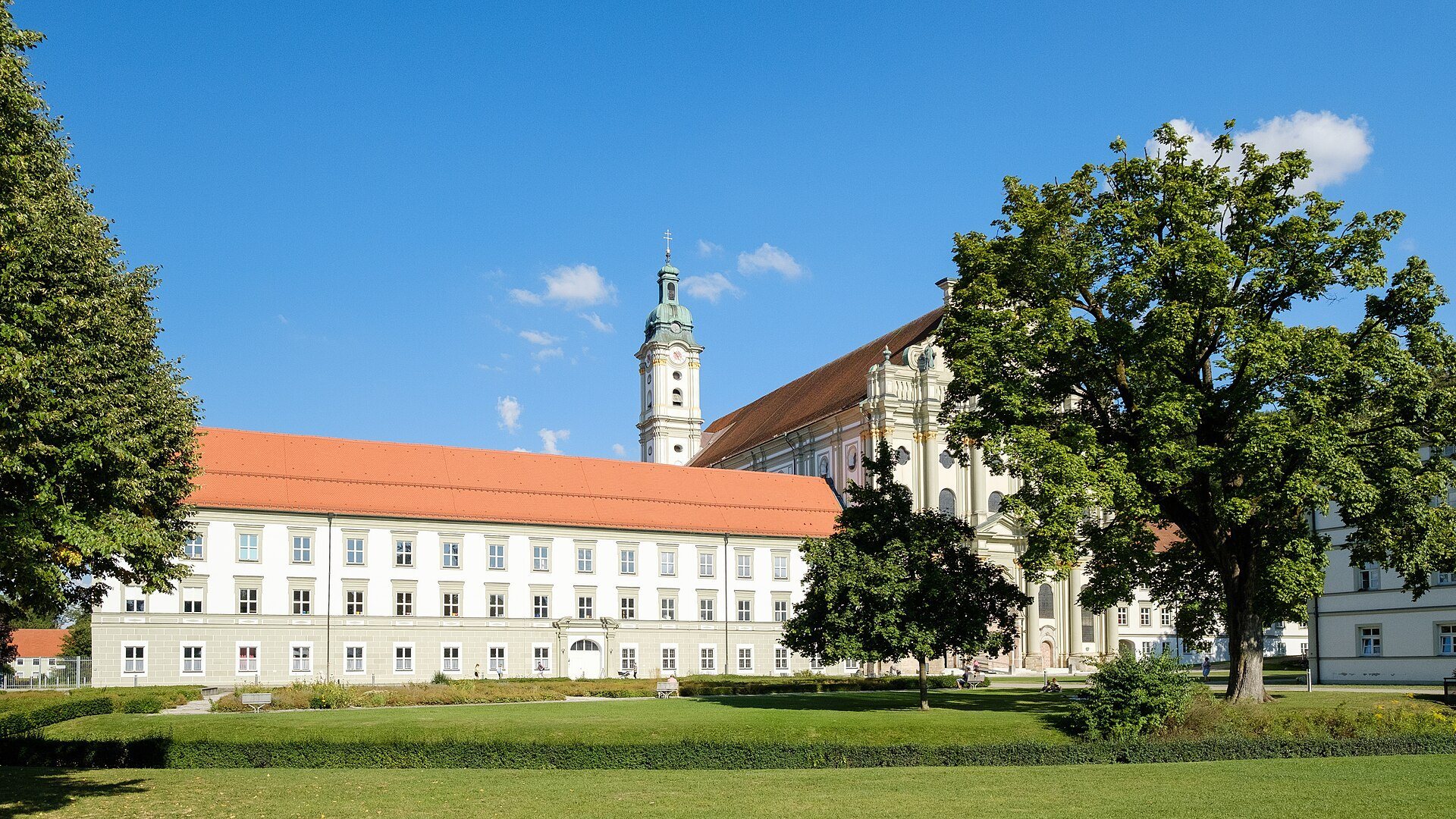
Fürstenfeld Abbey in Germany was a former Cistercian monastery in Fürstenfeldbruck, Bavaria, founded in 1256 and later rebuilt in the southern German Late Baroque style. Dedicated to Saint Mary, it belonged to the Upper German Cistercian Congregation and became one of the household monasteries supported by the Wittelsbach dynasty, the ruling family of Bavaria.
Foundation and medieval development
The foundation arose from an act of penance imposed on Louis II, Duke of Bavaria, after the wrongful execution of his first wife, Marie of Brabant, on unfounded suspicions of adultery. Pope Alexander IV required Louis to establish a monastery. Permission for Cistercian monks from Aldersbach was obtained in 1256, and an initial community was established at Seldental near Aibling in 1258 after an earlier attempt at Thal near Großhöhenrain. The monks moved to the site near Bruck in 1263. The Bishop of Freising confirmed the foundation in 1265, and the abbey received its charter in 1266.
Louis II endowed the monastery with land and privileges and was buried there after his death. His son, Louis IV, later Holy Roman Emperor, became another major benefactor. In 1322, monks or agents from Fürstenfeld intercepted messengers belonging to Louis IV’s Habsburg rival, Frederick the Fair, before the Battle of Mühldorf, the conflict that decided their struggle for the imperial throne. The abbey received additional privileges afterward. Louis IV died near Puch on 11 October 1347 during a bear hunt, and his heart was buried at Fürstenfeld.
The earliest Gothic monastery was built between about 1270 and 1290 and included a substantial library. Fürstenfeld also promoted the cult of Leonard of Noblac, whose shrine at nearby Inchenhofen became an important pilgrimage destination. During the Reformation, the community experienced spiritual decline and division, while the Bavarian duke repeatedly intervened in its administration. Aldersbach remained the mother house, Morimond the primary abbey, and Waldsassen one of Fürstenfeld’s daughter houses.
Cistercian reform and wartime damage
In 1595, under the chairmanship of the Abbot of Cîteaux, the French monastery that served as the institutional centre of the Cistercian order, Fürstenfeld became a place where principles of reform were developed. These measures sought to restore stricter monastic discipline and remained influential into the eighteenth century.
Swedish troops serving Gustavus Adolphus plundered the monastery in 1632 and 1633 during the Thirty Years’ War, a European conflict shaped by religious and political divisions. The monks fled, some to Munich, where two were held as hostages for three years. Economic recovery began in 1640. Under Abbot Martin Dallmayr, the number of monks doubled, discipline was renewed, several churches were built, and the financial foundation for the later Baroque rebuilding was established.
Baroque rebuilding
The foundation stone of the Baroque monastery complex was laid in 1691. Giovanni Antonio Viscardi, a court architect and master builder at Munich, was entrusted with the construction. Work on the church advanced chiefly after the War of the Spanish Succession, the European conflict of 1701 to 1714. Following Viscardi’s death in 1713, Johann Georg Ettenhofer directed the building work, although the extent to which he altered Viscardi’s plans remains uncertain.
The church choir was completed in 1723, and the church was consecrated in 1741. Interior furnishing continued until about 1780. The completed abbey church became a major example of southern German Late Baroque architecture. Gerhard Führer, the last Fürstenfeld abbot, experienced the dissolution of the abbey on 18 March 1803.
Dissolution and changing uses
Fürstenfeld was dissolved in 1803 during the secularisation of Bavaria, when church property and institutions were transferred to secular ownership. The complex passed to Ignaz Leitenberger, a Bohemian cloth manufacturer, but inhabitants of Bruck prevented the church from being demolished. In 1816 the church became the property of King Maximilian I Joseph of Bavaria and served as a church of the royal family.
In 1817 the Bavarian field marshal Carl Philipp von Wrede bought the monastery. A hospital and home for invalid soldiers opened in the former convent buildings in 1818, and a Protestant prayer hall was installed in the former chapter house in 1828. Between 1848 and 1921, parts of the complex served military purposes, including as bases for infantry and cavalry units and as a military hospital. A fire destroyed part of the southern tract in 1866 while it was being used as a hospital. After the First World War, the complex also housed a war hospital for German soldiers and foreign prisoners of war.
Twentieth-century institutions and restoration
From 1921, the monastery buildings were used as a state boarding school. Police institutions, including police training schools, occupied parts of the complex from 1924 to 1975, after which the police department of the Bavarian College of Public Administration was based there. Following the First World War, the economic tract passed to the Wittelsbach Compensation Fund, which leased it to Ettal Abbey in 1923.
The town of Fürstenfeldbruck acquired the economic buildings in 1979 and began converting them in 1987. The first part of the Fürstenfeldbruck Museum opened in 1991, and by 2001 the former economic buildings had become a cultural centre. The Veranstaltungsforum Fürstenfeld, opened in 2001 in and beside the restored buildings, combines the historic complex with a modern municipal hall.
Remains
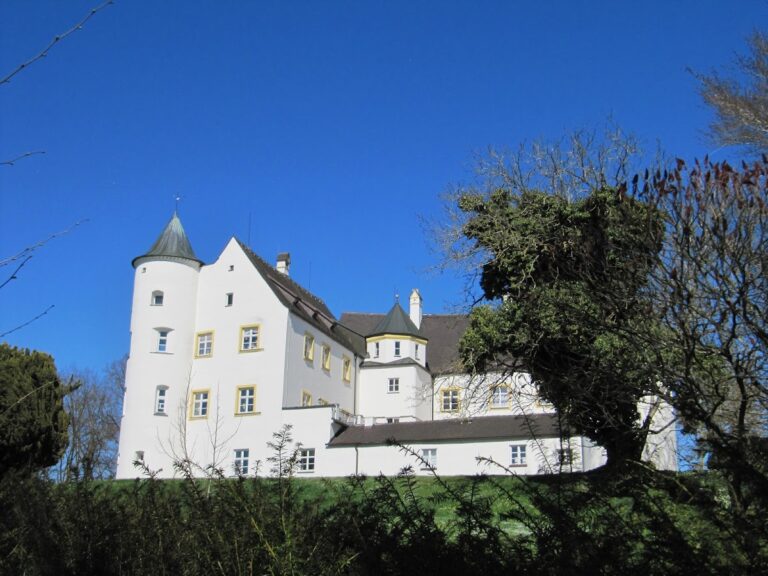
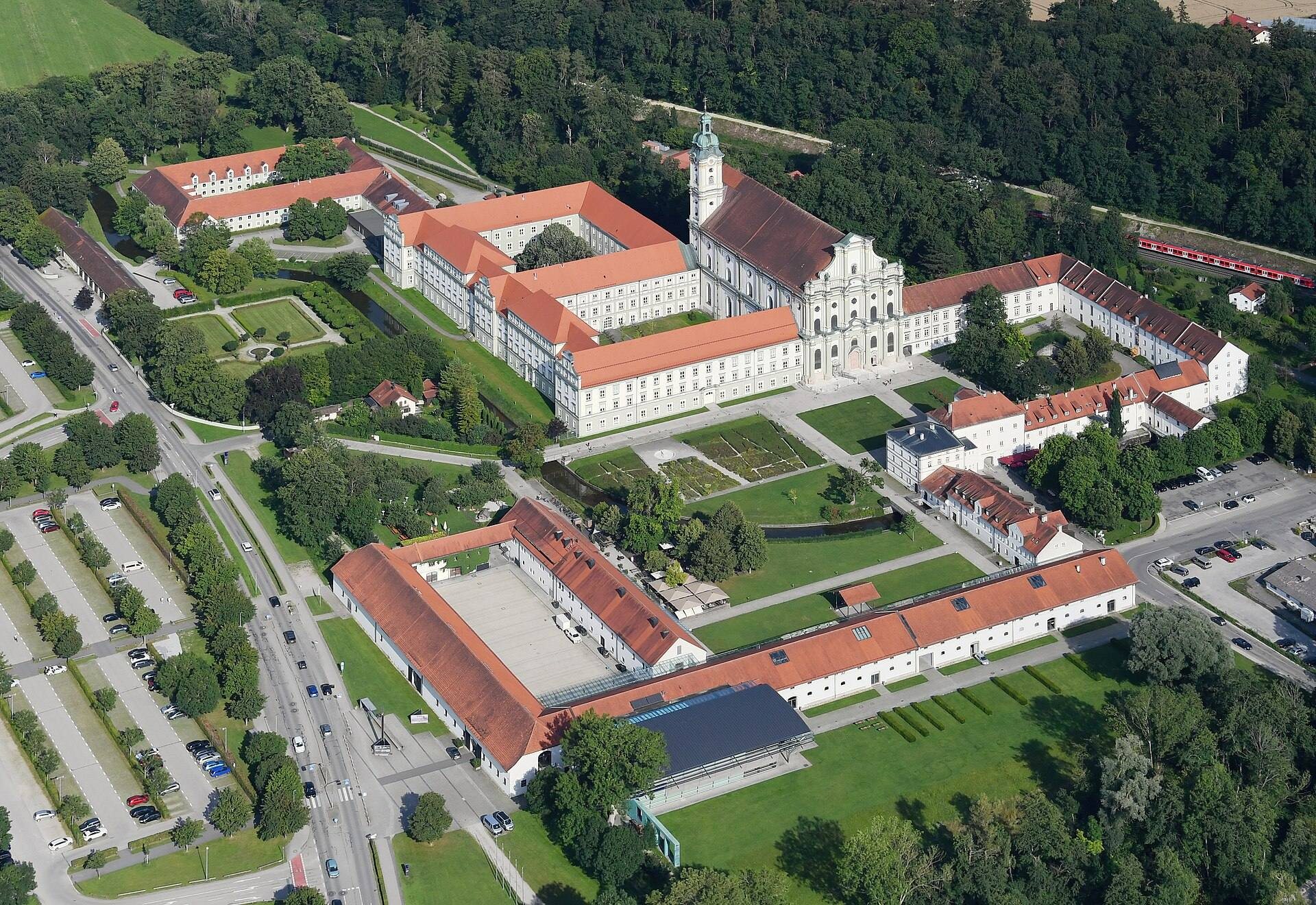
Fürstenfeld Abbey lies about 25 kilometres west or northwest of Munich, with the medieval castle site of Engelsberg immediately to the south on a spur of a glacial moraine ridge. Engelsberg was probably a Welf ministerial residence before it was acquired and destroyed by the abbey. The surviving monastery complex combines the medieval foundation with extensive Baroque rebuilding and later adaptations.
Abbey church
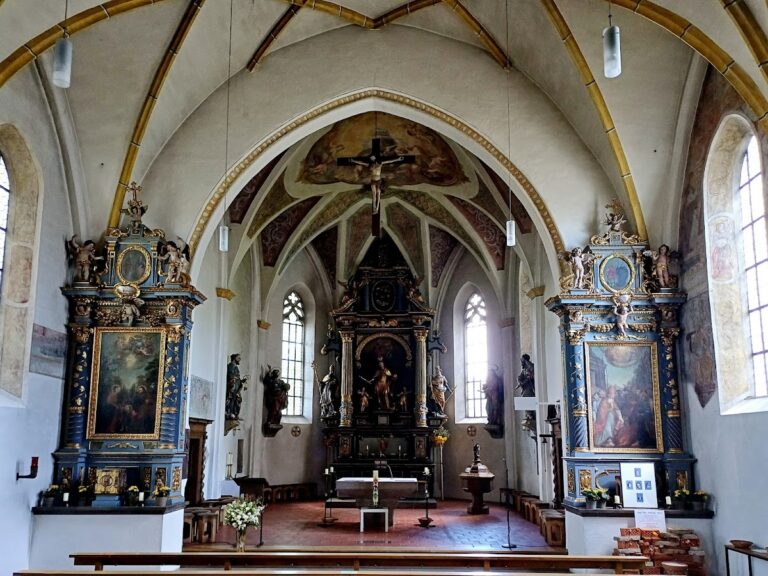
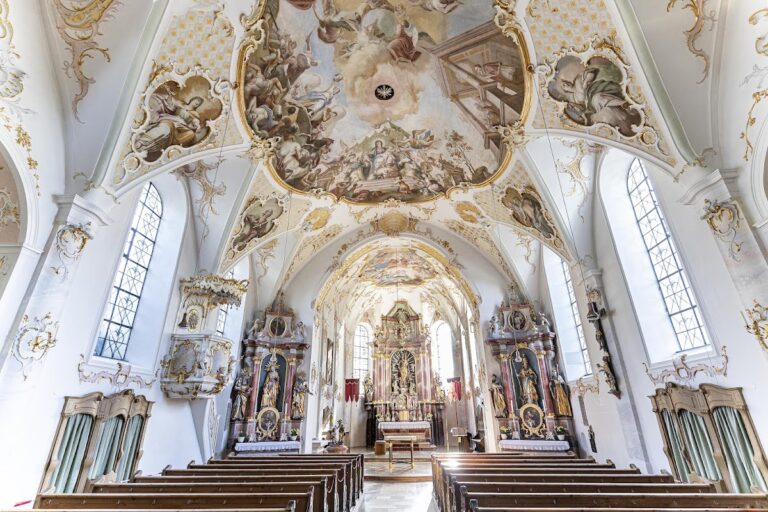
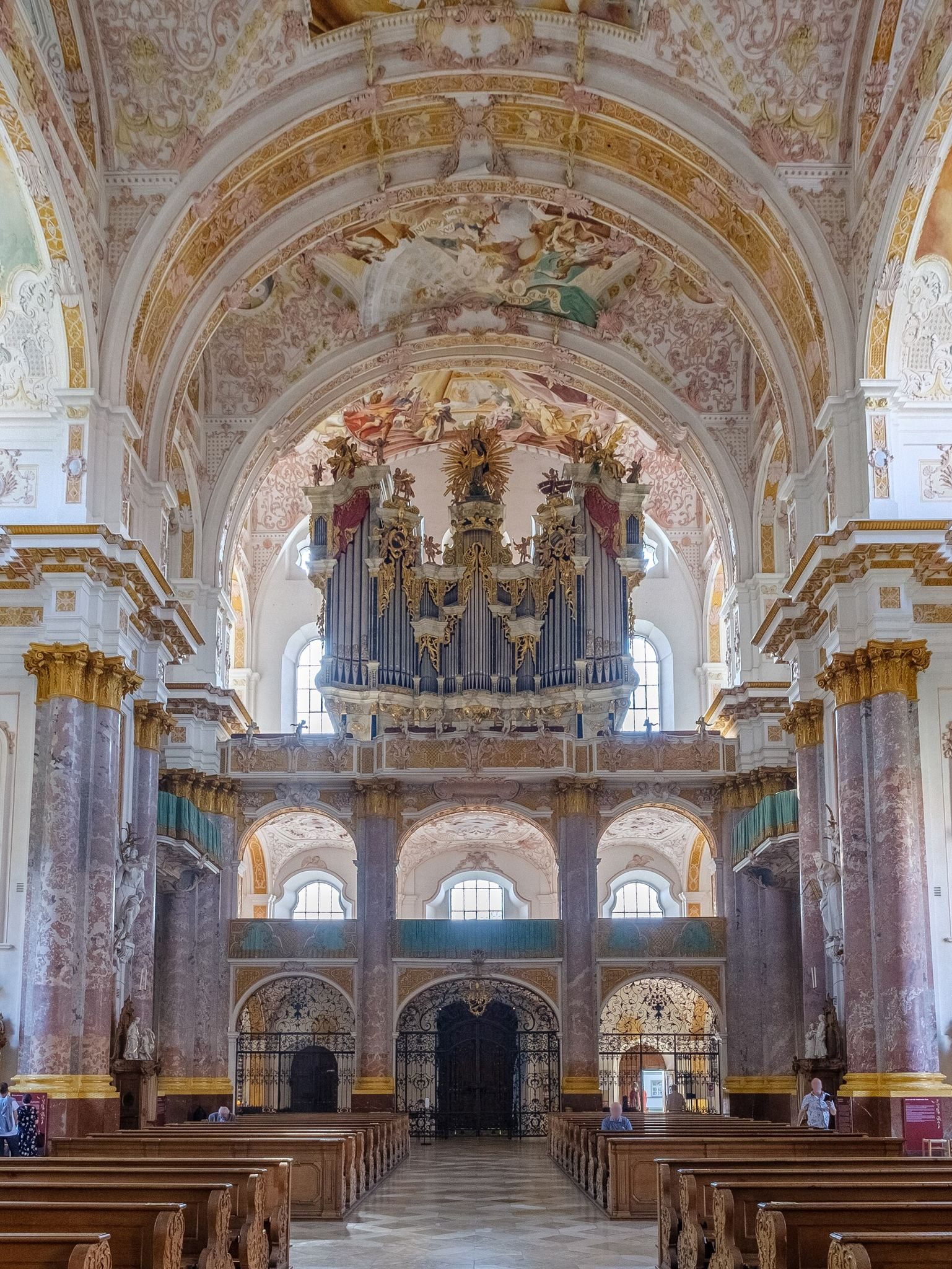
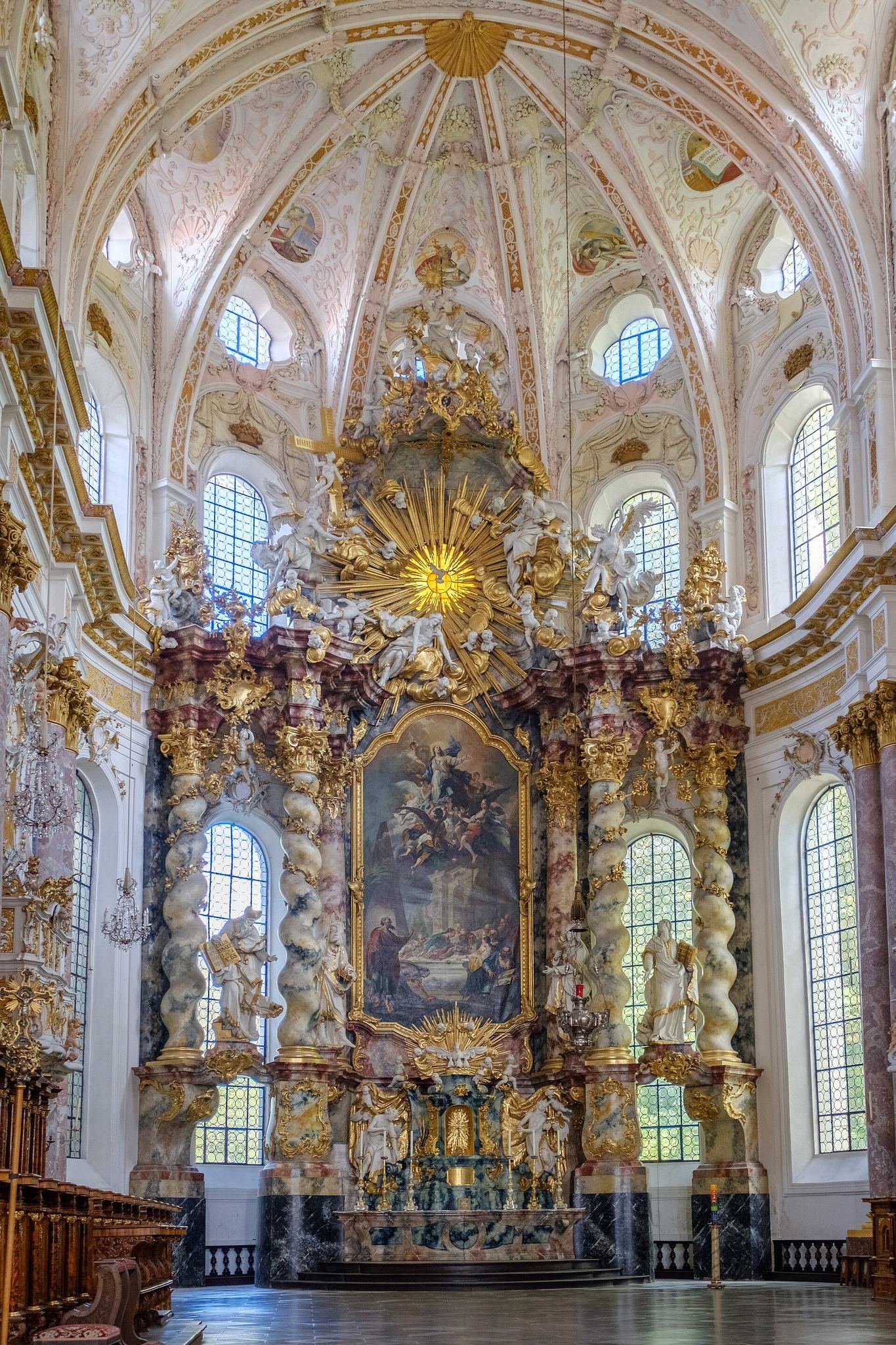
The Church of the Assumption of the Virgin Mary follows the southern German wall-pillar church type, in which wall projections support arches, vaults, or chapels rather than a free-standing colonnade. Its interior is notable for its height and width and for its unusually unified appearance despite the long period of construction and furnishing. Continuous gallery passages run above the main entablature, while additional suspended galleries occupy the attic zone at the level of the vaults. The continuous entablature reflects Italian models rather than the locally common arrangement that ends at the pillar capitals.
Cosmas Damian Asam painted the ceiling frescoes. Egid Quirin Asam created the middle side altars and probably designed the high altar, while Jacopo and Francesco Appiani also contributed to the interior furnishings. The church contains remains said to be those of Saint Hyacinth of Caesarea and Saint Clemens. Elaborate Baroque monuments commemorate Louis II and Louis IV.
Convent buildings
The convent building, sometimes called the Bavarian Escorial, contains a sequence of rooms decorated with frescoes by Hans Georg Asam and stucco by Pietro Francesco Appiani. The Elector’s Hall in the west wing occupies two storeys and measures almost 9 metres in height, 12 metres in width, and 27.5 metres in length. Hans Georg Asam painted its frescoes, while Giovanni Nicolò Perti created the stucco decoration around 1696.
In 1860, the Elector’s Hall lost its ceiling frescoes and ceiling stucco, and an intermediate floor disrupted the original spatial composition. Between 2007 and 2010, the hall was restored in reconstructed form, but without its ceiling. The former chapter house was converted into a Protestant prayer hall in 1828, and part of the tract south of the church was destroyed by the 1866 fire.
Economic buildings and cemetery
The former economic buildings were remodelled between 1987 and 2001 after their acquisition by Fürstenfeldbruck. Their conversion created museum, cultural-centre, and event spaces while retaining their connection with the historic monastery complex. The associated war graves cemetery contains the graves of 274 victims of war and oppressive rule, including prisoners of war and people displaced after the Second World War.