Church of Santa Maria Nascente: A Renaissance Parish Church in Gandellino, Italy
Site at a Glance
- Rating
- 4.6
- Popularity
- Very Low
- Country
- Italy
- Primary era
- Medieval
- Eras represented
- Medieval, Early Modern, Modern
- Civilizations
- Duchy of Milan, Italian, Venetian
- Site type
- Religious
- Remains
- Church
On this page9 sections
History
Church of Santa Maria Nascente in Italy is the oldest Catholic place of worship in Gromo San Marino, a hamlet of Gandellino in the upper Seriana Valley. Generally dated to the fourteenth century, the church has Renaissance architectural characteristics and is dedicated to the Nativity of the Blessed Virgin Mary. It belongs to the Diocese of Bergamo, a Catholic jurisdiction governed by a bishop.
Medieval origins
A church dedicated to Mary appears in the Nota ecclesiarum, an ecclesiastical tax register compiled in 1360 under the authority of Bernabò Visconti, the fourteenth-century ruler of Milan whose power extended over Bergamo. Further records mention the building in 1410. Its elevated position and early history have encouraged the possibility of an earlier foundation, perhaps in the twelfth century, when it may have served as an oratory for a small community of religious women. That community established a modest convent, which was later suppressed.
The church’s medieval administration is also recorded in documents from the fifteenth century. In 1410, Giovanni Buccelleni of Gromo became parish priest, although he later relinquished the position after being appointed rector of Sant’Andrea in Strozza, in Valle Imagna. A document from 1435 names Buccelleni, Stefano Robardi of Gromo, and Ziliono Negroni of Valgoglio as procurators, rectors, and administrators of the church’s monastery.
Parish status and dedication
Santa Maria Nascente separated from the parish of Gromo on 1 November 1445. Bishop Giovanni Barozzi consecrated the church and raised it to parish status, appointing Ernesto of Spira, a German priest, as its parish priest. Later holders of the office included Finamando Aquilina of Golio, a priest named Zuchini from Gromo, and Nicola Fornoni of Ardesio, who was appointed in 1535.
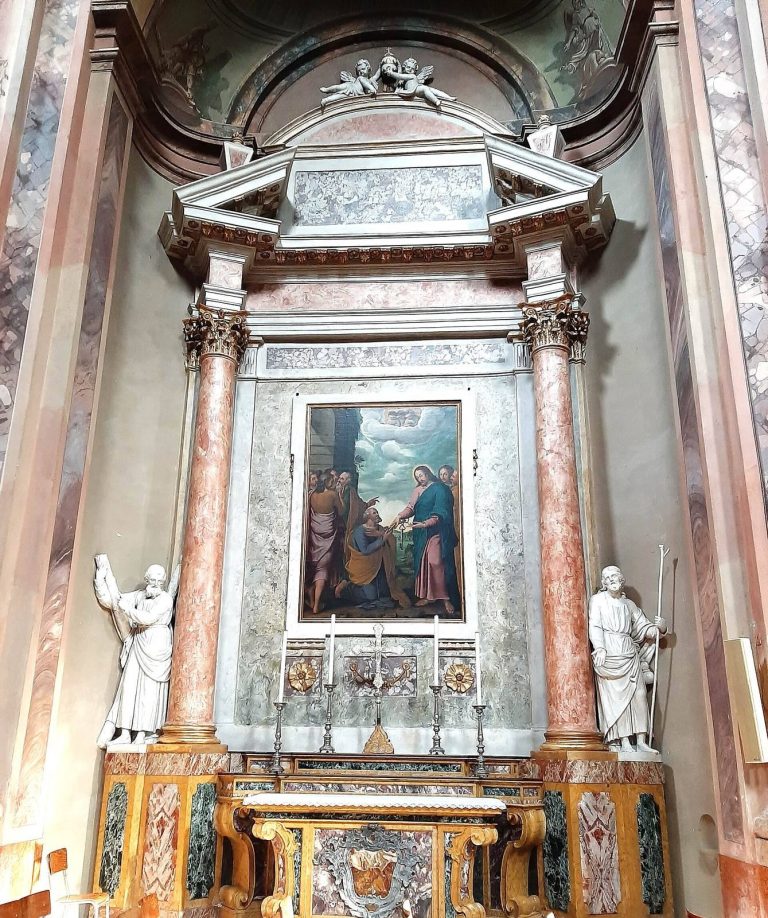
A decree issued on 10 September 1869 formally dedicated the church to the Nativity of the Virgin Mary and established 14 September as the date of its annual celebration. The church’s continuing religious importance is reflected in later consecrations. Bishop Adriano Bernareggi consecrated the altars dedicated to the Blessed Virgin and the Sacred Heart of Jesus, a Catholic image expressing Christ’s love and sacrifice, on 22 November 1942. On 8 September 1944, he consecrated the high altar. Inscriptions on the base behind the altar preserve the memory of these ceremonies.
Restoration and later memory
The building underwent several phases of repair and decoration. Its roof covering was replaced in 1870, when parish priest Martino Mazzoleni also directed restoration work and donated five bells. Further work and decoration followed under the parish priest in 1900. Exterior repairs were completed in 1978, and in 1987 Vincenzo Villa cleaned the interior paintings, frescoes, and stucco decoration, recovering original gilding and some of the earlier fresco colours.
The church is also connected with the memory of Alessandro Dordi, a missionary from the hamlet who was murdered in Peru by members of the Shining Path, a Maoist insurgent organization active there. A decree signed on 3 February 2015 declared him a martyr, and he was beatified on 5 December 2015. The church remains the subject of ecclesiastical cultural-heritage documentation by the Italian Catholic cultural-heritage office.
Remains
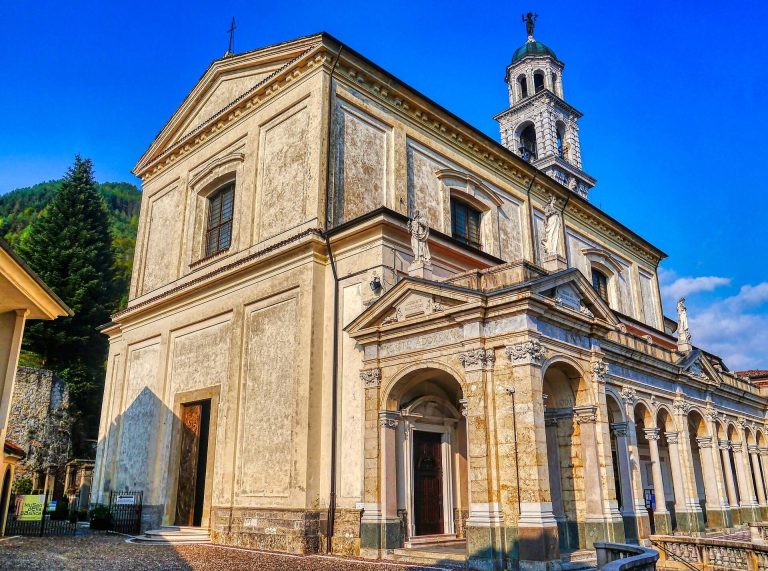
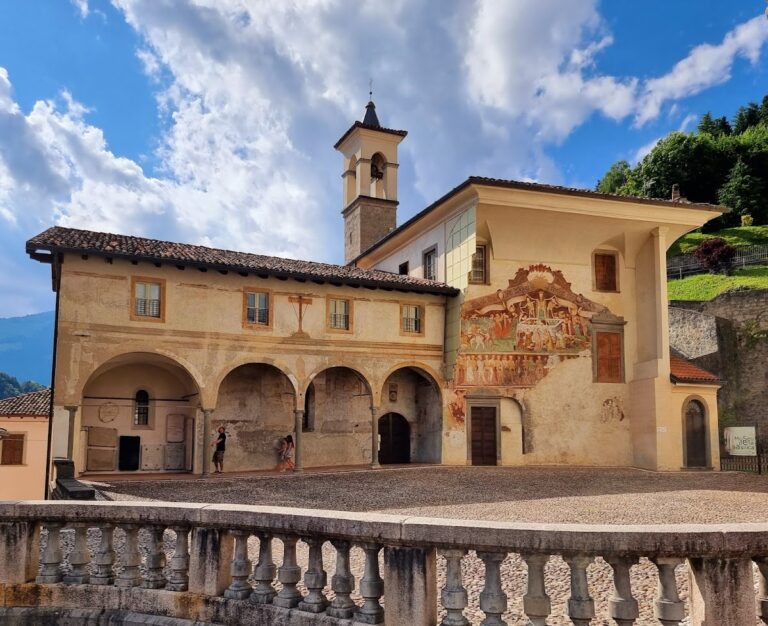
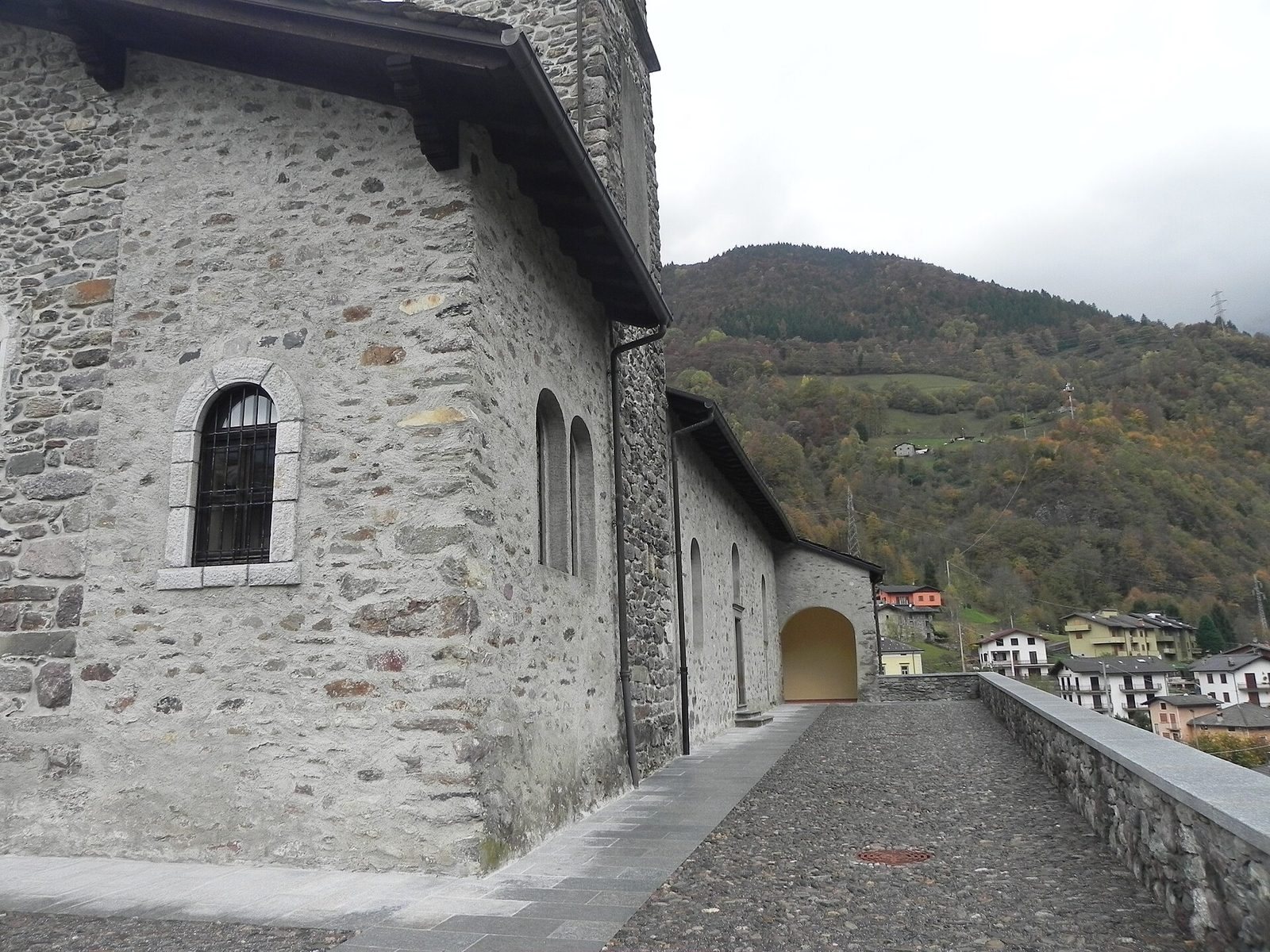
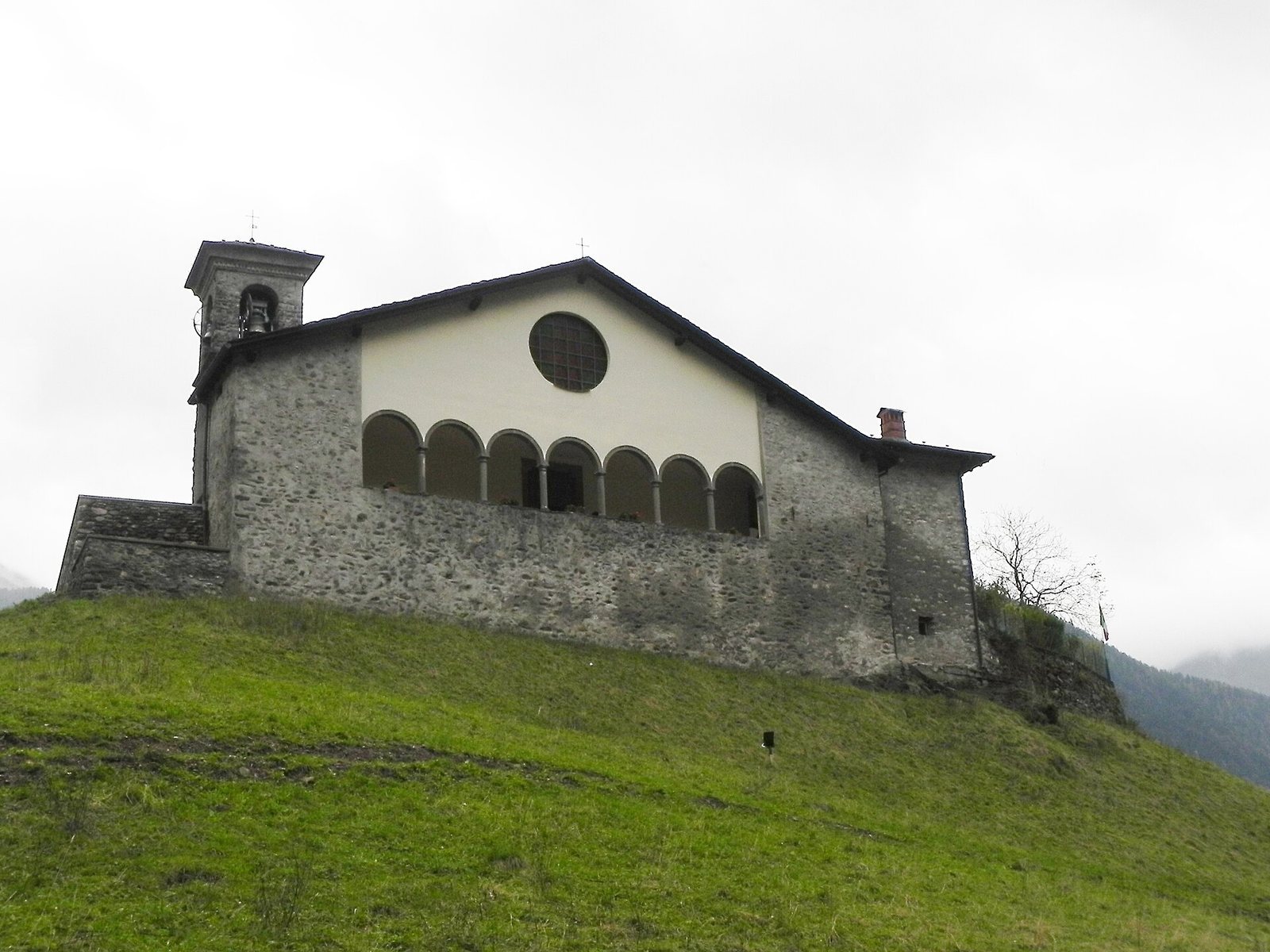
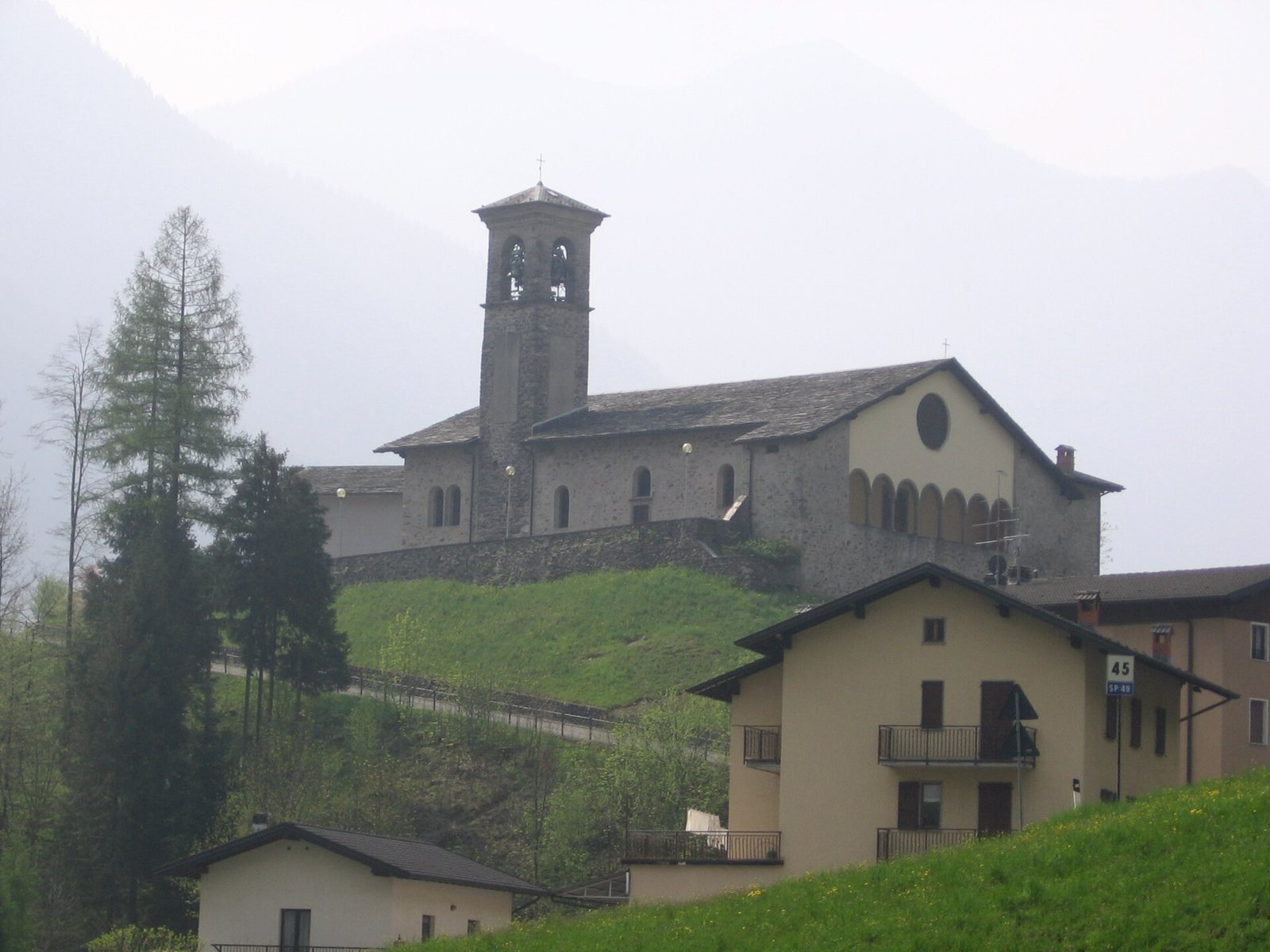
Santa Maria Nascente stands on a raised hill above the valley. Its east-facing position follows the orientation traditionally associated with early Christian churches. A broad cobbled churchyard approaches a portico extending along the north and west sides, while the building itself is arranged around a central nave higher than two lateral naves. Medieval, Renaissance, Baroque, and twentieth-century elements survive together in the structure and its decoration.
Portico and church layout
The portico is formed by seven round-headed arches built of sandstone and carried on Tuscan-style columns. Historically, this covered space served as a place for exchanging pastoral products, linking the church’s architectural setting with the economic life of the surrounding community. Beyond it, the three-nave interior creates a vertically stepped arrangement, with the central space rising above the two side aisles.
Medieval and later paintings
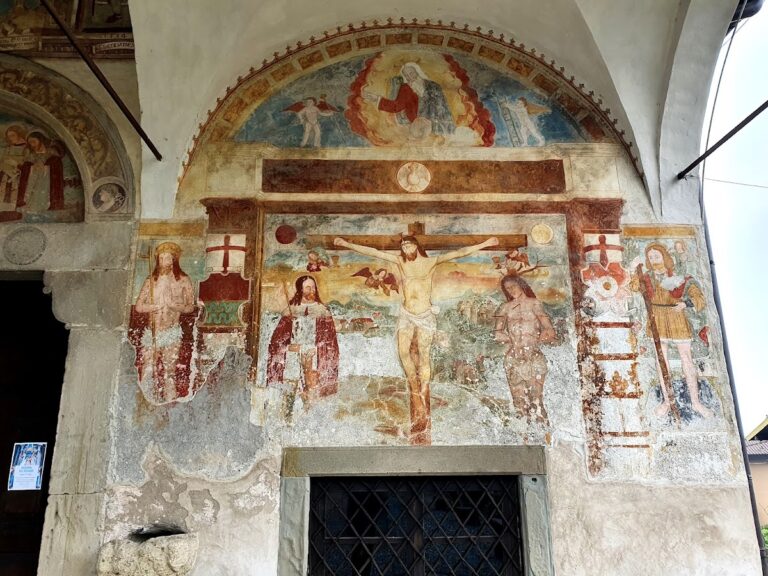
Frescoes associated with the earliest church remain inside the later enlarged building. Some are tentatively attributed to Giacomo Borlone de Buschis, known as Borlone, an Italian painter associated with religious murals in the Bergamo area. Other fifteenth-century frescoes, by unidentified artists, present the Apostles’ Creed, an early Christian statement of faith.
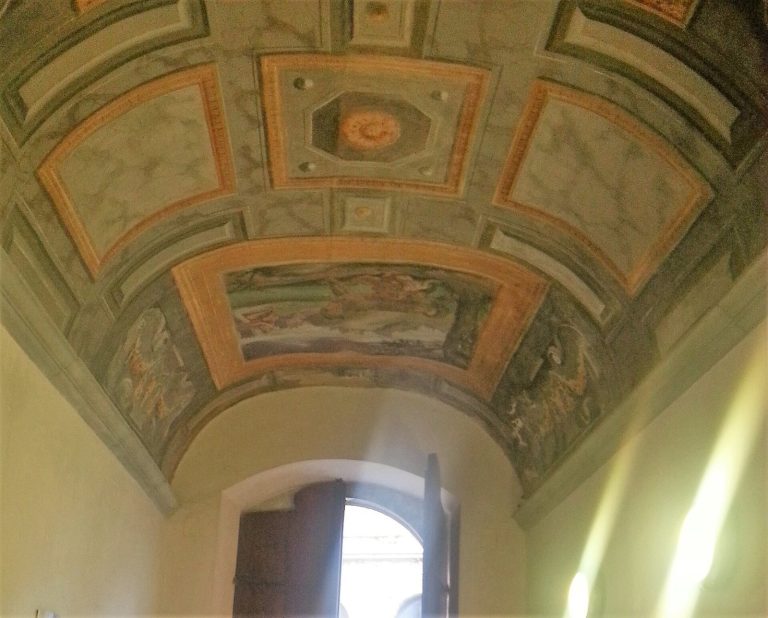
The central nave and presbytery carry Baroque stucco medallions and frames showing episodes from the life of Mary. Several of these works date to the eighteenth century and were made by anonymous artists. The interior also contains twentieth-century frescoes by Alfredo Tosti from 1912, Camillo Galizzi from 1940, and Mino Marra from 1988. The 1987 cleaning campaign restored portions of the original gilding and selected fresco colours.
Presbytery and altarpiece
A wooden altarpiece in the presbytery contains a sculpture of the Risen Christ, probably made around 1495 by the workshop of the Lombard sculptor Pietro Bussolo or by an artist associated with it. The attribution to Bussolo himself remains uncertain. The altarpiece originally included a wooden lower section depicting the tomb and soldiers startled by the extraordinary event. Those elements were later sold or otherwise removed from the altarpiece.
Adjacent cemetery
A small cemetery beside the church forms a separate physical feature of the complex. It contains the burial place of Alessandro Dordi, whose missionary work and death in Peru later became part of the religious memory associated with Gromo San Marino.