Basilica of Mary of the Assumption and St. John the Baptist in Clusone
Site at a Glance
- Rating
- 4.7
- Popularity
- Low
- Country
- Italy
- Primary era
- Early Modern
- Eras represented
- Medieval, Early Modern, Modern
- Civilizations
- Italian, Venetian
- Site type
- Religious
- Remains
- Basilica
On this page21 sections
History
The Basilica of Mary of the Assumption and St. John the Baptist is a Baroque church in Clusone, Italy, built between 1688 and 1698 and consecrated in 1711. It has served as the town’s parish church and principal Catholic place of worship since 6 July 1711, under the Diocese of Bergamo. Its dedication combines the Assumption of Mary with Saint John the Baptist, and its present building replaced an older church that had become too deteriorated to renovate.
Early church and medieval pieve
Local tradition places the church over the remains of a Roman temple dedicated to Diana. Bernardino Baldi connected this tradition with an inscription that may have referred to Diana of Clusone, but the inscription has never been found. A different inscription was recorded during a pastoral visitation in 1575. It commemorated the married couple Marco Reburro and Pittiena Massima and was later transferred to the Archaeological Museum of Bergamo.
By the eighth century, Clusone had become the ecclesiastical center of the upper Seriana Valley. The earliest documentary reference to its church appears in a will dated between 828 and 837, which mentions Santa Maria in Clisione. A property exchange of 909 calls it the church of Santa Maria of Clusone. In 1260 it was listed as the caput plebis, meaning the head church of a pieve, an ecclesiastical district whose principal church exercised pastoral and often baptismal authority over neighboring communities.
The church was included among the Bergamo-area churches subject to a levy imposed by the Church of Rome. It was mentioned again at the diocesan synod of 1304, when a deacon from Santa Maria attended. An ecclesiastical register of 1360 lists six canons and eleven dependent churches, although later records generally name four canons. The original ninth-century building was rebuilt in the thirteenth century, but its early appearance is not known.
Medieval conflict and early modern reform
The church and its clergy became involved in the political conflicts of medieval Bergamo, including the struggles between the Guelphs and Ghibellines, factions broadly associated with papal and imperial interests. On 28 May 1297, the Ghibelline archpriest Bonacore de Bunizonibus led an armed group in an attack on the bishop of Bergamo’s residence at Ardesio. The group destroyed the residence’s small church and high altar. In 1304, Bishop Giovanni da Scanzo issued measures against aggressive and scandalous behavior among the clergy.
A 1575 visitation by Saint Charles Borromeo described the church as a spacious, decorated single-nave building. Its worn wooden ceiling rested on three pointed arches, and thirteen side altars stood in addition to the high altar. The church also contained a wooden statue of the Assumption. A cemetery with communal and private burials occupied the area in front of the building. The Confraternity of the Blessed Sacrament, later the church’s largest and most important confraternity, established its statutes on 19 April 1495.
The sixteenth-century reforms associated with the Council of Trent, the Catholic Church’s major reform council, brought changes to parish administration, clerical discipline, and religious practice. A pastoral visitation ordered by Pope Gregory XIII addressed similar concerns in the Diocese of Bergamo, including absentee clergy and the spread of Lutheran ideas. These reforms shaped the church’s administration during the period before its replacement.
Campanile and construction of the present church
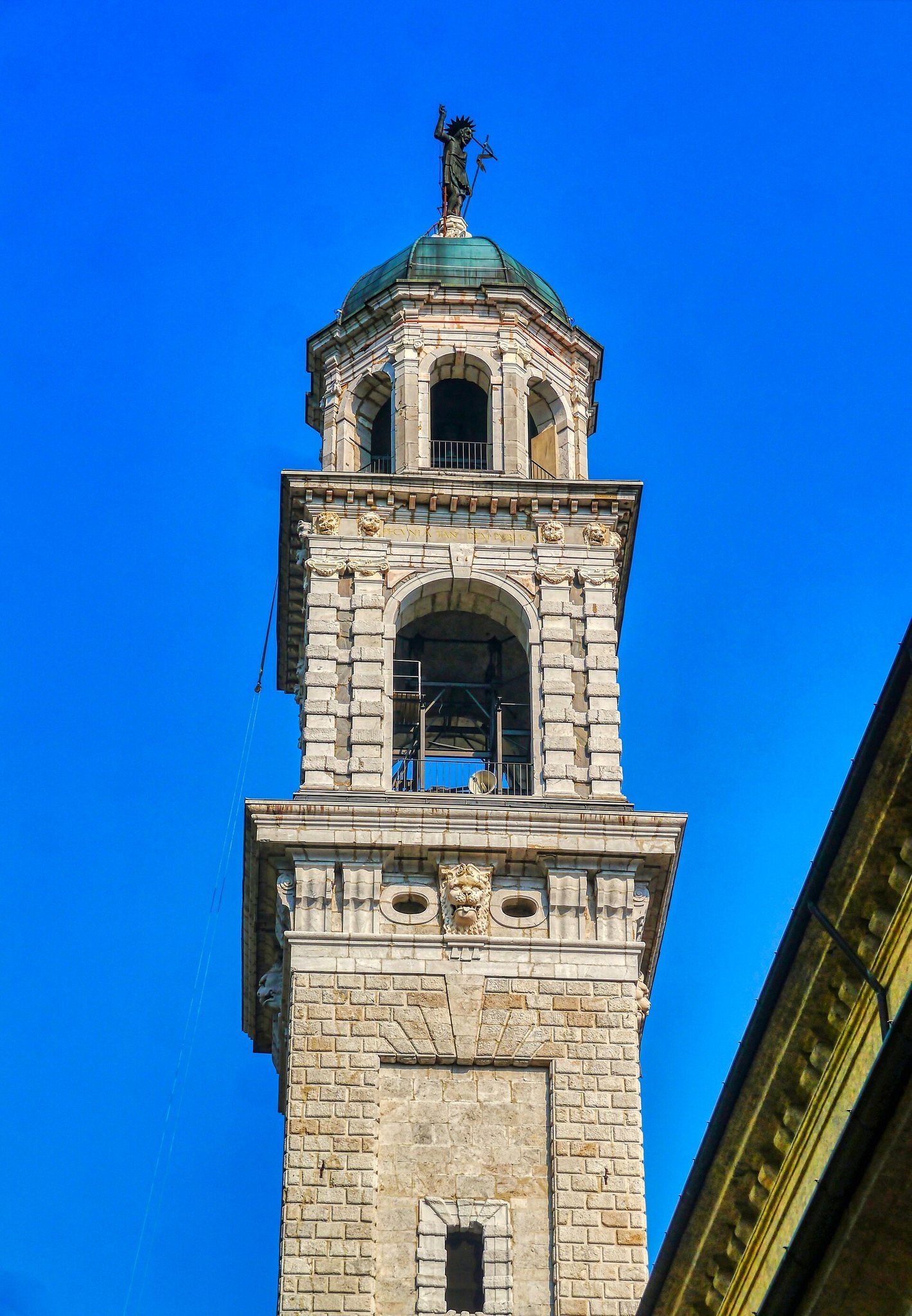
Construction of the campanile began in 1613 and reached the bell chamber in 1621. A crowning statue of Saint John the Baptist was installed in 1624. By the middle of the seventeenth century, the old pieve church had deteriorated beyond practical renovation. Archpriest Alessandro Ghirardelli therefore initiated plans for a new church in 1659 and left a bequest for its construction. After his death on 30 September 1686, the decision to proceed was confirmed.
The present church was built from 1688 to 1698 to a design by Giovanni Battista Quadrio, an architect associated with building works at Milan Cathedral. On the orders of Archpriest Ventura Carrara of Bergamo, the project was modified in 1688 by Gian Maria Terzini and Francesco Cifrondi. Cardinal Pietro Priuli, Bishop of Bergamo, consecrated the completed church on 6 July 1711.
The church was granted the status of a minor basilica by Pope John XXIII on 28 July 1961. This is a papal designation distinct from the architectural use of the word basilica. Later interventions included a new black-marble floor in 1887, a portico begun in 1894, and the replacement of the wooden entrance portal with a bronze portal on 30 July 2010. The stone statue of Saint John the Baptist on the campanile was replaced in 1979, while a damaged statue of the Assumption on the portico was replaced in 1991.
Remains
Building and exterior
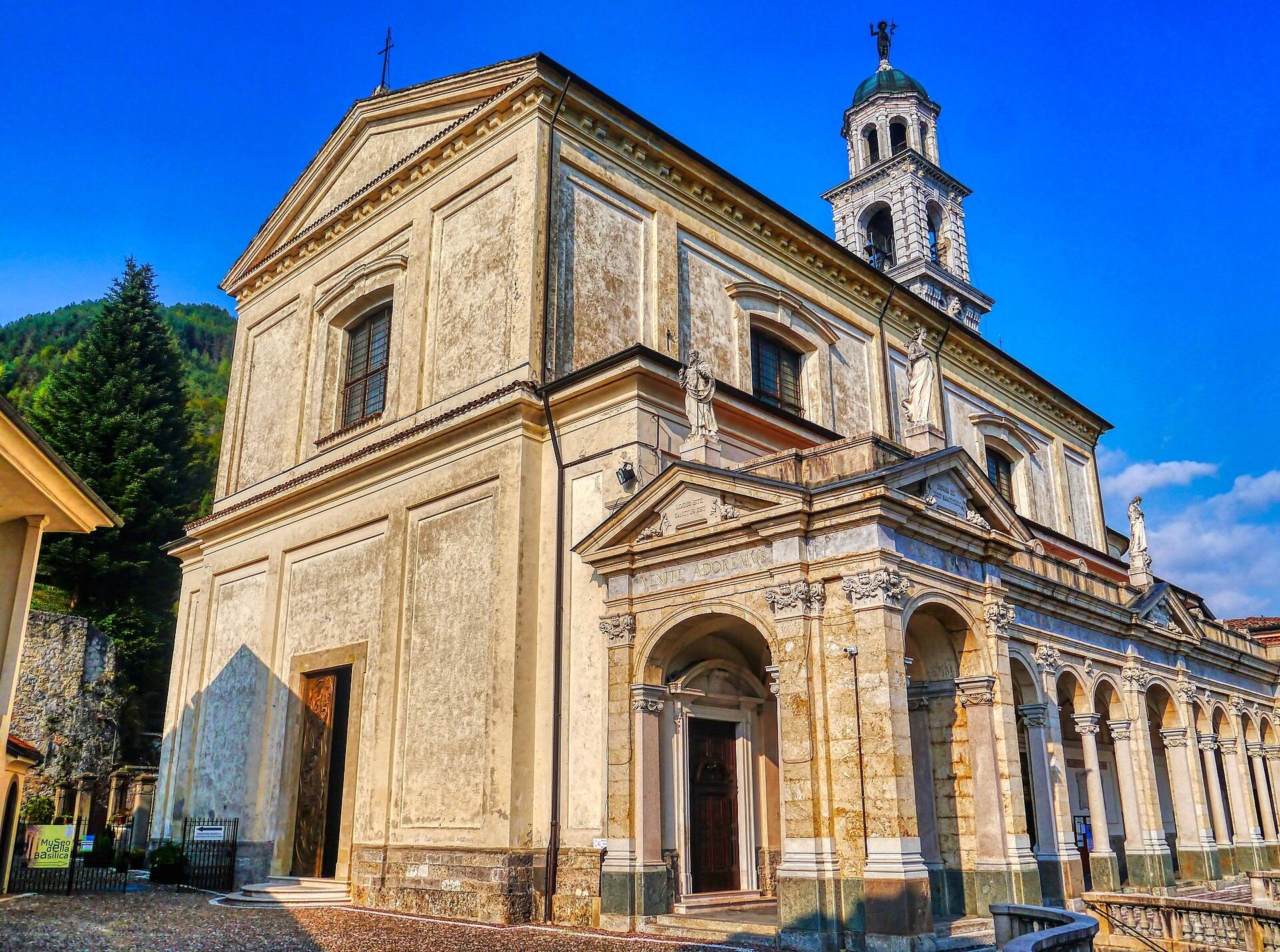
The church is a single-nave Baroque building approximately 50 metres long, 18 metres wide, and 20 metres high. Its slightly projecting facade has restrained ornament, a rectangular upper window, and the main entrance at ground level. Beside the apse rises the campanile, which is 66.5 metres high and reaches about 70 metres with the statue of Saint John the Baptist. It contains twelve bells, or thirteen when the Fanzaga bell in the lantern is included, tuned to low B-flat 2.
Portico and forecourt
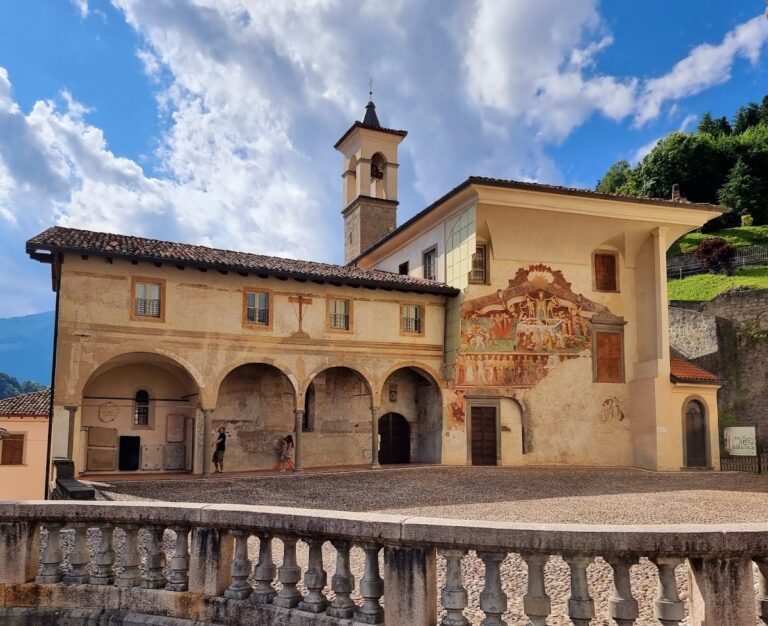
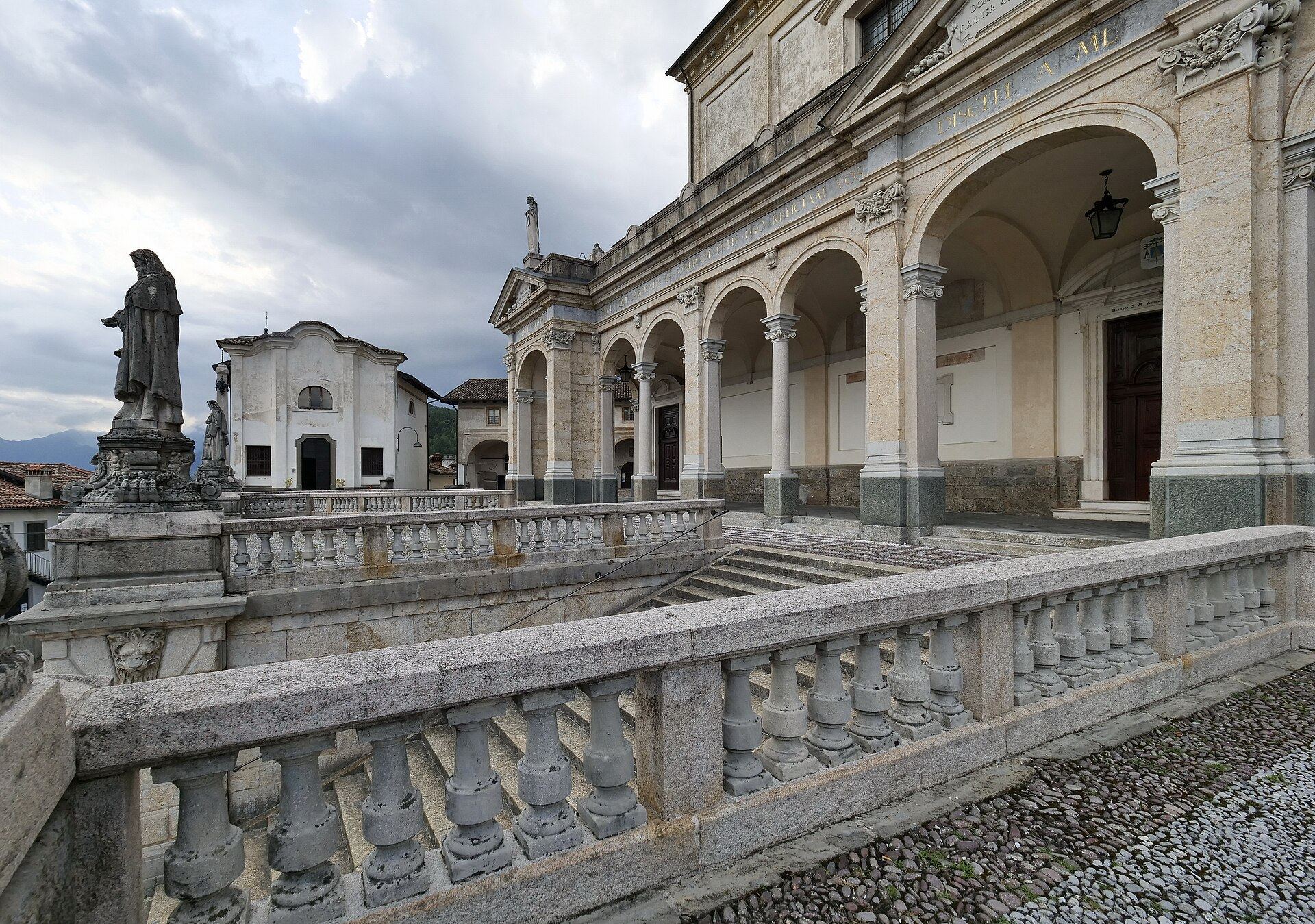
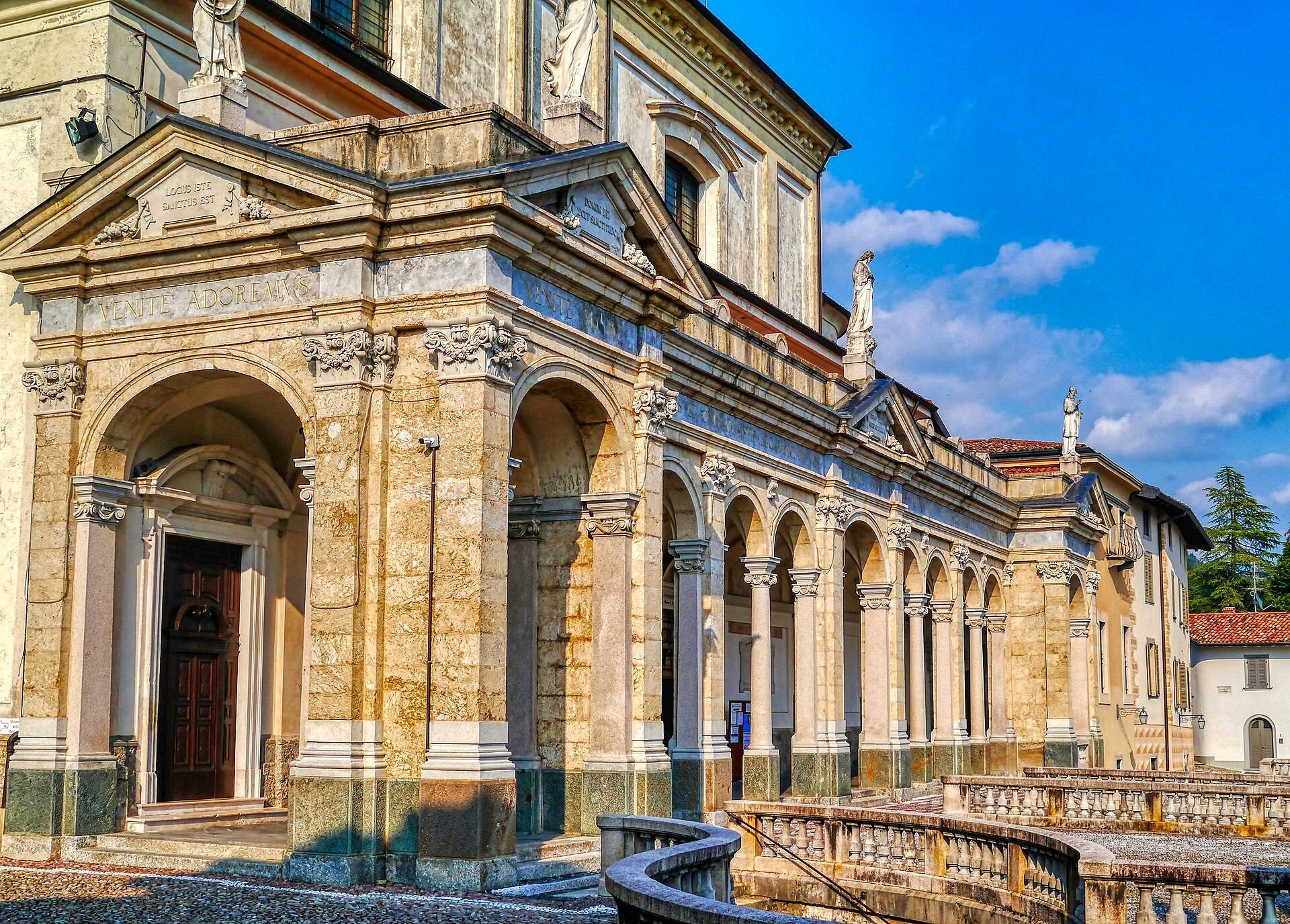
Along the right side of the church is a portico preceded by a raised forecourt enclosed by a balustrade. Four tall marble statues of the Evangelists decorate the forecourt. Angelo Magnoni carved them from wooden models by Giuseppe Rovida and Giacomo Sozzi. Three stairways connect the raised area with lower Via Pier Antonio Brasi, including two frontal flights and one lateral flight. The left stairway has a curved plan.
The portico has a cross vault, five central bays, and two projecting end sections. Round arches in the end sections and central bay rest on Ionic half-pilasters and are flanked by composite pilasters. The other four bays open outward through bifora, or two-light windows divided by a central column. Three portals stand beneath the portico.
Bronze entrance portal
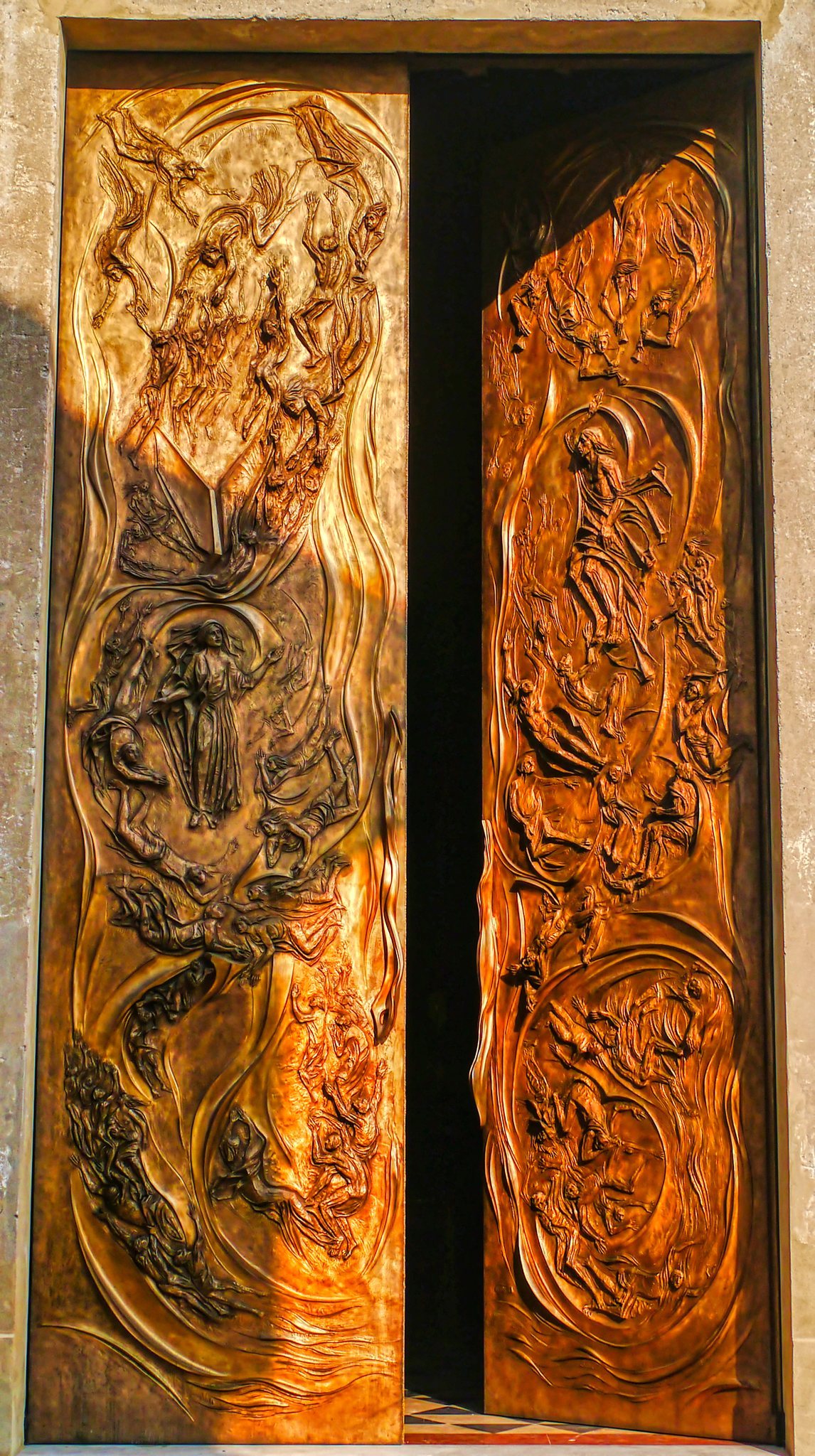
Installed on 30 July 2010, the bronze portal was made in a single casting by Mario Toffetti. Its reliefs present episodes from the life of Saint John the Baptist, including his preaching, the prophecy of the coming Lamb of God, Mary’s visit to Elizabeth, John’s vocation, the baptism of Jesus, his arrest, and his beheading.
Nave, vaults, and principal furnishings
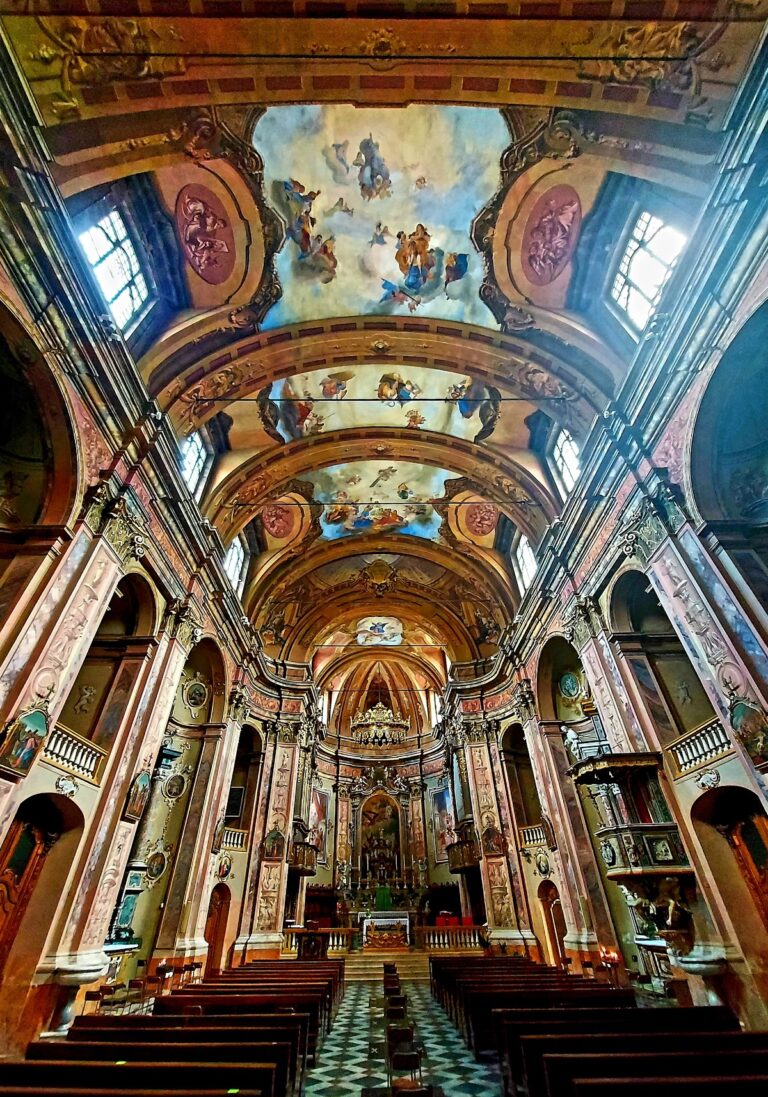
The nave opens onto eight side chapels through lowered arches resting on Corinthian columns, each 8.30 metres high. It ends in a deep semicircular apse. A cross vault covers the nave, while the apse has a barrel vault with lunettes. Bernardo Brignoli painted the vault frescoes. Antonio Cifrondi created the medallions of the Last Judgment, the Coronation of the Virgin, angels making music, and Christ in Gethsemane, as well as the counterfacade paintings of the Baptism of Jesus and the Preaching of Saint John the Baptist.
High altar and choir
The high altar was produced between 1702 and 1732. Andrea Fantoni designed it, the Corbarelli family of Brescia made its marble architectural framework and inlay, and the Fantoni workshop of Rovetta produced the tribune and statues. Fantoni personally carved the two lateral angels and the altar frontal showing the Transport of the Ark of the Covenant, where he included a self-portrait among the figures. Other sculptures represent Faith, Generosity, and Fortitude, while Saint John the Baptist and Saint Sebastian stand on the lateral columns.
Behind the altar is Sebastiano Ricci’s Assumption of Mary, painted between 1711 and 1713. To its right are Domenico Carpinoni’s Birth of Saint John the Baptist and Martyrdom of Saint John the Baptist. The choir stalls, made from burr wood, were produced by Domenico Visinoni and completed in 1699 by the Fantoni workshop.
Baptismal font
At the rear of the left side of the nave stands the fifteenth-century baptismal font, the oldest part of the church. It came from the earlier pieve church. The octagonal basin rests on a chalice-shaped support carved with foliage and bears images of Saint Stephen, the Risen Christ, the Crucifixion, the Baptism of Jesus, Saint John, Saint Peter, Saint Alexander, and the Virgin Mary. An inscription records financial support from the Confraternity of the Immaculate Conception.
Pulpit-confessional and organ
A polychrome-marble pulpit-confessional from the Fantoni school stands midway along the left side of the nave. Its inlaid and gilded wooden canopy is supported by four sculpted human figures, or telamons. Andrea Fantoni made these figures two years before his death.
Fratelli Ruffatti built the organ in 1960 and restored it in 1994. Its divided sections stand in wooden cases on the two choir galleries. Each case has a three-bay facade with principal pipes. The independent console is positioned in the nave along the left wall and has three 61-note manuals, a concave-radial 32-note pedalboard, electronic transmission, and 65 registers.
Side chapels
Nativity chapel
The chapel dedicated to the Nativity of Jesus has an altar made by Grazioso Fantoni the Younger between 1754 and 1756. Gaspare Diziani painted its altarpiece, which is flanked by statues of Saint Stephen and Saint Anthony of Padua dated 1702 and 1732 and attributed to the Fantoni school. Antonio Cifrondi’s painting of Saint Valentine and a relic of the True Cross are also kept in the chapel.
Chapel for the dead
The chapel for the dead contains a 1720 altar by Domenico Corbarelli with statues by Andrea Fantoni. Domenico Carpinoni painted the altarpiece, which shows the Holy Trinity with the Virgin Mary, Saint Joseph, and Saint Gregory interceding for the dead. He also painted Saint Charles and Saint Ambrose praying before Our Lady of Loreto.
Guardian Angel chapel
Grazioso Fantoni the Younger made the altar of the Guardian Angel chapel in 1759, replacing an altar produced by the Fantoni workshop in 1711. The earlier altarpiece, painted by Pietro Ricchi in 1659, shows the Virgin appearing to Saint Ursula, two of her nuns, and an angel carrying the Christ Child. Relics of the basilica are kept behind the painting. Antonio Cifrondi’s Madonna and Saint Anthony of Padua hangs beside the altar.
Chapel of the Crucifix
Andrea Fantoni and his workshop made the altar of the Crucifix chapel in 1698. Its wooden group depicts Saint Cajetan and Saint Charles adoring the Crucifix, beneath an angel bearing episcopal insignia. Domenico Caretti painted the Sorrowful Virgin pierced by the seven swords of sorrow, while another painting represents Saints Philip Benizi and Giuliana Falconieri.
Saint Anthony of Padua chapel
The chapel of Saint Anthony of Padua was made by Carlo Carra’s workshop in 1667. Allegories of Prudence and Justice stand beside the arms of the Fogaccia family. The altar table rests on a sarcophagus supported by three small lions and two putti, and was intended to hold the relics of martyrs. Giambettino Cignaroli painted Saint Anthony with the Christ Child and the Virgin for the altarpiece.
Rosary chapel
The Rosary chapel has an altar by the Manni of Desenzano and statues from the Fantoni workshop. The sculptures represent Judith with the sword and head of Holofernes and Esther holding a royal scepter.
Saint Lawrence chapel
For the Gromelli family, Giovanni Antonio Carra’s workshop made the altar of the Saint Lawrence chapel in 1629. It is flanked by seventeenth-century wooden statues of Saint Roch and Saint Anthony Abbot, carved by Giovanni Battista Torcelli of Chiari.
Chapel of the Deposition
The chapel of the Deposition of Jesus was formerly used by the discipline, penitential lay confraternities associated with devotional and charitable activities. Its altar incorporates marble recovered from the demolished earlier altar. The frontal contains figures of Saint Christopher, Saint Roch, the Redeemer, Prayer, and Penance made between 1725 and 1730. Domenico Carpinoni painted the Deposition from the Cross for the altarpiece, flanked by statues of Saint George and Blessed Albert of Villa d’Ogna. An anonymous painting shows Mary Magdalene witnessing the resurrection of Lazarus.