Disciplini Oratory: A Medieval Confraternity Building in Clusone, Italy


Site at a Glance
- Rating
- 4.7
- Popularity
- Low
- Country
- Italy
- Primary era
- Medieval
- External website
- Open
- Eras represented
- Medieval, Early Modern
- Civilizations
- Venetian
- Site type
- Religious
- Remains
- Chapel
On this page8 sections
History
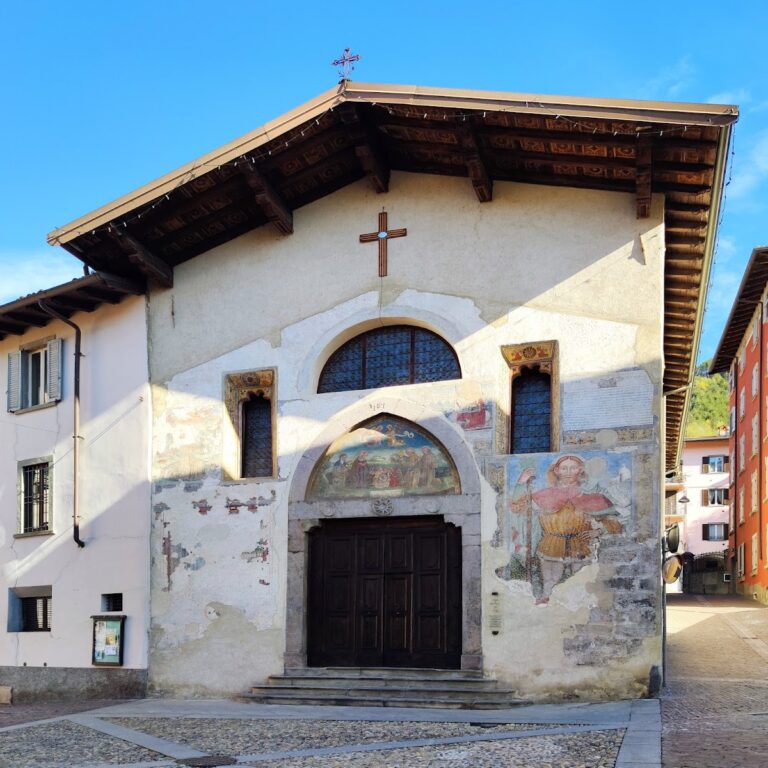
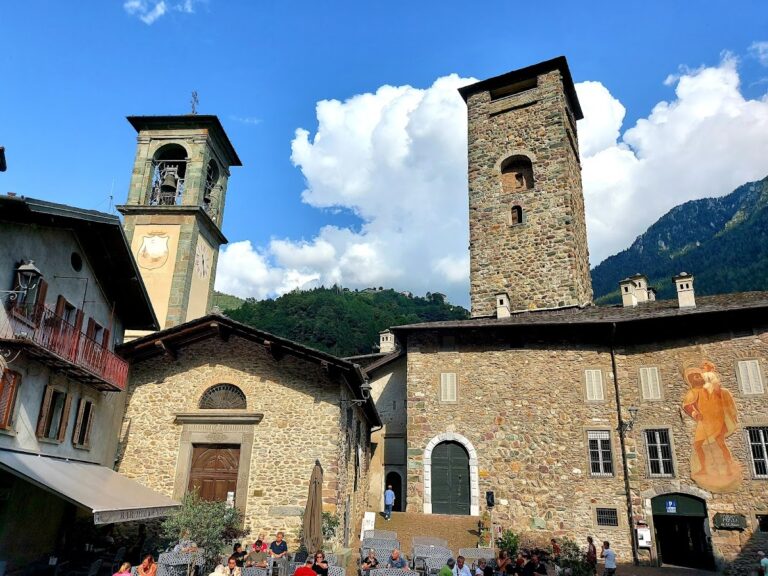
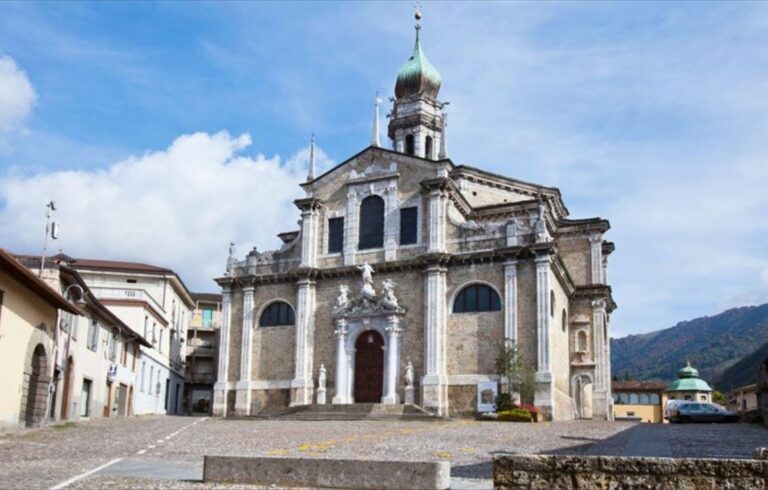
The Disciplini Oratory is a medieval Catholic building in Clusone, Italy, established in the fourteenth century as the seat and worship space of the Disciplini, a religious confraternity devoted to penitential and devotional practices. It stands opposite the Basilica of Santa Maria Assunta and is traditionally associated with the Diocese of Bergamo. The oratory became an important setting for the confraternity’s religious life and preserves frescoes from the fifteenth century.
Foundation and fifteenth-century expansion
The first oratory, dedicated to the Annunciation, was built in the mid-fourteenth century as a small structure. Its arched entrance is the surviving part of that original building. During the fifteenth century, the oratory was enlarged and rededicated to Saint Bernardino of Siena, a Franciscan preacher who promoted devotion to the name of Jesus and preached in Bergamo and the surrounding area. He became the patron saint of the Clusone Disciplini.
The painted decoration was created in at least two phases, dated approximately to 1470–1471 and 1484–1485. The works are attributed to Giacomo Borlone de Buschis, a painter from Clusone. The interior presents the Life of Jesus and the Crucifixion, while the exterior carries the Triumph of Death and the Dance of Death, themes that place human mortality at the center of the building’s religious imagery.
Seventeenth-century alterations
In 1673, the western part of the building was enlarged and a third oratory was added. An exterior doorway and a staircase were opened beside the frescoes, causing irreparable damage. A portico was also added during the seventeenth century, further harming the painted façade. The building’s completion is recorded as 1673, with Virginio Muzio listed as its architect.
Rediscovery and restoration
Gabriele Rosa made the first study of the frescoes in 1846. Although he did not identify their painter, he recognized their artistic value, especially in the upper section showing the Triumph of Death. A restoration attempt in 1868 removed the exterior staircase, and further campaigns followed in 1901 and 1903. Major work in 2001–2002 revealed a small decorated room with frescoes of the Madonna of Mercy sheltering the Disciplini beneath her mantle and a scourged Christ accompanied by two saints.
Late twentieth-century restoration and research also brought to light a group of wills connected with the confraternity’s activities. A fully legible document made by the notary Angelino di Cai on February 12, 1485, records Ser Gadaldo of Cavalino in Scalvioni giving land in return for the celebration of several masses of suffrage. The deed barred the confraternity from selling, donating, transferring, exchanging, mortgaging, or otherwise encumbering the land.
Remains
Exterior façade and portico
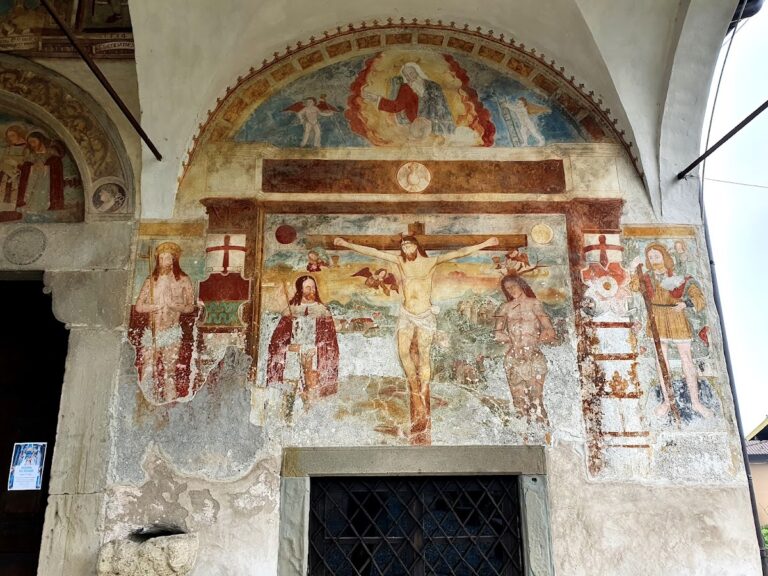
The oratory has a simple structure, with a façade organized into five painted sections arranged across three registers. The upper register contains the Triumph of Death and the Meeting of the Three Living and the Three Dead. The middle register shows the Dance of Death, a late-medieval theme bringing people of different social positions together before death. The lower register preserves fragments of a cycle of the Damned and the Just. These exterior paintings are attributed to Giacomo Borlone de Buschis. The main entrance bears Saint Bernardino’s trigram, the three-letter monogram IHS. Beneath the portico are several tombstones from the former cemetery around the Basilica of Santa Maria Assunta.
Interior fresco cycle
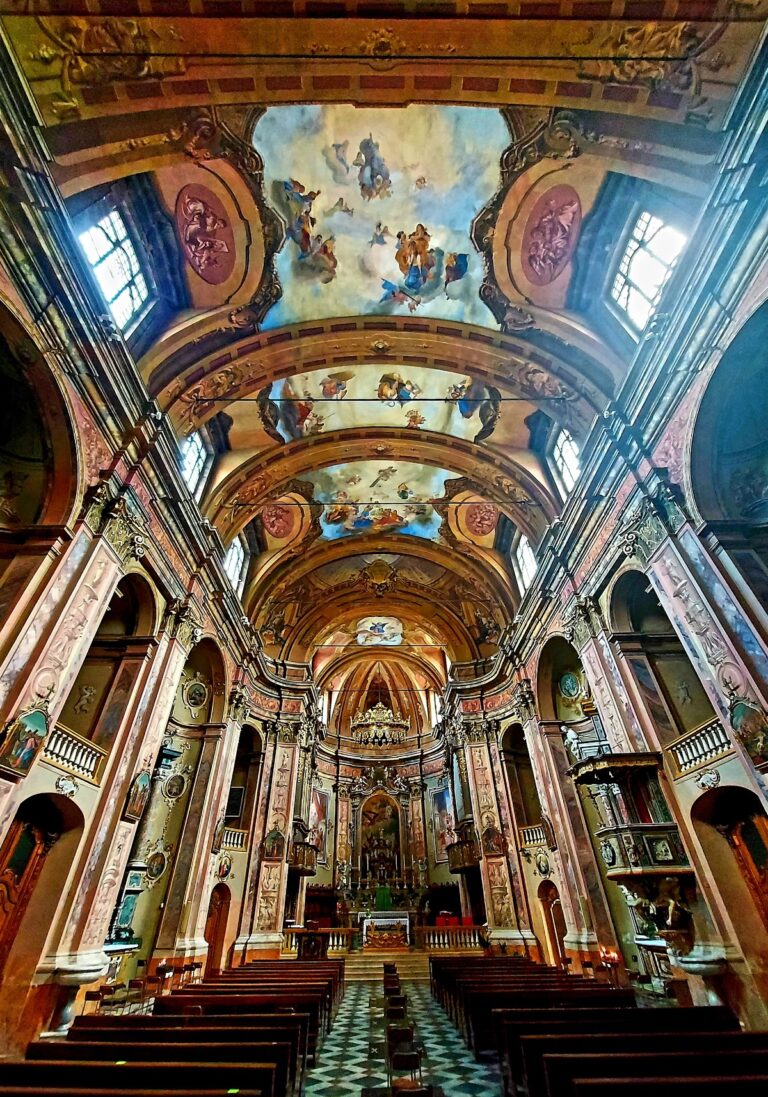
The interior frescoes narrate the Life of Jesus in framed scenes arranged in three superimposed bands. The sequence begins at the upper right and moves toward the rear and left side, following the liturgical order from Christmas to Easter. It proceeds from the Annunciation and Visitation through Christ’s childhood and public life to the Passion. The interior underwent fewer alterations than the exterior, although the number of altars changed over time and one window was closed.
Payments preserved in the State Archive of Milan link the Disciplini confraternity’s interior Life of Jesus cycle with a painter named Jachobo pentori de Borlonis. In 1965, Franco Mazzini connected these paintings with frescoes at Solto Collina signed “JACOBUS DE BUSCHIS DE CLIX[ON]E.” This evidence makes the attribution to Giacomo Borlone de Buschis highly probable.
Presbytery and sculpture
Above the pointed arch enclosing the presbytery, the part of the church reserved for the altar and clergy, is a Crucifixion fresco dated 1471. The signature “CHOB PINXIT” appears on the right. Floral decoration surrounds the scene, whose composition draws attention to Christ crucified between the two thieves. The Gospel figures associated with the event accompany the central group. The souls of the thieves appear as children emerging from their mouths: one is received by the devil, while the pardoned thief’s soul is taken by an angel. Soldiers carry a Roman standard marked SPQR, the traditional abbreviation for the Senate and People of Rome. On the left are the pious women, while soldiers on the right gamble with dice for Christ’s garments.
The Crucifixion contains details comparable to a late-fifteenth-century Crucifixion in Santa Maria Assunta at Esine, painted by Giovanni Pietro da Cemmo. The presbytery vault has eight hexagonal niches containing prophets, religious figures understood to convey divine messages. Each holds a scroll bearing a name and a recurring passage concerning death and salvation from death, creating a thematic connection with the exterior Dance of Death.
Two statues of Saint Bernardino stand beside the nave passages leading to the presbytery, although their attribution remains uncertain. A statue of Saint Sebastian, regarded as a particularly fine work by Francesco Belinzeri, is dated 1472 by the contract between the artist and the Disciplini.