Cong Abbey: A Medieval Augustinian Monastery in Ireland


Site at a Glance
- Rating
- 4.7
- Popularity
- Medium
- Country
- Ireland
- Primary era
- Medieval
- External website
- Open
- Eras represented
- Medieval, Early Modern
- Civilizations
- Irish
- Site type
- Religious
- Remains
- Monastery
On this page9 sections
History
Cong Abbey is a former medieval Irish Augustinian abbey in Cong, Ireland, whose surviving ruins largely belong to the thirteenth-century rebuilding and display early Gothic design. Its foundation is traditionally attributed to Saint Feichin, an early medieval Irish saint associated with churches and monasteries, who is said to have built a church here in the early seventh century. The site later became connected with the rulers of Connacht and with important ecclesiastical families.
Early church and episcopal status
A bishopric was established at Cong during the Synod of Rath Breasill in 1010. This church assembly addressed the organization of the Irish Church, including the arrangement of dioceses. Cong later declined after a building on the site was destroyed by fire in 1114, and it lost its episcopal status.
About two decades after the fire, Turlough Mor O’Connor, High King of Ireland and ruler of Connacht, refounded the abbey. A High King claimed overarching authority over Ireland’s regional kings, although the title did not always indicate direct centralized rule. Raiders from Munster destroyed the buildings in 1137, after which O’Connor rebuilt them. Cong became an Augustinian settlement in 1138. Augustinian canons followed the Rule of Saint Augustine and combined communal religious life with pastoral and institutional duties.
Royal patronage and medieval rebuilding
In 1198, Ruaidrí Ua Conchobair, known as Rory O’Connor and the last High King of Ireland, endowed Cong with new buildings. He spent the final 15 years of his life there and died at the abbey. He was reportedly buried at Cong for a short time before being exhumed and reburied at Clonmacnoise, an important early medieval monastic site in County Offaly.
Rory O’Connor’s family maintained a close connection with the abbey. His son Maurice the Canon, his daughter Nuala, and his sister Fionnuala were buried at Cong. Members of the de Bermingham family, an Anglo-Norman family with medieval estates and political influence in Ireland, were also buried there, as were the abbots Niahol and Gillebard O’Duffy and other prominent figures.
The O’Duffy family was associated with Cong from at least 1097 to 1501. Muireadhach Ua Dubhthaigh, Archbishop of Connacht, died at Cong in 1150 at the age of 75, and his name is inscribed on the Cross of Cong, a richly decorated medieval processional cross associated with the abbey.
Cathal, an illegitimate son of King Conchobair who came to power in 1205, is credited with rebuilding the abbey and dedicating its church to Our Lady of the Rosary, a title of the Virgin Mary linked with devotion to the Rosary. A further reconstruction took place in 1307, when the church was described as dedicated to Saint Mary. The surviving ruins mostly date from this broad period of thirteenth-century rebuilding.
Suppression and modern preservation
The abbey was suppressed sometime after 1542. It was then abandoned and gradually fell into ruin, although later abbots continued to live at the site and serve as parish priests. Father Patrick Prendergast, the nominal last abbot and parish priest of Cong from 1795 until his death in 1829, preserved the Cross of Cong. After his death, James MacCullagh acquired it for the Royal Irish Academy.
Benjamin Lee Guinness began the first restoration of the abbey in 1855, after purchasing nearby Ashford Castle in 1852. Members of the Foy family, whose sculptors and masons had been associated with Cong for generations, also made substantial contributions to the restoration. Cong Abbey is now a National Monument in the care of the Commissioners for Public Works.
Remains
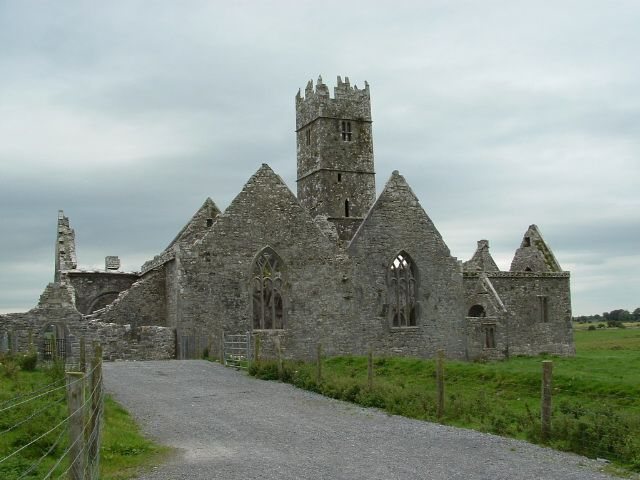
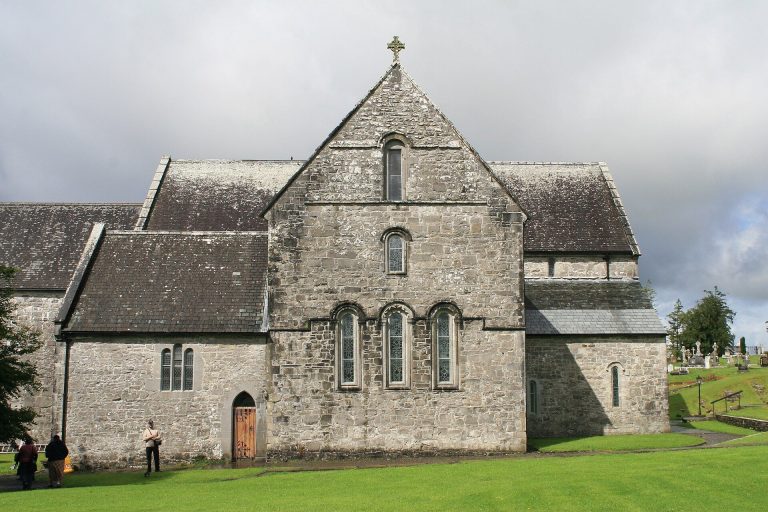
The principal visible remains form a medieval monastic complex of church, cloisters, and a monks’ fishing house. Most of the ruins belong to the thirteenth century and are regarded as among Ireland’s finest examples of medieval ecclesiastical architecture, early Gothic design, and masonry. The abbey’s sculpture is especially accomplished and suggests connections with contemporary French styles.
Monastic buildings
Church
The present church belongs to the rebuilding of the early thirteenth century. Its western facade retains Gothic doors, rounded-arch Romanesque windows, and other carved decorative elements. Romanesque architecture uses rounded arches and substantial masonry, while Gothic architecture is associated with pointed arches, more elaborate tracery, and a stronger vertical emphasis. The north doorway and the elaborate doorways leading from the monastery’s east range toward the cloister may predate the attack associated with William de Burgo, a Norman nobleman and military leader active in medieval Ireland.
Between the chancel, the part of the church around the altar, and the former sacristy is an arched niche that may have served as a sedilia, a recessed stone seat for clergy during parts of the liturgy. A projecting stone beside it was traditionally believed by local people to have healing powers.
Cloister and chapter house
The fragmentary cloister, a covered walkway around a courtyard, may also belong to the early thirteenth-century rebuilding. It was associated with the monks’ work, prayer, and communal life. A doorway flanked by two fine windows belongs to the chapter house, the room where the community conducted administrative business, heard a reading from its rule, and gathered for public confession.
Monks’ fishing house
The grounds include a monks’ fishing house probably built between the fifteenth and sixteenth centuries, more specifically between 1400 and 1550. It stands on a stone platform over a small arch on an island in the River Cong, which flows toward nearby Lough Corrib. A trapdoor in the floor may have been used to keep freshly caught fish. Local tradition holds that a line connected the building with the monastery kitchen, allowing the cook to be alerted when fish arrived.