St. Nicolai Church: An Evangelical-Lutheran Church in Beidenfleth, Germany
Site at a Glance
- Rating
- 4.4
- Popularity
- Very Low
- Country
- Germany
- Primary era
- Medieval
- External website
- Open
- Eras represented
- Medieval, Early Modern, Modern
- Civilizations
- Holy Roman Empire
- Site type
- Religious
- Remains
- Church
On this page8 sections
History
St. Nicolai Church is an evangelical-Lutheran church in Beidenfleth, Germany, whose foundations probably date from the twelfth century or, at the latest, the thirteenth century. Dutch people probably built the church as they drained and cultivated the surrounding marshland. Dedicated to Saint Nicholas, the Christian saint traditionally associated with sailors and maritime communities, it served a community shaped by the waterways of the Elbe marshes.
Medieval origins
The church is listed in the register of Hamburg Cathedral in 1325. Its dedication and early position within the marshland landscape connect it with the religious and settlement history of Beidenfleth during the Middle Ages.
Bell tower and later repairs
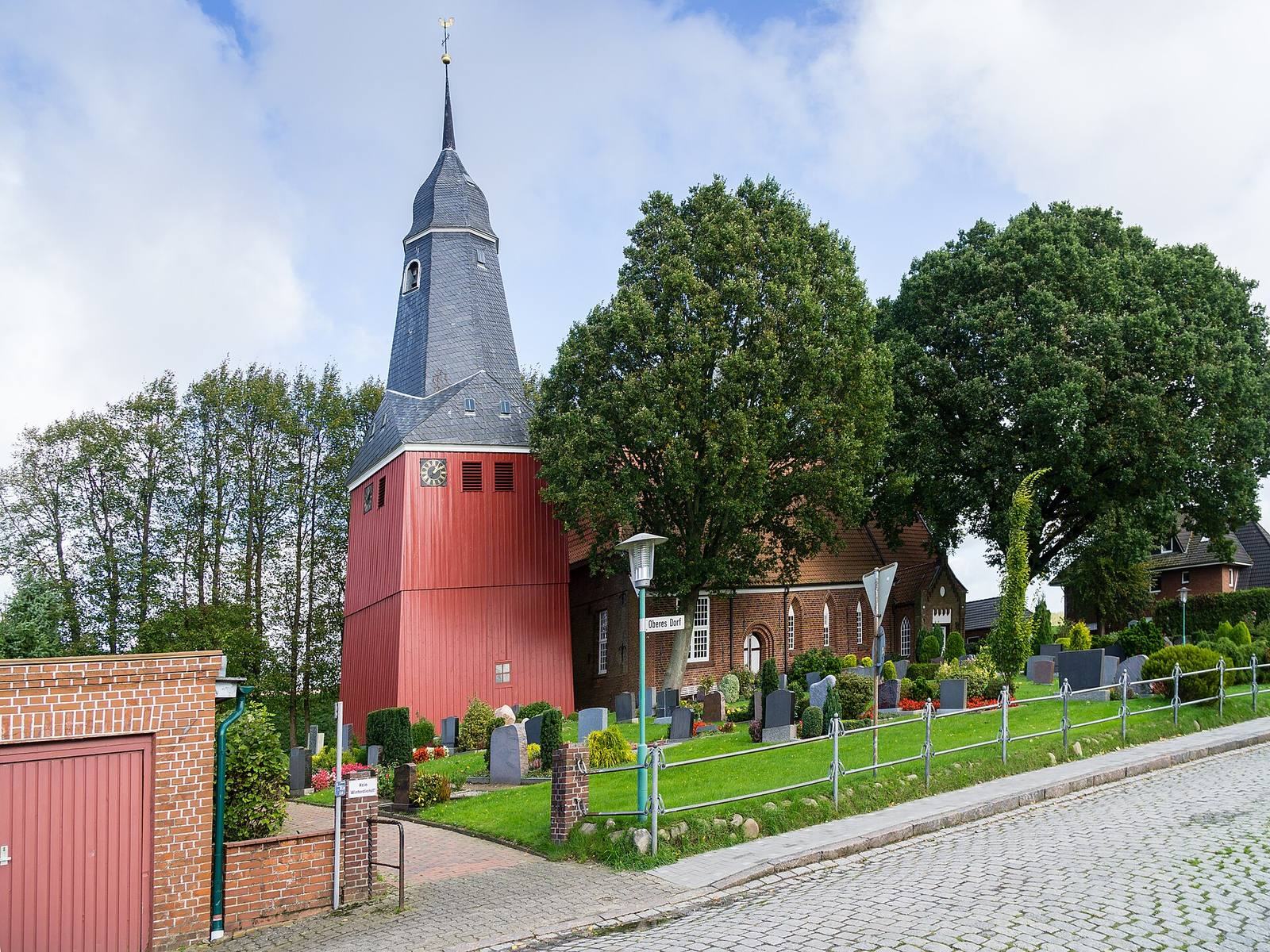
The freestanding wooden bell tower is traditionally attributed to Valentin Möller of Itzehoe and dated to 1557. A bell tower of this kind is a separate timber structure built to house church bells. The tower was renewed in 1860, received a new foundation in 1990, and underwent further restoration in 1989–1990 and 1998–1999.
Remains
Church building
St. Nicolai is a brick building with a long rectangular nave and a recessed, box-shaped choir. A Neo-Gothic porch from the nineteenth century is attached to the south side of the choir. The nave has a round-arched south portal and pointed-arched windows, while the choir has narrow pointed-arched windows grouped in threes on the east side. The exterior brick facing is later, and alterations to the windows have produced a mixture of pointed-arched and rectangular forms.
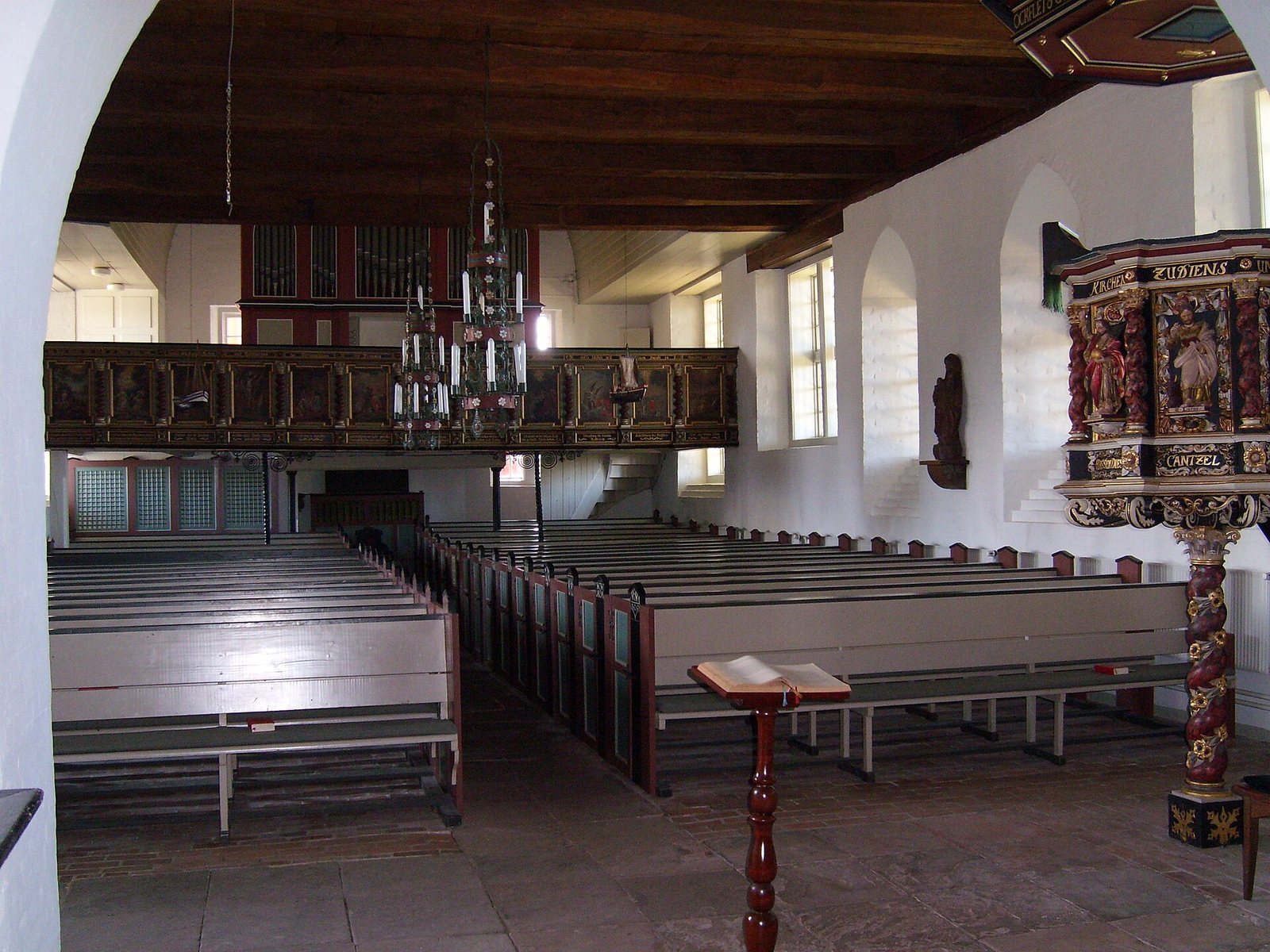
A broad arch links the nave and choir, opening the interior toward the altar. Most of the church is covered by a flat wooden-beam ceiling extending across both spaces. A wooden barrel vault covers the western area containing the organ and west gallery. The interior brick facing is also later than the original construction.
Bell tower and bells
The wooden bell tower stands west of the nave and is covered by a pointed hood, a form also found at the church in Glückstadt. Its two bronze bells date from the early modern period. B. Karkow cast the older bell in 1605. It is 77 centimetres high and carries a three-line inscription. The second bell was cast by Chr. Haupner in 1705, measures 110 centimetres in height, and bears a multi-line inscription with a continuous leaf frieze.
Gallery and organ
The west gallery dates from 1707 and rests on two slender, twisted wrought-iron supports that end in ornamental spirals. Its balustrade carries twelve oil paintings on wood showing scenes from biblical history.
Marcussen & Søn, a Danish organ-building firm, built the organ in 1878. It is a mechanical slider-chest instrument, using sliding strips to control air to individual stops, with ten stops on two manuals. The pedal is coupled to the great manual and has a compass from C to d1. The fourth great-manual stop replaced an earlier 8-foot trumpet stop, while both the key and stop actions remain mechanical.
Churchyard memorials
The churchyard preserves several eighteenth- and nineteenth-century funerary steles in forms characteristic of the Elbe marshes. These memorials extend the history of the churchyard beyond the medieval church itself and reflect local burial traditions.