Church of San Vittore: A Renaissance Monastic Church in Meda, Italy
Site at a Glance
- Rating
- 4.9
- Popularity
- Very Low
- Country
- Italy
- Primary era
- Early Modern
- Eras represented
- Early Modern, Modern
- Civilizations
- Duchy of Milan
- Site type
- Religious
- Remains
- Church
On this page13 sections
History
Church of San Vittore is a Catholic church in Meda, Italy, dedicated to Saint Victor the Moor and belonging to the Ambrosian rite, the Catholic liturgical tradition associated with the Archdiocese of Milan. It was built in the first decades of the sixteenth century as part of a Benedictine women’s monastery and is now incorporated into the Villa Antona Traversi complex.
The Benedictine monastery
The monastery was founded around 830 and became one of the region’s most important Benedictine women’s monasteries. Benedictine nuns lived according to the Rule of Saint Benedict, a Western Christian monastic tradition governing prayer and communal life. The institution also held feudal authority over the territories of Meda and Cabiate.
Its standing is reflected in the visit of Emperor Henry VI and his wife, Constance of Altavilla, in 1194, when the couple stayed at the monastery. Henry VI, a member of the Hohenstaufen dynasty, was Holy Roman Emperor from 1191 until 1197. Constance was a Norman Sicilian princess who later became queen of Sicily.
The sixteenth-century church
Construction of the present church began in 1520, a date preserved in an inscription written with both Arabic and Roman numerals on two exterior pilasters. The church was consecrated in 1536. Its arrangement followed the period’s double-church model, inspired by San Maurizio al Monastero Maggiore in Milan, whose construction began in 1503.
The single nave was divided into two nearly twin churches. One section served the nuns within the convent, while the other was open to the public. A grille enabled the nuns to follow services in the public church, and a special opening allowed Communion to be passed through the partition. This arrangement connected the two communities while preserving the monastery’s enclosure.
The extensive fresco cycle was created between 1520 and 1525 and is attributed to the school of Bernardino Luini. Luini was a leading Lombard Renaissance painter whose work was strongly influenced by Leonardo da Vinci. The identities of the artists responsible for individual figures remain debated, although the decoration has a unified character.
Seventeenth- and eighteenth-century changes
The high altar was reorganized for the solemn transfer of the bodies of Saints Aimo and Vermondo on 14 June 1626. Abbess Prassede Lodi obtained permission for the work from Cardinal Federico Borromeo. The earlier altarpiece by Antonio Campi was replaced by a painting of the Risen Christ with Saints Scholastica of Norcia, Paul, Ambrose, Charles, and Victor, commissioned from Giovan Battista Crespi, known as Il Cerano, the cardinal’s favored painter.
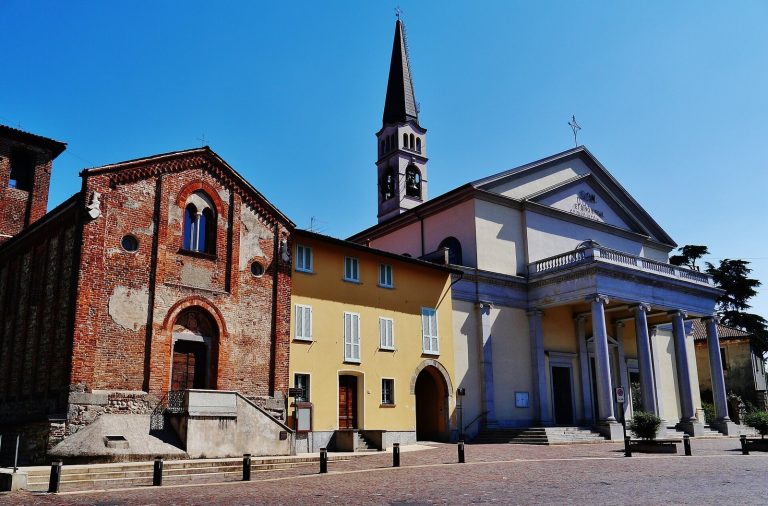
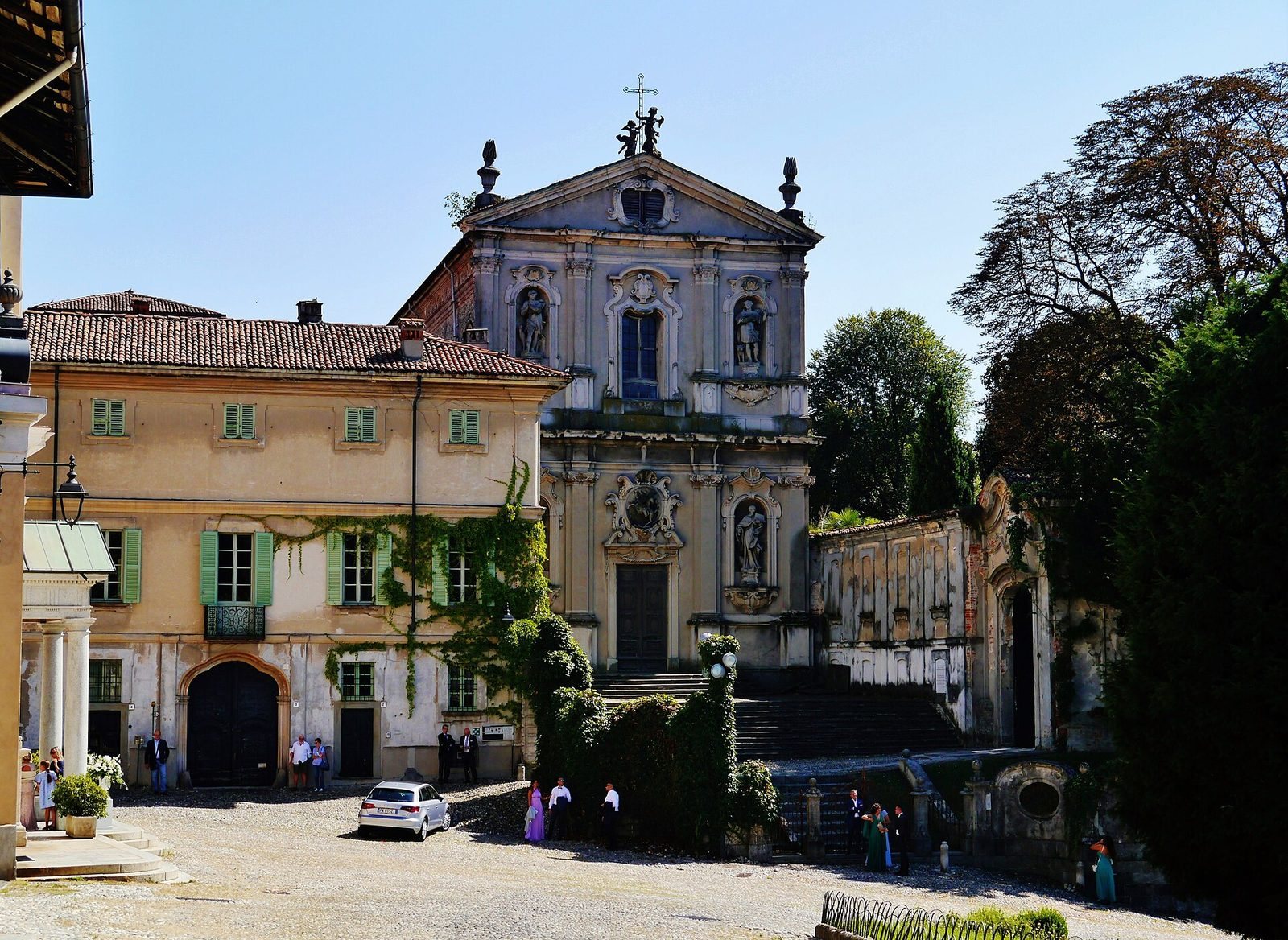
During the third decade of the eighteenth century, the church’s original undecorated front was replaced by its present façade in the lively regional style known as Lombard Barocchetto. This late Baroque form is characterized by elaborate ornament and animated façades. The Benedictine monastery continued to operate until 29 May 1798, when a decree of the Cisalpine Republic government suppressed it.
Villa Antona Traversi
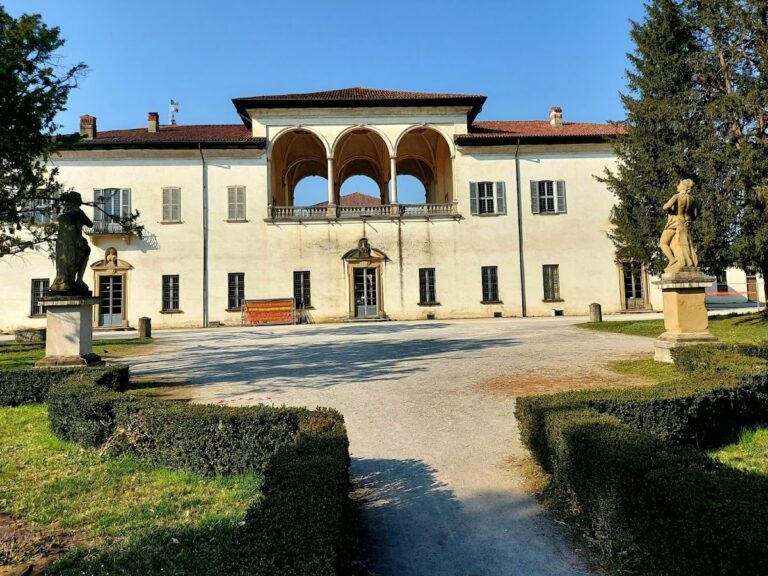
After the suppression, Giovanni Giuseppe Maunier, a merchant from Marseille and supplier to the French army, purchased the monastic buildings. He commissioned the Viennese architect Leopoldo Pollack to convert them into a Neoclassical villa. The public section of San Vittore was preserved, while the nuns’ section was incorporated into the villa and extensively altered.
Giovanni Traversi acquired the entire villa complex, including the church, in 1836. His descendants, the Antona Traversi family, continue to preserve it.
Remains
Church of San Vittore is approached by a monumental eighteenth-century staircase facing the piazza. The staircase forms a raised base for the Barocchetto façade. Above the entrance portal, a roundel contains a sculpture of Saint Victor on a rearing horse, while statues of the founders Aimo and Vermondo flank the window on the upper level.
The public church
Frescoed nave
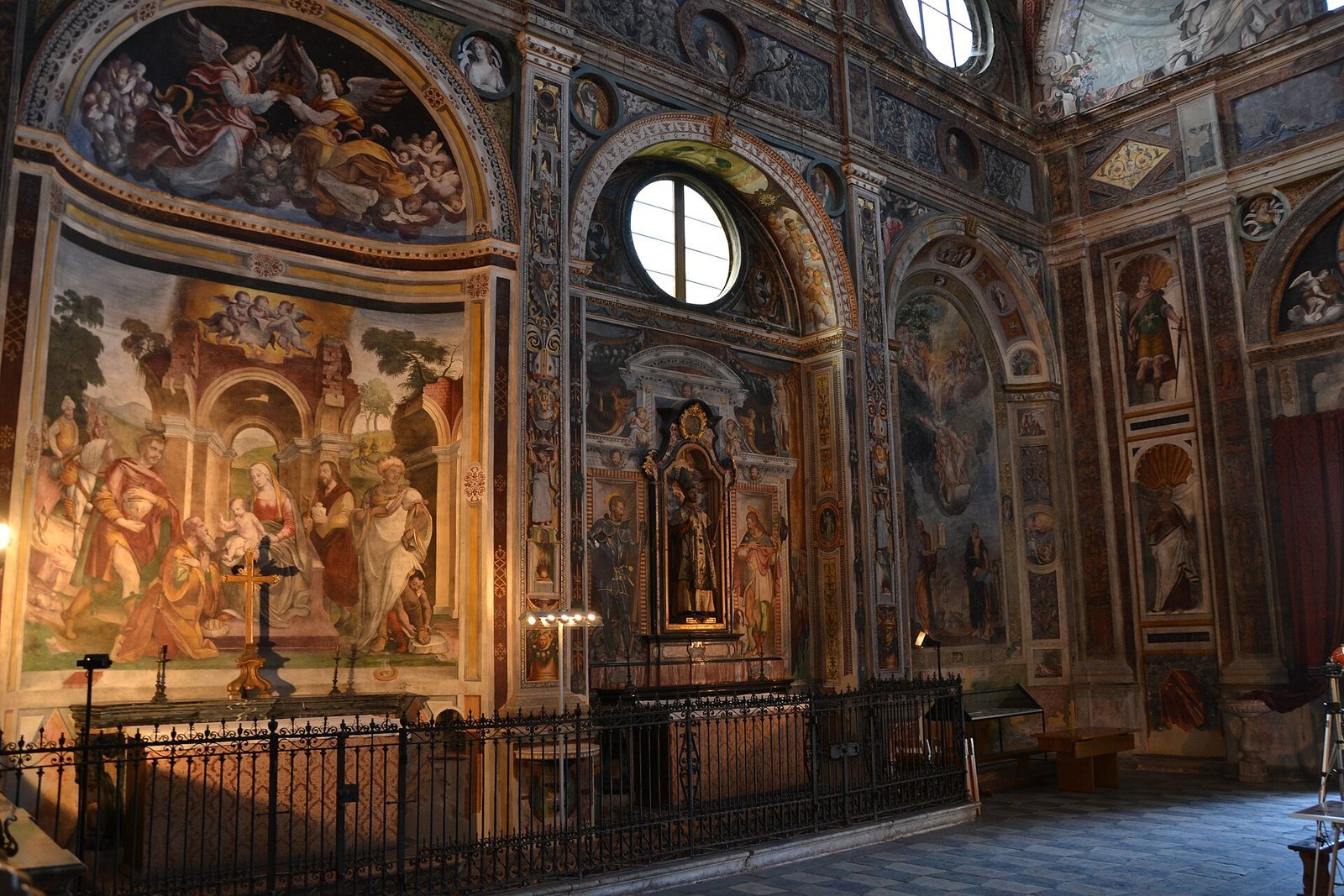
The public interior consists of a single nave covered by a barrel vault and entirely decorated with late-Renaissance frescoes. Six side chapels and the entrance portal are defined by large arches alternating with pilasters, which support a high entablature. Painted half-length figures appear within roundels on the entablature, and large oculi in the upper zone admit light.
The vault and architraves carry dense vegetal and ornamental patterns, grotesques, and putti painted in grisaille, a restricted range of gray tones used to imitate relief sculpture or create ornamental effects. The roundels in the public nave portray Saint Blaise with an iron comb, Saint Sebastian at the column, Saint Adrian with a sword, Saint Ambrose with a scourge, Saint Gaudentius with a mitre and crozier, Saint Nazarius with the palm of martyrdom, Saint Vincent with a palm and millstone, and Saint John the Baptist with the lamb.
Above the altar is Saint Victor with a sword and the standard of Christ, while Saint Scholastica appears above the entrance portal. The roundel portraits are regarded as the only autograph works by Bernardino Luini in the church. Their circular form reflects the Renaissance revival of the classical imago clipeata, a portrait format derived from Roman art and especially associated with portrait medallions on sarcophagi.
Partition portraits
Two further portraits of Aimo and Vermondo, attributed to Luini, occupy diamond-shaped panels beside Saint Victor on the partition wall between the church’s public and convent sections.
Chapels and devotional images
The first chapel on the left contains a sixteenth-century polychrome wooden Lamentation over the Dead Christ. The group consists of nine life-size statues by an unknown artist, representing the deposition of Christ’s body.
The second altar is dedicated to Our Lady of the Rosary and contains an eighteenth-century gilded wooden statue of the Virgin. A noblewoman from Meda belonging to the Fossati family commissioned the statue.
Saint Catherine and Susanna
On the right, a fresco shows Saint Catherine of Alexandria presenting a nun to the Virgin. The nun may represent Abbess Maria Cleofe Carcano, who was devoted to Saint Catherine and promoted the church’s reconstruction in 1520, or Abbess Susanna del Bene, who held office from 1535. The biblical scene of Susanna and the Elders appears beside it.
The frescoes of Saint Catherine and Susanna and the Elders are attributed to Giovanni Lomazzo, a Milanese painter and art theorist who inherited Luini’s workshop after Luini’s death.
The former nuns’ church
The former internal church is visible on the upper floor of the altered monastic section. Its frescoed roundels depict Christ blessing, Saint Peter, and Saint John the Evangelist.
Altered monastic spaces
The former nuns’ section was divided vertically by the insertion of a mezzanine. The lower level became a lemon-house, while the upper level was used as a granary. On the lower floor, plaster covered the frescoes and the side chapels were opened through to form large windows. The upper-level frescoes remain visible, though their nineteenth-century use as a granary damaged them.