Our Lady of Sorrows Church in Mierzyn: A Medieval Roman Catholic Church
Site at a Glance
- Rating
- 4.6
- Popularity
- Low
- Country
- Poland
- Primary era
- Medieval
- External website
- Open
- Eras represented
- Medieval, Early Modern, Modern
- Civilizations
- Duchy of Pomerania, Holy Roman Empire
- Site type
- Religious
- Remains
- Church
On this page9 sections
History
Our Lady of Sorrows Church in Mierzyn is a medieval Roman Catholic church in Poland, built in the thirteenth century soon after the establishment of the village near Szczecin. Its architecture belongs to the transitional period between the Romanesque and Gothic styles, combining features associated with both medieval traditions. The church serves the parish of Our Lady of Sorrows, a Catholic title for the Virgin Mary that emphasizes her suffering in connection with the Passion of Christ. The parish celebrates its liturgical feast on 15 September.
Fire and reconstruction
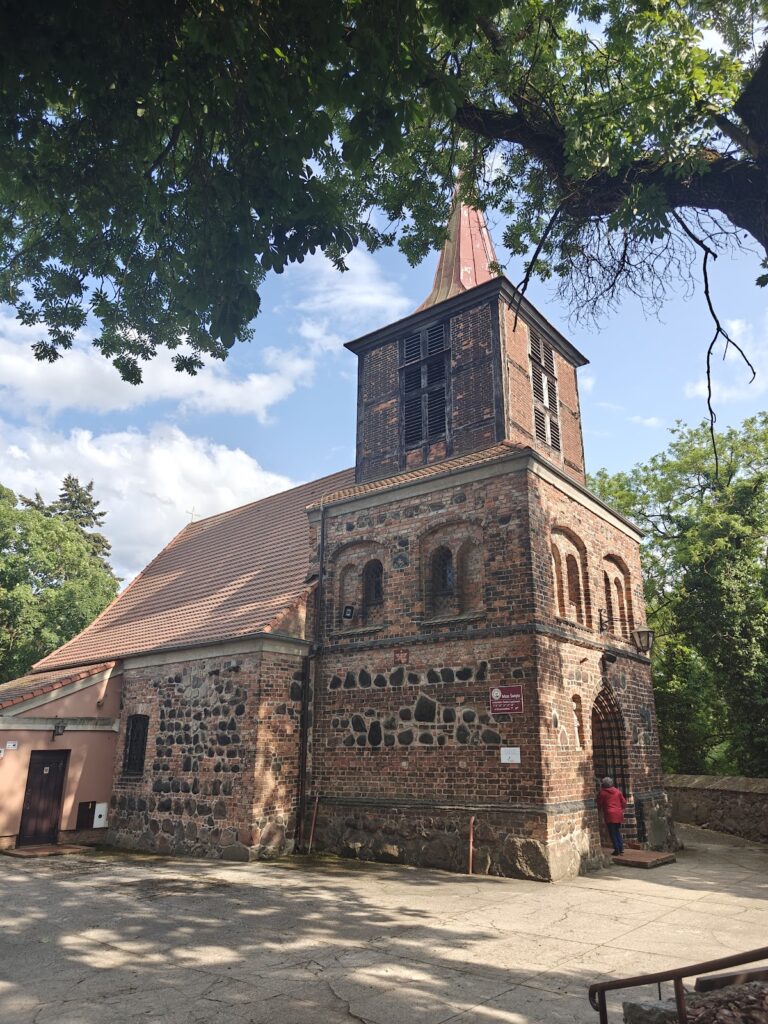
In 1637, a fire seriously damaged the church and destroyed or severely affected its original wooden tower. Reconstruction was completed in 1644, when the present wooden tower was erected with a domed roof and lantern. The surviving bell was installed in the rebuilt tower during the same year.
Repairs and later changes
The church underwent repairs during the nineteenth century and was repaired again after the Second World War, in 1958 and 1995. Restoration of the altar and pulpit began in 1992. A sacristy was added on the south side during the postwar period. Since 2006, an electronic bell has also sounded from a loudspeaker, while the historic bell remains associated with the tower.
Remains
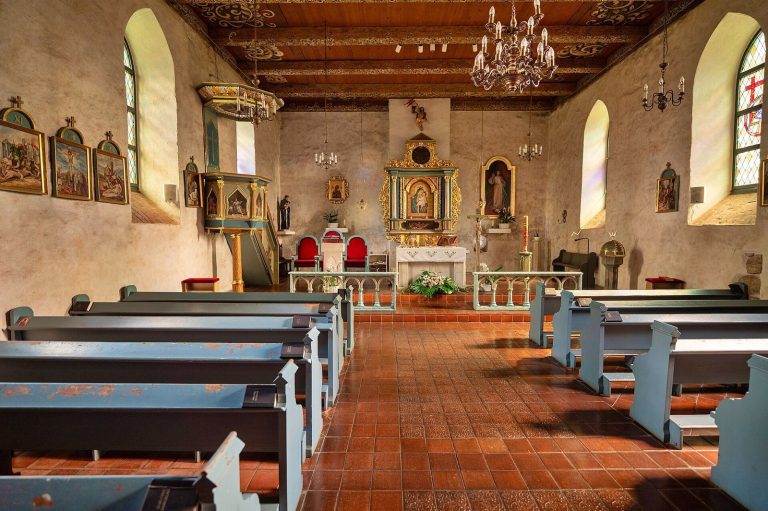
The church is oriented and stands on a rectangular plan, with a nave measuring 22.7 by 9.9 metres and no separately defined chancel. The nave accommodates approximately 300 people. Regularly laid granite blocks bonded with lime mortar form the walls. The windows vary in width and height, reflecting rebuilding over time. Two have Romanesque characteristics and three are Gothic. On the eastern gable, a cross-shaped blind panel, a recessed or outlined feature that resembles an opening but is not open, is accompanied by four further blind panels beneath the arms of the cross. Similar decoration appears on the church at Wołczkowo.
Tower and bell
The tower is slightly wider than the nave. Its lower part is built of stone and its upper section of wood, rising 48 metres above the church. A slender domed roof and lantern crown it, ending in a sphere and cross. The bell weighs about 350 kilograms and measures 83 centimetres across. Lorentz Kökeritz, a bell founder who also cast a bell for Szczecin Cathedral, made it in 1644. The tower also preserves a yoke associated with the former bell.
Interior furnishings
High altar
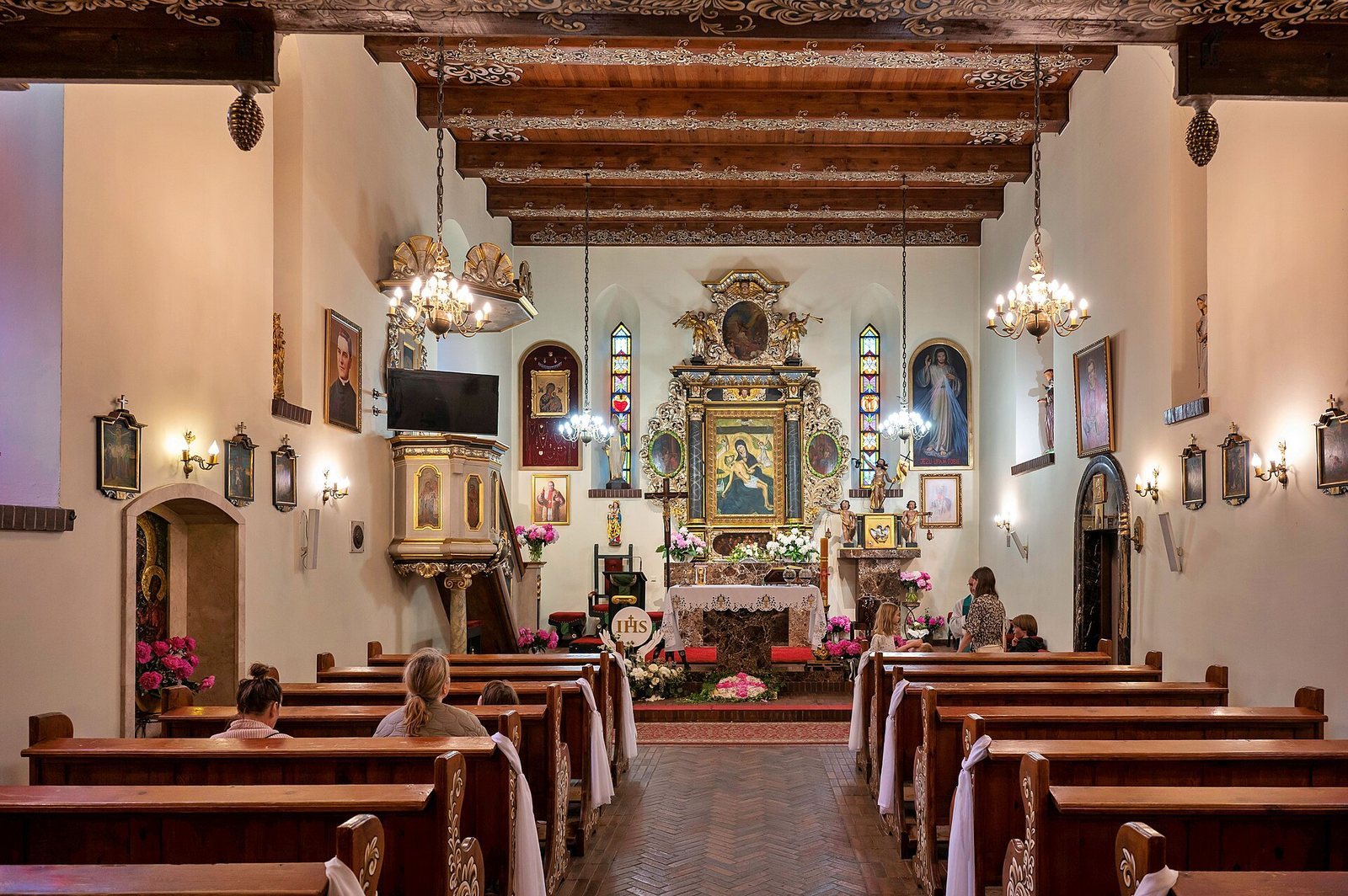
The early-eighteenth-century high altar is Baroque, a style known for dramatic forms and elaborate decoration. Its predella, the lower section of an altar framework, contains a wooden painting of the Last Supper. The retable, the decorated structure behind the altar, now holds a modern image of Our Lady of Sorrows. Before the Second World War, the same position contained an image of the Crucifixion of Christ. The upper structure depicts the Descent of the Holy Spirit. Three sculptures that once formed part of the altar are now positioned beside the tabernacle.
Pulpit
The early-eighteenth-century pulpit has panels showing Matthew, Mark, Luke, and John, the four Evangelists traditionally regarded as the authors of the canonical Gospels. Its rear panel depicts Christ, while the canopy is decorated with silver-and-gold fan-shaped elements. The style of the paintings suggests the work of a skilled folk artist. A large monitor is now installed on the pulpit to display liturgical texts.
Organ gallery
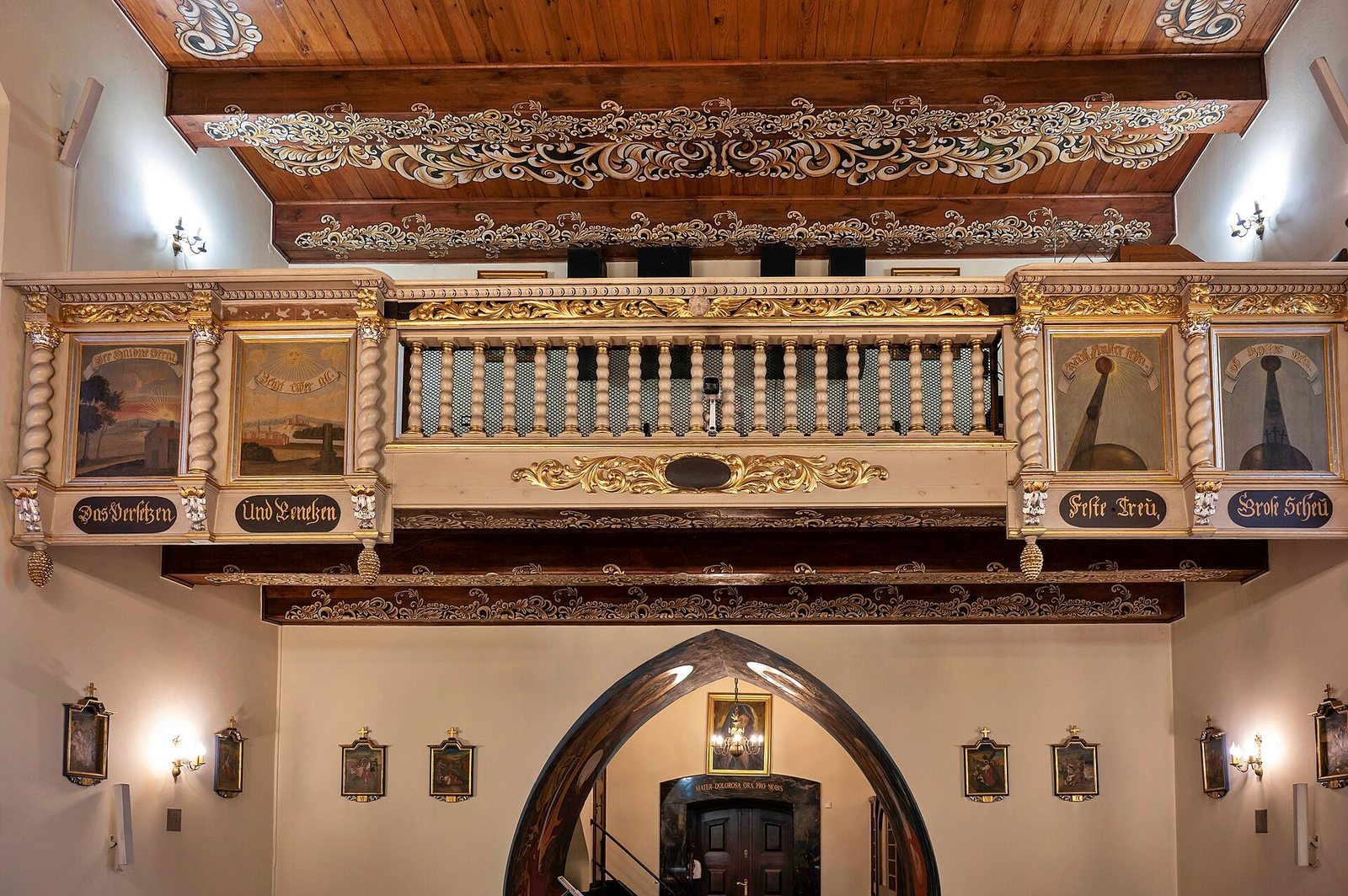
The organ gallery was built in the late nineteenth century in the Neo-Baroque style, a nineteenth-century revival of Baroque principles. Four columns support it, and its structure includes a decorative balustrade and four symbolic paintings. A twelve-stop organ made by B. Grüneberg in 1908 has not survived.