Cathedral Basilica of St. James the Apostle: Szczecin’s Cathedral Church in Poland


Site at a Glance
- Rating
- 4.7
- Popularity
- Medium
- Country
- Poland
- Primary era
- Medieval
- External website
- Open
- Eras represented
- Medieval, Early Modern, Modern
- Civilizations
- Duchy of Pomerania, Holy Roman Empire
- Site type
- Religious
- Remains
- Cathedral
On this page19 sections
History
The Cathedral Basilica of St. James the Apostle is a Roman Catholic church in Szczecin, Poland, whose construction began around 1187 in a Romanesque form before the building developed into a late Gothic hall church. It stands in the city’s Old Town and is the principal church of the Archdiocese of Szczecin-Kamień, as well as the metropolitan church of its ecclesiastical province.
Foundation and medieval development
The church was consecrated on 25 July 1187 by Siegfried, Bishop of Kamień, in the presence of Duchess Anastasia, the widow of Duke Bogislaw I. Its foundation is traditionally attributed to Bering of Bamberg, a wealthy citizen who probably established it as a votive church connected with the missionary work of Otto of Bamberg. Otto was a twelfth-century bishop who evangelized Pomerania.
The church was the third Christian church in Szczecin and became an independent parish under the patronage of the Benedictine monastery of Bamberg. Duke Bogislaw II of Pomerania was buried there around 1220 or 1221. Around 1237, Duke Barnim I designated St. James’s Church for Szczecin’s German inhabitants, while St. Peter’s Church served the Slavic population.
During the Middle Ages, St. James’s Church and the Church of St. Mary, which was later demolished, served as the city’s parish churches. Construction at St. James proceeded in stages from the thirteenth through the fifteenth centuries. Work begun in the second half of the thirteenth century was interrupted around 1320 and resumed about fifty years later. From 1375 onward, the building was substantially reorganized.
Reconstruction after the fifteenth-century collapse
A southern tower collapsed in 1456 for unknown reasons, damaging the western part of the nave and destroying the western vaults. During the second half of the fifteenth century, the church was rebuilt as a hall church, with aisles of approximately equal height and one central tower replacing the earlier two-tower arrangement. The main reconstruction was completed around 1503 or 1504.
The Reformation brought Lutheranism to the Duchy of Pomerania in 1534, a change that placed the church within the Protestant religious order established by the dukes. Ducal patronage passed to Barnim IX, the son of Bogislaw X and Anna Jagiellon. From 1534 to 1945, St. James served the Pomeranian Lutheran community. The parish belonged to the Stettin-Stadt church district and the Pomeranian church province of the Evangelical Church of the Old Prussian Union. In 1940, its congregation numbered 22,900 members and had three pastoral positions.
Fire, Baroque rebuilding, and nineteenth-century restoration
During the Brandenburg siege of Szczecin on 16 August 1677, an artillery projectile caused a fire that seriously damaged the church. The blaze destroyed much of its furnishings, including the tower, nave vaults, Gothic altars, pulpit, organ, bells, and library.
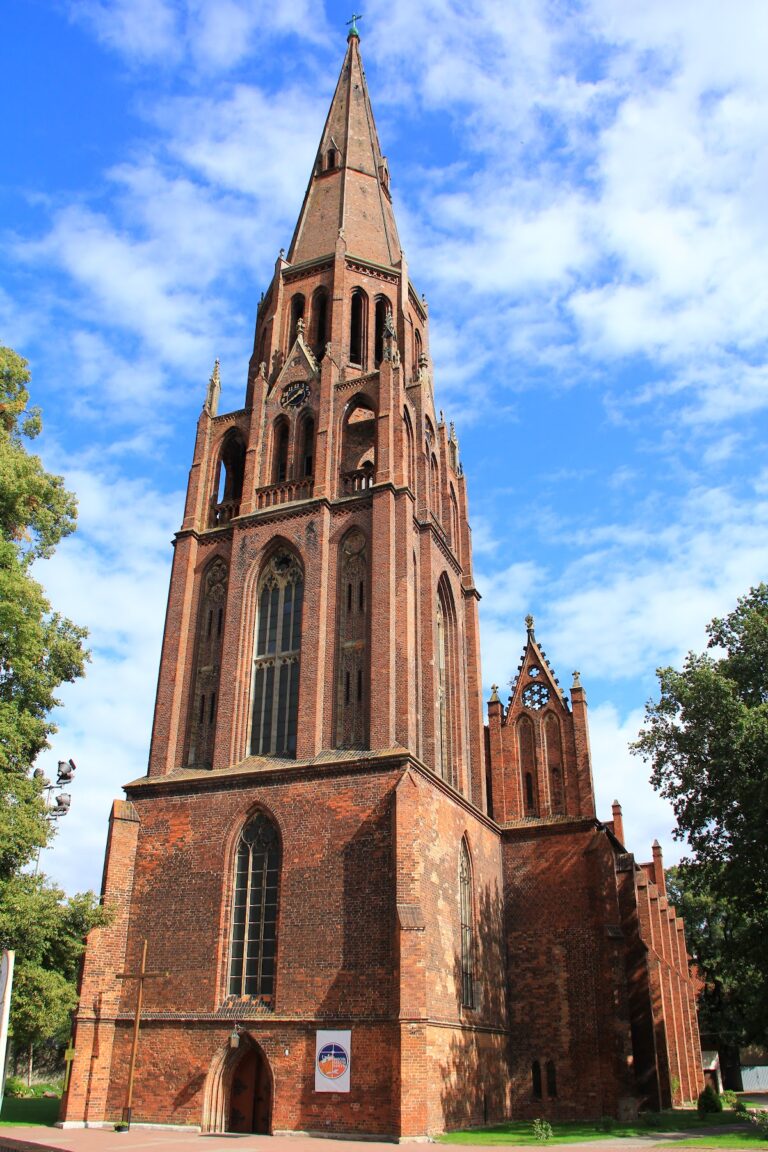
Rebuilding began in 1693 and continued through the eighteenth century. The interior was given Baroque vaults, a richly carved pulpit, a new organ case, choir stalls, chandeliers, and a two-storey high altar designed by Erhard Löffler in 1711. In the nineteenth century, the church received electrical and heating installations and a new slender spire in 1894. The construction caused a structural accident, and the top of the tower collapsed during the restoration before being rebuilt. The completed spire reached 119 metres.
War damage and Roman Catholic restoration
Air raids during the Second World War caused extensive destruction, especially during the bombing of 16 August 1944. The nave roof and tower spire were destroyed, the roof structure collapsed, and about 75 percent of the vaults were lost. The northern nave, exterior elevations, interiors, altars, and artworks were severely damaged or burned, while the tower and choir survived, although the tower no longer had its spire.
The ruins were temporarily secured between 1947 and 1949. The choir received a vault and was separated by walls from the largely destroyed nave. After the war, the former Lutheran church was taken over by the Roman Catholic Church in Poland and transferred to the Polish Episcopal Conference.
Permission to reconstruct the church was granted on 27 April 1971. Work took place from 1972 to 1974 under the Szczecin architects Stanisław Latour and Adam Szymski, with construction directed by the parish priest Julian Janas. The project sought to recover the church’s historical form, although the rebuilt northern elevation received a modern design and the damaged tower was initially left without a spire.
Cathedral and basilica
In 1972, the church became the cathedral of the Diocese of Szczecin-Kamień, which Pope Paul VI restored by a papal bull dated 28 June that year. Cardinal Stefan Wyszyński consecrated the restored choir on 8 October 1972 during the installation of the diocese’s first bishop, Jerzy Stroba. The nave was consecrated on 8 November 1974, and Bishop Kazimierz Majdański consecrated the cathedral on 31 May 1982.
Pope John Paul II granted the church the status of a minor basilica on 23 May 1983. This is an honorary papal title for a church of particular historical, religious, or pastoral importance. John Paul II visited the church on 11 June 1987. Since 1992, it has also served as the cathedral of the Archdiocese of Szczecin-Kamień.
Work on the interior and fabric continued after the main reconstruction. The roof was covered with copper sheet in 1980 and 1981, the interior was painted in 1982 and 1983, and stained glass was installed in nine windows between 1983 and 1991. Between 1982 and 1989, the presbytery was extended and furnished with an altar, canon stalls, and a bishop’s seat. A diocesan museum began to take shape on the southern gallery in 1990.
From 2007, the tower was remodelled to restore a prominent spire. A new spire, influenced by the earlier form shown in a 1624 view of Szczecin, was installed on 12 January 2008. It differs from the spire destroyed in 1944 and includes viewing platforms. The restored tower reached 110.18 metres. A new 66-stop organ was consecrated and named for John Paul II on 15 June 2008, and an 18-metre roof turret was installed on 8 October 2010.
Music, memorials, and remembrance
Carl Loewe served as organist and cantor from 1820 to 1865 and became a major figure in Szczecin’s musical life. He directed the city’s first performance of Beethoven’s Ninth Symphony in 1827 and the public first performance of Mendelssohn’s overture to A Midsummer Night’s Dream. A monument to Loewe formerly stood before the church, and its neo-Gothic pedestal survives.
The cathedral contains memorials to Kazimierz Majdański, Jerzy Stroba, Carl Loewe, August Hlond, Stefan Wyszyński, John Paul II, Jan Szyrocki, and Stefan Kwilecki, as well as to Lithuanian aviators. A plaque unveiled in the basilica on 13 July 2008 commemorates Steponas Darius and Stasys Girėnas, who died when their aircraft crashed near Pszczelnik on 17 July 1933 during a non-stop flight from New York to Kaunas. A nearby anchor-shaped monument commemorates Szczecin yacht captains Kazimierz “Kuba” Jaworski, Ludomir “Ludek” Mączka, and Jerzy Siudy.
Remains
Layout and exterior
The cathedral is a Brick Gothic building, a medieval Gothic tradition that uses brick as its principal structural and decorative material. It has three aisles, a large choir, an ambulatory, and chapels arranged between the internal buttresses. The reported dimensions are about 25 metres in width and 30 metres in length, while the side aisles rise 8.5 metres.
The present hall church has aisles of equal ceiling height supported by three pairs of octagonal pillars. The choir is nearly as large as the nave. At the east end, a five-sided presbytery is surrounded by an ambulatory, a passage around the sanctuary, and the side chapels occupy spaces between buttresses drawn into the interior.
Southern elevation
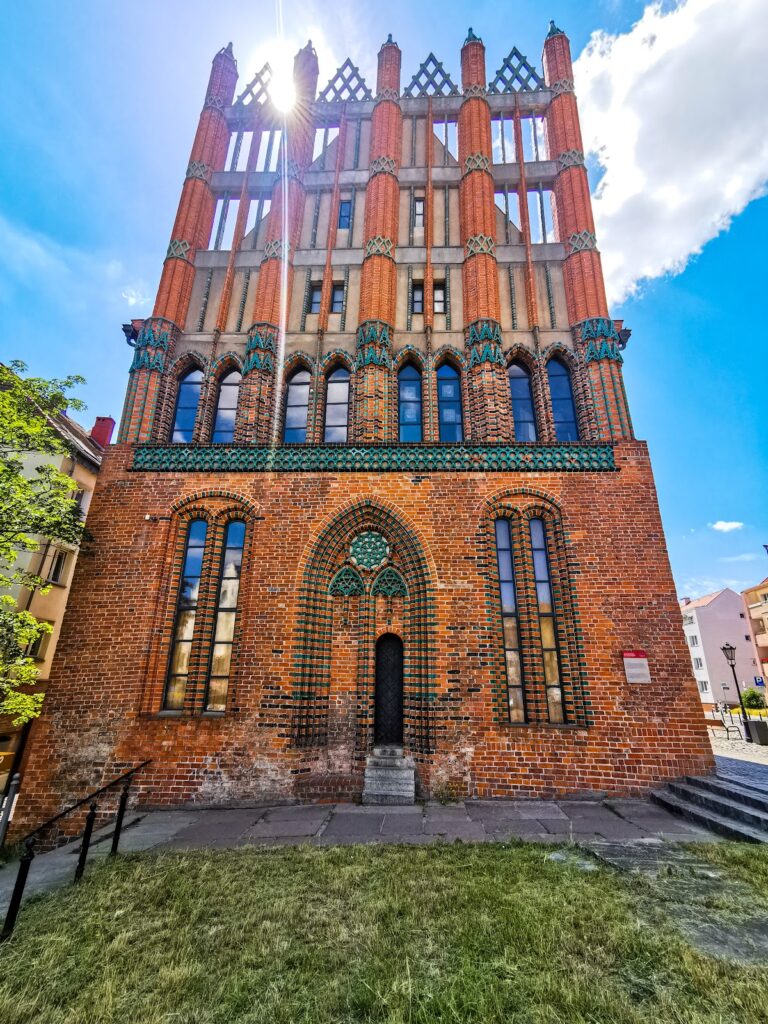
The southern nave wall retains a highly decorative Gothic design possibly associated with Hinrich Brunsberg and his workshop. Its surface includes numerous lesenes, pinnacles, blind panels, and richly ornamented elements made from glazed brick or terracotta. The northern elevation was rebuilt after the Second World War in a modern form, and a project has been undertaken to restore a Gothic appearance there while altering adjoining rooms.
Central tower
The western elevation originally had two towers. After the southern tower fell in 1456, the rebuilding completed around 1503 or 1504 created a single central tower. The tower now rises 110.18 metres and carries a reconstructed neo-Baroque spire together with an 18-metre roof turret.
Presbytery and principal furnishings
Presbytery altar
The presbytery dates from 1375 to 1387. Its central altar is a large rectangular table founded in 1982 for the tenth anniversary of the Szczecin-Kamień diocese. Brass reliefs on its sides show the Virgin Mary, the twelve Apostles, and figures connected with the Christian history of Pomerania, Poland, and the wider Church, including Otto of Bamberg, Duke Wartislaw I, Maximilian Maria Kolbe, Stefan Wyszyński, and John Paul II. The altar and pulpit were designed and made by Kazimierz Bieńkowski.
Triptych and crucifix
A reconstructed triptych stands on two pillars at the eastern side of the presbytery. Its case, rebuilt in 1981, contains 18 reliefs dating from about the fifteenth century. The reliefs include a Beautiful Madonna with the Child from Mieszkowice, six female saints and two bishops from Chojna, and nine Apostles from Żukowo; three figures are modern additions.
Above the altar hangs a late Gothic Tree of Life crucifix from Usedom, dating from the fifteenth or sixteenth century. Its branching form has visible buds and four medallions bearing the symbols of the Evangelists.
Chapels and devotional works
The chapels bring together medieval, early-modern, and modern furnishings. One contains four modern copies by Małgorzata Wodejszo of sections from Michael Pacher’s 1463 Altarpiece of the Church Fathers, depicting Jerome, Augustine, Gregory, and Ambrose.
Another chapel began as a free-standing building with a three-sided eastern end. It was temporarily used as a coal store before receiving a neo-Gothic interior and returning to religious use in the late nineteenth century. Its furnishings include a copy of the Black Madonna of Częstochowa, a late nineteenth-century crucifix from Christ Church in Kamień Pomorski, and Marian stained glass by Wiktor Ostrzołek.
A chapel dedicated to a patron of difficult and hopeless causes contains a 2003 painting by Krystyna Bogdan in an eighteenth-century Baroque frame. Its stained-glass composition shows Michael the Archangel, Jude Thaddeus, Francis of Assisi, and Barbara.
One chapel preserves a wooden cross that stood in the port of Lastadia during the August 1980 strikes. Beneath it is a 1693 relief of the Virgin and Child with fish, formerly part of the richly decorated seating of the fish merchants’ guild in St. James’s Church. The chapel also contains a painting of the miraculous catch of fish, a 1990 stained-glass view of Szczecin harbour, and a plaque referring to the victims of December 1970.
Memorial chapels
The chapel dedicated to victims of the German extermination camps contains a modern sculpture by Anna Dopierała Bomba. It stands against a wall inscribed with the names of German concentration camps, while the grille is designed to recall their barbed-wire fences.
The chapel on the cathedral axis has a modern triptych case containing a sixteenth-century figure of the Apocalyptic Virgin from the former Church of St. Mary in Chojna, a figure of St. Adalbert with an oar, and a seventeenth-century sculpture of Michael the Archangel that once stood above the cathedral pulpit canopy. A reliquary holding relics of St. Adalbert stands below the altar, and the floor gives access to the burial crypt of Szczecin’s bishops. Above the chapel is an approximately 80-square-metre stained-glass window associated with John Paul II’s pilgrimage to Szczecin.
A former burial chapel of the shoemakers’ guild retains its original 1779 Baroque interior. Human remains found during cathedral reconstruction in 1971–1972 and 2005–2006 are kept there, including bones placed in a tin sarcophagus belonging to the Pomeranian von Wedel family of Krępcewo. The stained glass was made in 1998 by Michał Kośmicki after a design by Grażyna Strykowska.
Another chapel contains a modern image of the Merciful Christ in a nineteenth-century wooden frame from Christ the King Church in Świnoujście. Its 1992 stained-glass window was funded by the West Pomeranian Association of Siberians and designed by Father Jan Młyńczak. The chapel dedicated to St. Catherine has a modern altar by Aleksander Sęk and Edward Rogalski, a sculpture of the saint, and scenes from her martyrdom. Its 1998 window by Michał Kośmicki, designed by Sebastian Ratajczak, depicts St. Catherine with Christopher, Nicholas, Stanislaus Kostka, and Raphael Kalinowski.
Ducal, maritime, and Polish historical memory
A modern stone tomb contains the remains of Pomeranian dukes. The bones had previously been kept in sarcophagi in the crypt of Szczecin’s Ducal Castle, where the crypt collapsed and the sarcophagi were damaged during the Second World War. The restored sarcophagi are displayed in the castle museum. Above the tomb hangs an epitaph painting from about 1600, flanked by seventeenth-century wooden sculptures and consoles decorated with skull motifs. A stained-glass window depicts the nine-field ceremonial coat of arms of the Griffin dynasty, the ruling house of the Duchy of Pomerania.
The chapel containing the Stella Maris triptych by Ryszard Kiełtyka also displays a ship’s wheel, compass, navigation lamps, and a ship’s bell. Its 1992 stained-glass window by Michał Kośmicki presents scenes from the lives of seafarers.
One chapel contains a 1947 copy of the Ostra Brama Madonna by Łucja Bałzukiewicz, donated by John Paul II during his 1983 pilgrimage to Poland. Its 1987 window, Mater Misericordia, by Irena Kisielewska, depicts the painting, the Ostra Brama Gate, and St. Anne’s Church in Vilnius.
A chapel dedicated to soldiers of the Home Army and participants in the Warsaw Uprising contains a late fifteenth- or early sixteenth-century Pietà from Lubniewice. A Pietà represents the Virgin Mary mourning while holding the dead Christ. The chapel’s stained glass depicts the Home Army’s patrons, Barbara and George.
Altarpieces, sculptures, and historic objects
A late fourteenth-century triptych from Ciećmierz, probably made originally for the Norbertine convent at Cerkwica, contains the Coronation of the Virgin and the Adoration of the Magi in its centre. Four female saints appear on the sides and twelve Apostles on the wings. Its original painted decoration has not survived.
Another triptych was made in the 1520s in the workshop of Claus Berg of Lübeck. The Virgin and Child occupy its centre, with two angels holding a crown above them. The wings contain eight saints, while the lower section, or predella, has modern representations of the four Evangelists. A reliquary beneath it holds relics of Otto of Bamberg, donated by the Bishop of Bamberg in 1974.
The cathedral also preserves a seventeenth-century baptismal font from Dobropole, made in Wolin by the carpenter Christoph Schmidt and painter Joachim Sellin, and a decorative Baroque wooden screen from the church at Stolec. Other objects include Gothic altarpieces transferred from Ciećmierz, Chojna, and Lübeck, early-modern epitaphs and sculptures, a 1693 sculpture of St. James, Michael Wahrlang’s 1685 tomb slab with epitaph, a 1683 relief of the Virgin Mary, and a seventeenth-century sculpture of St. Peter.
Organs, bells, and military memorials
The main organ was built by Dariusz Zych’s firm and consecrated in 2008. It has 66 stops and 4,743 pipes ranging from 11 millimetres to 10 metres in height, together with 183 Spanish-trumpet resonators. The instrument is 10 metres high, weighs 36 tonnes, and has four manuals and a pedal keyboard. Its mechanical action is supplied by four blowers delivering 80 cubic metres of air per minute. The design leaves visible a 30-square-metre stained-glass window depicting the Transfiguration.
A separate nine-stop mechanical organ was built near the presbytery in 1983 by the Edmund Kamiński firm, and a later side organ was made by the Kamiński-Jacobi firm. The cathedral also contains two bells, known as the St. James Bell and the Independence Bell, along with three historic panoplies, or military memorial ensembles. They commemorate Field Marshal Adam von Weyher in 1680, Captain Theophil Michaelis, who died in 1709, and Adam Reinhard von Maltzan around 1689.
The cathedral is associated with the European Route of Brick Gothic and is protected as a registered monument under designation A-903, dated 12 June 1954.
Nearby sites