Church of St Mary: An Anglican Parish Church in Berry Pomeroy
Site at a Glance
- Rating
- 4.8
- Popularity
- Very Low
- Country
- United Kingdom
- Primary era
- Medieval
- External website
- Open
- Eras represented
- Medieval, Early Modern, Modern
- Civilizations
- British, English
- Site type
- Religious
- Remains
- Church
On this page14 sections
History
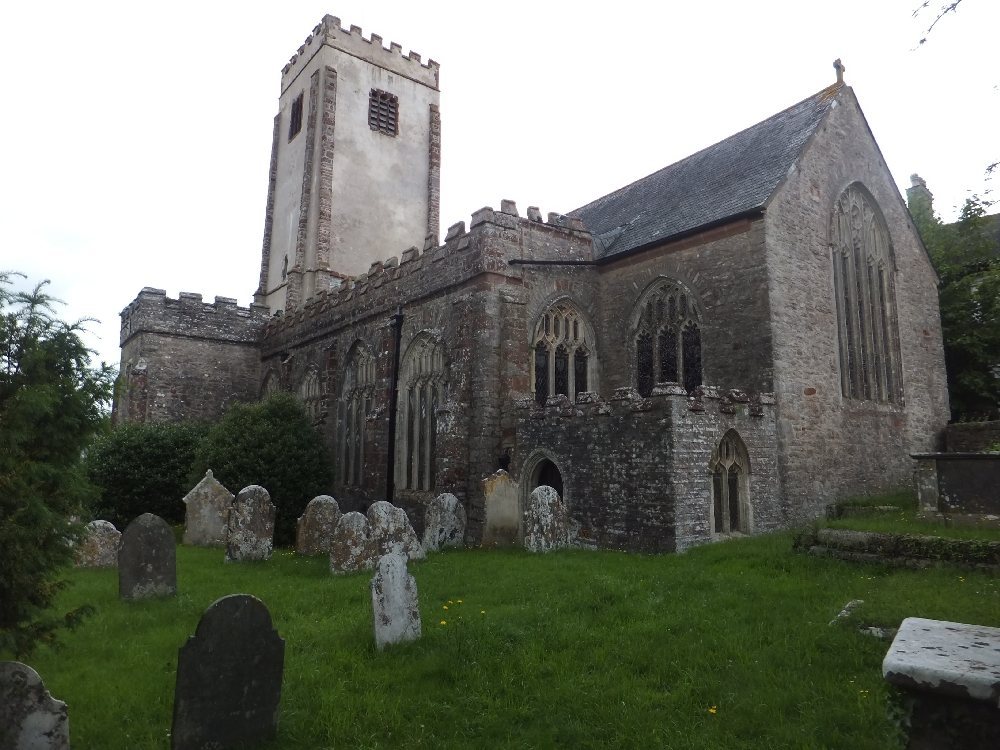
Church of St Mary is an Anglican parish church in Berry Pomeroy, United Kingdom, rebuilt in the late fifteenth century in the Perpendicular style of English Gothic architecture. The church belongs to the parish of Berry Pomeroy within the Totnes archdeaconry. Its rebuilding is associated with Richard de Pomeroy of the Pomeroy family and replaced an earlier church on the same site.
Early origins and medieval rebuilding
The Domesday Book records an eleventh-century Anglo-Saxon settlement called Beri and a fortified manor at Berry Pomeroy. One of the church’s predecessors may therefore have had Anglo-Saxon origins, although that possibility remains uncertain. The surviving tower appears to be earlier than the nave and aisles, while a western entrance is associated with the thirteenth or fourteenth century.
Richard de Pomeroy’s late-fifteenth-century rebuilding created the principal Gothic church that survives today. The work produced a three-aisled building with a substantial chancel and a richly decorated interior, including monuments and a rood screen, an internal partition traditionally separating the nave from the chancel and supporting a representation of the Crucifixion.
Later changes and parish life
The church was renovated during the seventeenth century and underwent another major renovation in 1878 and 1879. Its long succession of vicars included John Prince, who served from 1681 to 1723 and wrote Worthies of Devon, followed by Joseph Fox, John Edwards, Edward Brown, William Burrough Cosens, Arthur J. Everett, and Henry Stewart Prinsep. Together, these incumbencies covered more than two centuries, from 1681 to 1908. In more recent times, clergy from outside the village have served the parish rather than a resident vicar.
Church of St Mary has been a Grade I listed building since 1961, a designation used in England for buildings of exceptional historic or architectural interest. It is also on the Heritage at Risk Register, which identifies designated heritage assets threatened by neglect, decay, or other dangers. The church is in poor condition, with slow decay and no agreed solution. The Friends of Berry Pomeroy Church organize its maintenance.
The building’s later history also includes memorials connected with the two World Wars. An interior display recalls the presence of American soldiers in Berry Pomeroy as they prepared for the D-Day operations during the Second World War. In April 1920, a carved wooden figure of Saint George was dedicated to soldiers who died in the First World War. The figure was presented by the Reverend W. T. Wellacott, vicar of Totnes.
Remains
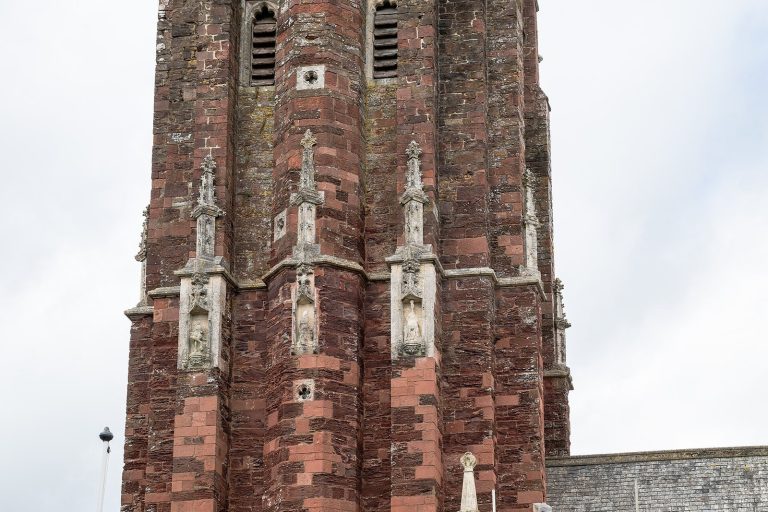
Church of St Mary is a Perpendicular Gothic building arranged around a nave and chancel forming one principal space, with north and south aisles. The aisles have external parapets, and the medieval fabric includes a tower that appears to predate the main body of the church. The south porch has a groined, cross-ribbed roof with carved bosses and displays the arms of the Pomeroy family.
Medieval fabric
Tower and bells
The tower contains eight bells. Four bear the dates 1607, 1635, 1751, and 1829, while the remaining four date from 1897 and 1909. Their dates reflect several phases of alteration and renewal within the tower’s continuing use.
South porch
The south porch retains a groined, cross-ribbed roof, a form created by intersecting ribs that divide the vault into sections. Bosses decorate the roof, and the Pomeroy arms connect the porch’s architectural detail with the family associated with the late-fifteenth-century rebuilding.
Screen and stained glass
Rood screen
A complete rood screen extends about 42 feet, or 12 metres, from the north wall to the south wall. It retains its original coving, cornice, cresting, and other carved details, although its doors have been removed. Nikolaus Pevsner, the twentieth-century architectural historian who surveyed the buildings of England, described the screen as one of the most perfect in Devon.
The screen’s wainscoting carries painted figures of Saints James the Younger, Thomas, Stephen, Jude Thaddeus, Matthias, Mary Magdalene, and Barbara. It also depicts the four Church Fathers, major early Christian theologians named Gregory the Great, Ambrose, Augustine, and Jerome of Stridon. Names of people who contributed to the church’s embellishment appear on some of the column capitals.
Stained-glass windows
The stained-glass windows retain a few reset fragments from earlier glazing. Most of the later panels were made by Christopher Whall in 1897 and 1908, and another panel was installed by his daughter, Veronica Whall, in 1926.
Monuments and memorials
Pomeroy monument
On the north side of the chancel stands a late-fifteenth-century monument to Sir Richard Pomeroy, who died in 1496, and his wife. Its tomb chest, or stone sarcophagus, is decorated with quatrefoils and figures known as weepers placed in niches. The monument’s ornamental elements had been removed before the eighteenth century.
Seymour monument
The Seymour Chapel occupies the eastern end of the north aisle, where a monument against the north wall commemorates Lord Edward Seymour, son of Edward Seymour, the Protector Somerset, who died in 1593. It also commemorates his son Sir Edward Seymour and his daughter-in-law Elizabeth, daughter of Arthur Champernowne.
The monument’s arch is decorated with roses and pomegranates. Beneath it are two armoured knights, arranged one above the other, together with a reclining female figure. A cradle containing a child appears behind her head, while a seated figure is shown at her feet. The lower panel contains nine kneeling children, five male and four female. Architectural historians have judged the monument’s figure carving in sharply different ways, describing it both as remarkably naïve and as fine.
Later memorials
The chancel contains a memorial tablet to John Prince. The church also retains the carved wooden Saint George dedicated in 1920 as a memorial to those who died in the First World War, along with the display recalling the American military presence in Berry Pomeroy before D-Day.