Buckow village church: a medieval fieldstone church in Berlin


Site at a Glance
- Rating
- 4.6
- Popularity
- Low
- Country
- Germany
- Primary era
- Medieval
- External website
- Open
- Eras represented
- Medieval, Early Modern
- Civilizations
- Holy Roman Empire, Margraviate of Brandenburg
- Site type
- Religious
- Remains
- Church
On this page13 sections
History
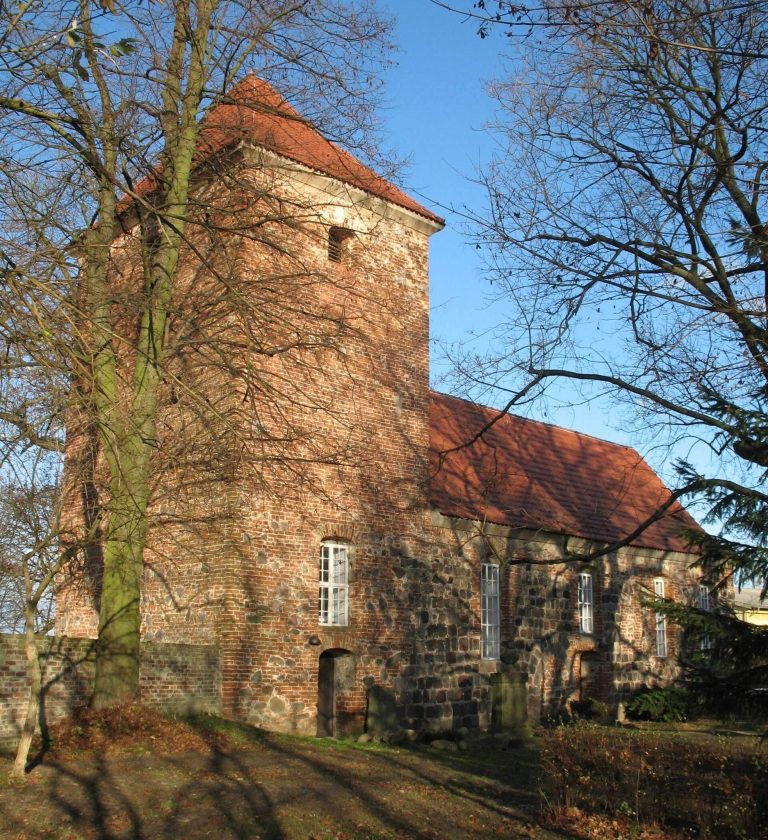
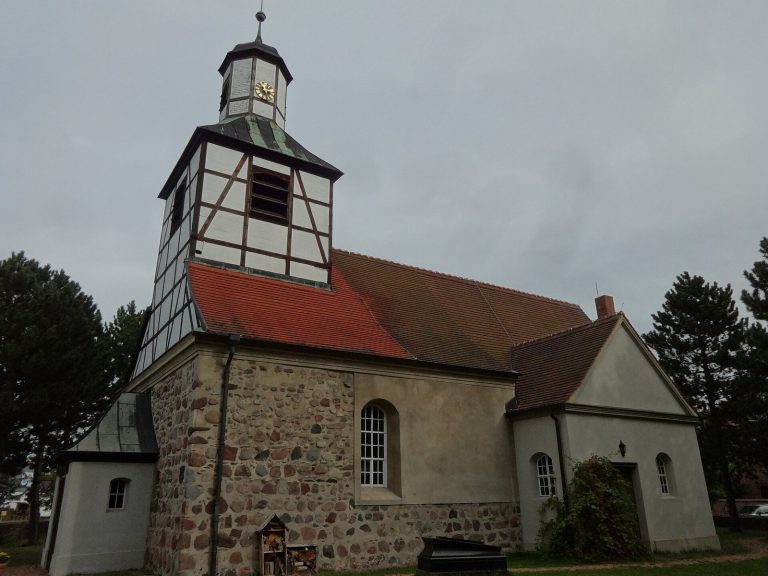
Buckow village church is a medieval fieldstone church in Berlin, Germany, built by a medieval Christian community in the mid-thirteenth century, probably between 1245 and 1255. It stands near the village pond in the historic center of Alt-Buckow, once an Angerdorf, a village arranged around a shared green or pasture. Its early Gothic form and surviving medieval fabric place it among the historic buildings that shaped the settlement. The church is a listed monument and remains the worship center of a Protestant congregation within Region 5 of the Neukölln church district, an administrative grouping of congregations.
Medieval foundation and growth
The date of construction is linked to the wooden locking bar preserved at the west portal. Dendrochronology, the dating of timber through its annual growth rings, places the wood in the period probably from 1245 to 1255. The original building was an early Gothic hall church with a rectangular west tower as broad as the nave. Its broad tower required substantial expenditure, since this was among the more costly forms of village-church construction.
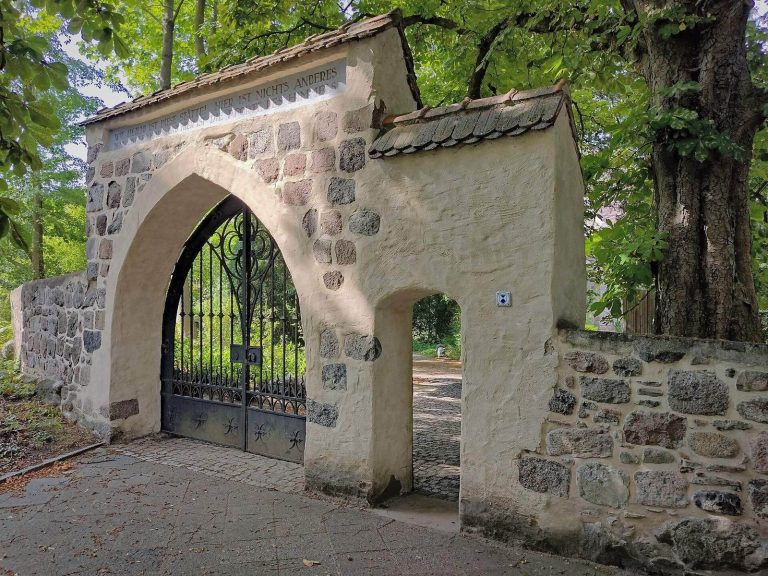
Buckow’s local circumstances also indicate a degree of prosperity by the late fourteenth century. In 1375, the village had both an inn and a windmill. The older church could also offer refuge, as the surviving internal locking-bar mechanism suggests. A fieldstone wall was added around the churchyard after an edict issued by King Frederick William I in 1719.
Religious change and later alterations
The church was originally Catholic. During the Reformation, the villagers and their congregation became Protestant. Repairs and small alterations followed over the succeeding centuries, while the building retained its basic medieval form. In the Baroque period, its narrow slit windows were enlarged and parts of the walls were plastered. A painting by Heinrich Wohler from 1834 shows an east wall that was plastered and richly decorated, although that appearance has not survived.
War damage and continued use
Twentieth-century renovation revealed remnants of medieval late Gothic wall painting. On 2 September 1943, an Allied air raid brought down the roof when an aerial mine struck the church. After the Second World War, the building was restored as far as considered possible and appropriate. This work included the principal entrance through the tower and the opening that connects the tower with the church interior.
Buckow village church continues to serve Protestant worship and ceremonies, including baptisms, confirmations, weddings, and funerals. A community center designed by architect Hardy Treger was dedicated on 4 March 1973. It contains group and multipurpose rooms, while a connected residential and office building links to it through the churchyard wall.
Remains
The church is oriented strictly eastward, and its axis does not run exactly parallel to the street. Its surviving structure is built from Märkisch fieldstone, laid with relatively rough and irregular squaring. The medieval walls, original west portal, and historically preserved window openings remain legible, while later changes are visible in the enlarged windows and plastered sections.
Medieval structure and later building phases
The church began as a hall church, meaning that its nave and aisles were designed at approximately equal height, with a west tower attached to the western end. In the sixteenth century, three columns divided the originally flat-roofed nave into two aisles. These spaces were then covered by groin vaults, ceilings formed by the intersection of two barrel vaults. The fifteenth-century south portal is an elaborate late Gothic feature, as is the three-window group in the east gable. The gable originally contained four windows.
Paintings and interior furnishings
Vault paintings
Faint fragments of medieval late Gothic painting survive on the church’s ribbed vault, a vaulted ceiling articulated by projecting ribs. The clearest scene is a Last Supper in the front part of the church, preserving a trace of the medieval interior decoration.
Altar and memorials
The chancel contains a winged altar, an altar with hinged panels that open or close to reveal different scenes or figures. Two wings carry figures of apostles and saints from the Franciscan monastery in Berlin, a Catholic religious house belonging to the Franciscan order. The church or tower vestibule also preserves a late Gothic wooden Madonna and an epitaph, a memorial for a deceased person, commemorating Count Johann of Hohenlohe. He was a knight who fell in 1412 while serving with the retinue of Frederick I, the first Hohenzollern margrave. A heraldic panel commemorates Arnold de Reyger, the elector’s vice-chancellor, who died in 1627. The Hohenzollerns were the ruling dynasty associated with Brandenburg and later with the Prussian and German crowns.
Altar window and sacrament niche
A colored altar window by the artist Sigmund Hahn depicts the slander of Peter. To the right of the altar, a sacrament niche surviving from the church’s Catholic period contains older and newer liturgical vessels used for Communion and baptism.
Organ and bells
Organs
An organ is recorded by 1842. The instrument was replaced in 1872 by one made by the Dinse brothers, which was later replaced by an organ built by W. Sauer. That instrument was destroyed during the Second World War. In 1958, a new organ by E. F. Walcker & Cie. was installed. The present organ was built in 1998 as Opus 604 by Orgelbau Alexander Schuke of Potsdam. It is a slider-chest organ, whose pipes are controlled by sliding perforated boards, with mechanical action for both keys and stops. Seventeen stops are distributed across two manuals and a pedal.
Bronze bells
The peal comprises four bronze bells. The smallest and oldest is undated, but its distinctive form attributes it to the thirteenth century, and it is regarded as Berlin’s oldest bell. It can be rung only by hand with a rope and serves as the Lord’s Prayer bell. The second-oldest, the Great Bell or Christ Bell, bears the date 6 May 1322.
Both older bells were confiscated during the Second World War for melting down. They were found intact in a bell-collection depot in Hamburg in 1948 and returned during the Berlin Blockade by airlift, reportedly as a gesture intended to encourage Berlin’s population. The remaining bells, dated 1954 and 1979, replaced bells lost during the two world wars.