Monastery of Agathon: A Historic Orthodox Monastery on Mount Oeta


Site at a Glance
- Rating
- 4.9
- Popularity
- Medium
- Country
- Greece
- Primary era
- Medieval
- External website
- Open
- Eras represented
- Medieval, Early Modern, Modern
- Civilizations
- Ottoman
- Site type
- Religious
- Remains
- Monastery
On this page13 sections
History
The Monastery of Agathon is a historic male coenobitic monastery of the Eastern Orthodox Church in Greece, in the Lamia area on the northern slopes of Mount Oeta near Lychno and Ypati. Founded in the early 15th century, it is dedicated to the Dormition of the Virgin Mary and Venerable Agathon and remains under the Metropolis of Phthiotis. As a coenobitic monastery, it follows a common rule in which monks share worship, work, and resources.
Foundation and early history
The monastery was founded by the monk Agathon in the early 15th century, when its principal church, or katholikon, was also built. Agathon had previously lived in another small monastery in the wider Ypati area. He financed and supervised the construction of the new foundation himself.
The locality may have had an earlier monastic association. In 1271, John I Doukas, a medieval ruler of Thessaly, reportedly received horses there. This reference points to a possible predecessor or local connection, but it does not establish that the present Monastery of Agathon already existed at that time.
Ottoman rule and the destruction of 1822
During Ottoman rule, the monastery became a center of resistance in Phthiotis. At the beginning of the Greek War of Independence in 1821, it served the Greek rebels of Roumeli as a refuge, a base, and a supply center.
In 1822, the Ottoman military commander Mahmud Pasha Dramali led a campaign through central Greece, during which Ottoman forces burned the monastery and almost completely destroyed it. The fire caused irreparable damage to the interior decoration of the katholikon and to valuable post-Byzantine religious paintings. Monks saved important historical relics and the holy relics kept at the monastery. The church roof and dome were rebuilt after the destruction, followed by the reconstruction of the wider monastic complex.
Rebuilding and modern religious life
After the liberation of Greece and the establishment of the modern Greek state, the rebuilt monastery acquired additional functions. Its facilities were later granted for the accommodation and operation of the Royal Gendarmerie school, making the monastery an important training center for the force in Central Greece.
Germanos Dimakos, a member of the Greek Resistance and the Greek People’s Liberation Army, served as hegumen, the abbot or superior of an Orthodox monastery, until 1940. The Greek People’s Liberation Army was the principal armed resistance organization associated with the communist-led National Liberation Front during the Second World War.
The monastery has also remained an important pilgrimage center in Phthiotis. Its principal feast is the Dormition of the Virgin Mary on 15 August, while the Transfiguration of the Savior is celebrated on 6 August. In March 2006, the remains of the hieromonk Vissarion the Agathonite were transferred there for public veneration. A hieromonk is a monk ordained as a priest. His body was found almost intact and uncorrupted, leading to public discussion and scientific commentary about natural mummification. The Ecumenical Patriarchate of Constantinople officially recognized his sainthood in June 2022.
Museum and environmental role
Since the 20th century, the monastery has housed the Oeta Natural History Museum, established in cooperation with the Philo-forest Association. The museum presents the geology, climate, flora, and fauna of Mount Oeta and its national park, adding a natural-history function to the monastery’s religious and historical roles.
The monastery is also associated with conservation of the natural environment of Central Greece. Its grounds include facilities for breeding and housing wild birds, including pheasants, partridges, and peafowl. A fenced 1,200-stremma protected game-breeding and controlled hunting area supports a population of red deer that lives and reproduces there.
Remains
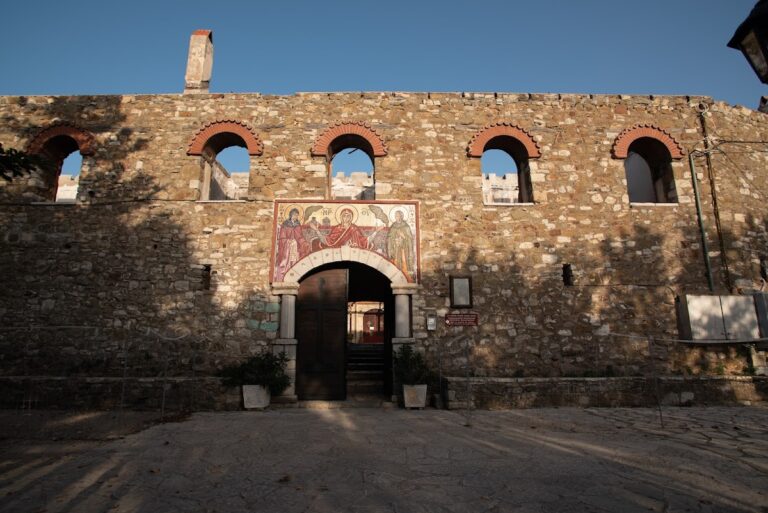
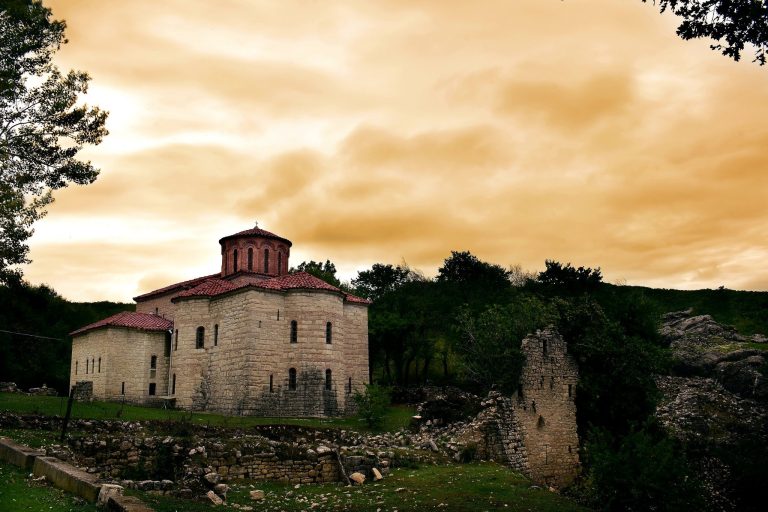
The monastery stands at an elevation of 553 meters on the northern slopes of Mount Oeta. Its surviving complex combines the 15th-century katholikon, later monastic buildings, chapels, relic spaces, the natural history museum, and environmental facilities. The architectural center is the church on the northeastern side of the complex, while later construction reflects the destruction and rebuilding that followed the fire of 1822.
The katholikon and its chapels
Main church
The katholikon is a domed, Athonite-type cross-in-square church. This plan is associated with the monastic churches of Mount Athos and commonly includes side conches, or curved spaces for singers. The church is organized as a four-supported cross-in-square building and includes a narthex, the entrance hall, and an exonarthex, an outer entrance hall. Although its core dates from the 15th century, later architectural interventions have altered the building.
The church has a carved wooden icon screen fitted with later portable icons dated 1905. The icons were made by the Iosaph brothers, Asia Minor icon painters from Mount Athos. The church also contains the alleged tomb of Venerable Agathon, discovered in the south wall in 1959.
Corner chapels and wall paintings
Four small chapels are incorporated into the four corners of the katholikon’s building mass. The southeastern chapel is dedicated to the Transfiguration of the Savior, the northeastern chapel to the Holy Apostles, the northwestern chapel to Saint Charalambos, and the southwestern chapel to Saint John the Baptist.
These chapels contain notable wall paintings dating from the mid-16th century. The surviving paintings in the katholikon reflect three phases of work, from the 16th and 17th centuries, the 18th century, and repairs and additions made in the 20th century. Their condition was severely affected by the 1822 fire and by the monastery’s subsequent historical disruptions.
Relics and devotional features
A specially arranged chapel in the complex houses the incorrupt remains of Saint Vissarion the Agathonite for veneration. The monastery also preserves the skull of Patriarch John IV the Faster.
The central relic of the monastery is the icon of the Virgin of Agathon. Orthodox tradition holds that the icon was found miraculously and regards it as healing. It attracts worshippers throughout the year and forms a central part of the monastery’s devotional identity.
Later buildings, museum, and grounds
Monastic buildings and museum
The buildings surrounding the katholikon are of more recent construction, reflecting the reconstruction of the complex after the earlier buildings were destroyed. The Oeta Natural History Museum occupies part of the monastery and presents the natural history of Mount Oeta through displays on its geology, climate, plant life, and animals.
Environmental facilities
The grounds include a wild-bird breeding installation for pheasants, partridges, and peafowl. They also extend to a fenced 1,200-stremma game-breeding and controlled hunting area, where red deer live and reproduce. These facilities connect the physical setting of the monastery with its role in conserving the natural environment of central Greece.