Agde Cathedral: A Fortified Romanesque Church in France


Site at a Glance
- Rating
- 4.3
- Popularity
- Low
- Country
- France
- Primary era
- Medieval
- Eras represented
- Medieval, Early Modern, Modern
- Civilizations
- French
- Site type
- Religious
- Remains
- Cathedral
On this page8 sections
History
From Roman Temple to Episcopal Seat
Agde Cathedral is a Roman Catholic church in Agde, France, dedicated to Saint Stephen, an early Christian martyr traditionally regarded as the first Christian martyr. The present Romanesque fortified building began in 1173 under William II, Bishop of Agde. It replaced a ninth-century Carolingian church, which had itself stood on the foundations of a fifth-century Roman church built on the site of an older temple dedicated to Diana.
The cathedral was the seat of the Bishops of Agde from the fifth century until 1790. A diocese is a territorial jurisdiction administered by a bishop. During its medieval development, the building served both religious and defensive purposes, functioning as a fortified cathedral and church-fortress.
Revolution and Reorganization
Agde Cathedral suffered major damage in 1793 during the French Revolution. Charles-François-Siméon de Rouvroy de Saint-Simon de Vermandois de Sandricourt, the last Bishop of Agde, was guillotined during the Reign of Terror, the most violent phase of the Revolution, when revolutionary authorities carried out large numbers of executions.
The episcopal see was not restored after the Revolution. Under the Concordat of 1801, the agreement that reorganized relations between Napoleonic France and the Roman Catholic Church, the cathedral’s parishes were incorporated into the Diocese of Montpellier. The adjoining Romanesque cloister was demolished in 1857, and elements from it were reused in the Notre-Dame Chapel, which became the cathedral’s entrance.
Protection and Musical Changes
Agde Cathedral was classified as a French historic monument in 1840. The fifth bell received the same designation in 1959. The church’s musical furnishings also changed over time. A Romantic organ built by Maurice Puget in 1901 was modified in 1956 and later replaced by the present instrument, built in 1990 by Gérald Guillemin, an organ builder from Malaucène.
Remains
Basalt Fortifications
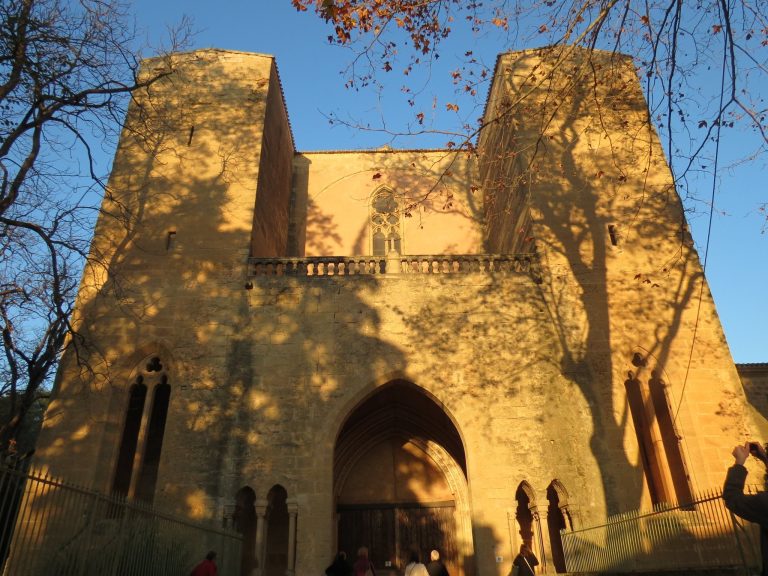
Agde Cathedral stands beside the Hérault River and is built principally from black basalt quarried nearby on Mont Saint-Loup. Its square tower, or donjon, rises 35 metres. A donjon is the principal fortified tower of a medieval castle, and this one could function as a keep. Walls measuring between 2 and 3 metres thick, prominent crenellations, and machicolations carried on arches give the building its defensive character. Machicolations are projecting structures with openings through which defenders could drop or discharge materials onto attackers below.
Entrance and Interior
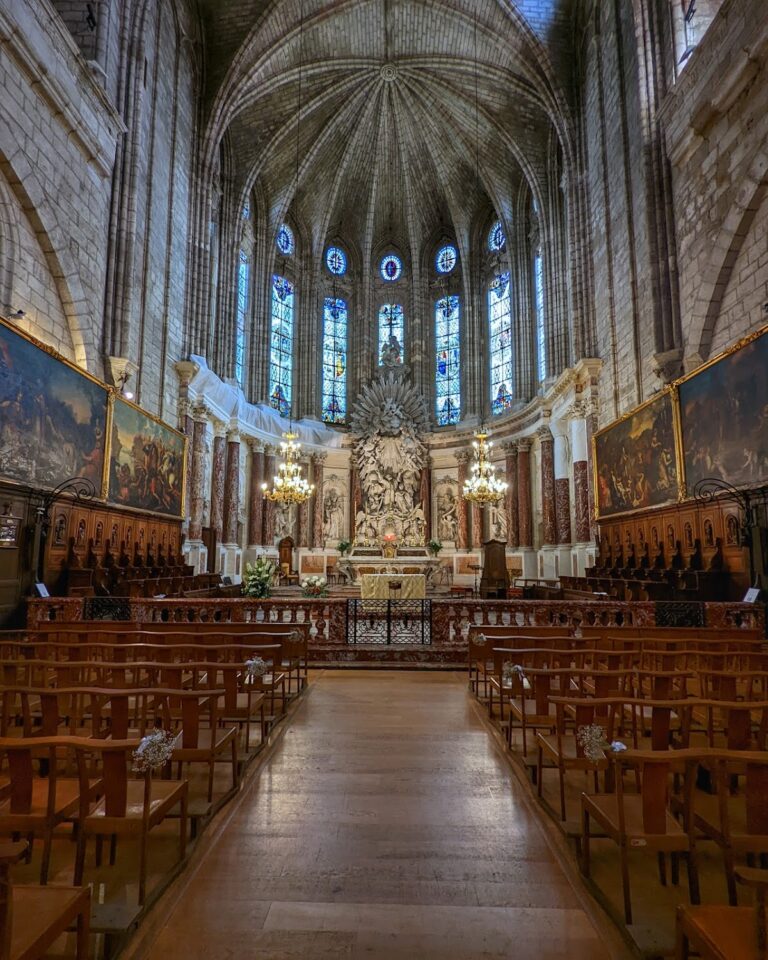
The former Romanesque cloister once adjoined the cathedral. After its demolition, capitals and small columns were incorporated into the Notre-Dame Chapel, which now forms the entrance. Inside, the seventeenth-century high altar is made of polychrome marble and contrasts with the church’s otherwise austere interior.
Organs and Bells
The present organ, built in 1990 by Gérald Guillemin, has a Central German Baroque aesthetic. It contains 29 stops, two 56-note keyboards, a 30-note pedalboard, and mechanical action. Its design was inspired by an organ by Gottfried Silbermann, an eighteenth-century German organ builder whose instruments are associated with the organ tradition of Johann Sebastian Bach. The earlier organ’s four-tower facade, small lantern, three flat sections, and 16-foot cherry-wood bourdon were reused.
The cathedral has five bells. Four hang in the bell chamber at the top of the bell tower. Cast in Lyon by Burdin-Aîné in 1894 and 1895, they include a 130-centimetre bourdon sounding D3 and three smaller bells measuring 118, 96, and 76 centimetres, sounding E3, G3, and B3. The fifth bell is mounted on the roof of the bell tower and serves only the clock. Damiac Fulcrand cast it in Béziers in 1665.