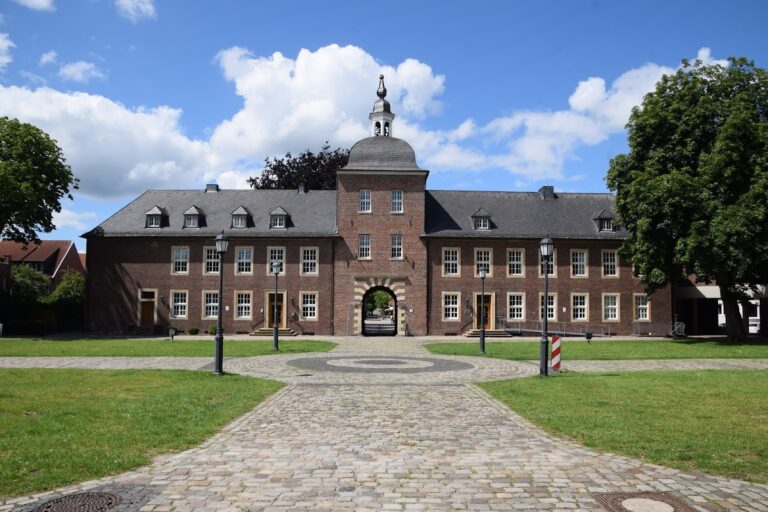
Varlar Abbey: A Premonstratensian Monastery Transformed into a Castle


Site at a Glance
- Rating
- 4.3
- Popularity
- Low
- Country
- Germany
- Primary era
- Early Modern
- External website
- Open
- Eras represented
- Early Modern, Modern
- Civilizations
- Holy Roman Empire
- Site type
- Domestic
- Remains
- Castle
On this page9 sections
History
Varlar Abbey is a former Premonstratensian monastery in Germany, located in Varlar within the municipality of Rosendahl, North Rhine-Westphalia. Founded by the Counts of Cappenberg around 1123 or 1124, it remained a religious institution until secularization in 1803, after which its buildings were converted into Varlar Castle. The Premonstratensians were a Catholic order of Canons Regular whose members combined communal religious life with pastoral ministry.
Foundation and medieval development
A main farmstead near Coesfeld, in the Höven farming community, existed by the eleventh century. It belonged to a noblewoman named Reimod before passing to the Counts of Cappenberg. Otto von Cappenberg supported Lothar von Supplinburg, a German king and later Holy Roman Emperor, in his struggle against Emperor Henry V. After Lothar’s defeat, Otto, influenced by his brother Gottfried, gave most of his property to the Premonstratensian Order. Bishop Egbert of Münster confirmed the foundation.
The idea that Benedictines had lived at Varlar before the Premonstratensians remains uncertain. The new community based its economy on the Varlar and Coesfeld main farmsteads, then expanded its holdings especially during the thirteenth and fourteenth centuries. It acquired the patronage of the church at Rhede in 1249 and its associated bailiwick in 1338. A bailiwick was an administrative or jurisdictional area under a bailiff or similar official. By the end of the fourteenth century, eighty-five farms were subordinate to Varlar, while by the end of the eighteenth century the abbey held 440 estates that paid rent.
Religious and economic role
Varlar’s canons served parishes including Coesfeld, Lette, and Rhede. Their activities extended beyond worship and pastoral care. They provided nursing, organized processions that drew participants from the Netherlands, and introduced contemporary agricultural methods to the surrounding countryside. Over the centuries, however, monastic discipline declined, and the institution increasingly became a provision for younger sons of the nobility. Reform attempts during the sixteenth and seventeenth centuries did not succeed.
The monastery suffered severe looting and destruction in 1591 and again in 1643. On 18 July 1454, during the Münster Diocesan Feud, a fifteenth-century conflict over control of the bishopric of Münster, a battle was fought in front of Varlar. Friedrich II of Brunswick-Lüneburg was defeated there by Dietrich II of Moers, Archbishop of Cologne.
Secularization and the Salm-Horstmar estate
Varlar was dissolved under the Imperial Deputation Act of 1803. This measure reorganized the Holy Roman Empire and transferred many ecclesiastical institutions and properties into secular ownership. The former monastery and its estates passed to the Wildgrave and Rhinegrave of Salm-Grumbach as compensation for the loss of his county on the left bank of the Rhine. Wildgrave and Rhinegrave were historical German noble titles associated with territorial lordship.
The Protestant Salm family used the former monastery as a residence and briefly exercised territorial authority there. The independent County of Salm-Horstmar ended in 1806, when it was mediatized under Article 24 of the Act of Confederation of the Rhine and incorporated into the new Grand Duchy of Berg. Mediatization meant the loss of a small territory’s direct sovereignty when it was absorbed into a larger state. The family nevertheless retained the estates as private property and adopted the name Salm-Horstmar.
Friedrich August Karl zu Salm-Grumbach, who became Prince of Salm-Horstmar in the Prussian princely rank in 1816, introduced various innovations at the estate. His successor, Otto, 2nd Prince of Salm-Horstmar, assumed control in 1865, and Otto, 3rd Prince of Salm-Horstmar, took over the property in 1892. During the nineteenth and early twentieth centuries, the surviving monastery buildings were altered and adapted as a castle complex.
Conflict and twentieth-century use
In 1919, Otto, 3rd Prince of Salm-Horstmar, allowed Walther Stennes to train the volunteer force Freiwillige Kompanie Stennes secretly at Varlar Castle. Stennes later became an SA leader and an opponent of Adolf Hitler. The organization subsequently developed into the Freikorps Hacketau. Freikorps were irregular volunteer military formations that operated in Germany especially during the political upheaval after the First World War, while the SA was the Nazi Party’s paramilitary organization.
Toward the end of the Second World War, equipment for launching V-1 and V-2 weapons was positioned around the castle. On 22 September 1944, a rocket struck a launch installation after a construction defect caused it to fail. The resulting destruction shattered approximately 250 to 300 windowpanes at Varlar Castle and killed two people.
From July 1948, the castle housed royalist Yugoslav officers who supported Peter II, the last king of Yugoslavia. They spent their final years in exile at Varlar with the consent of the British military government. After they left, the Salm-Horstmar family regained the castle. The family is currently represented by Philipp-Otto, 5th Prince of Salm-Horstmar.
Remains
Monastic enclosure and defensive layout
The complex probably developed from an older castle site. Its plan consisted of a forecourt containing supply and economic buildings and a principal enclosure with the monastery buildings and church. Moats surrounded the complex and provided its defensive protection. This arrangement combined the practical needs of a large religious estate with the enclosed form of a fortified residence.
Churches
The oldest monastery church dated from around 1030. It was a single-nave hall church with five or six bays, a polygonal choir, and a sacristy on the south side. A new church was constructed on the same site in 1679, but it was demolished in 1821. The successive churches therefore mark the religious center of the complex across its medieval and early modern phases, while the later building no longer survives as a church.
Monastery wings and castle conversion
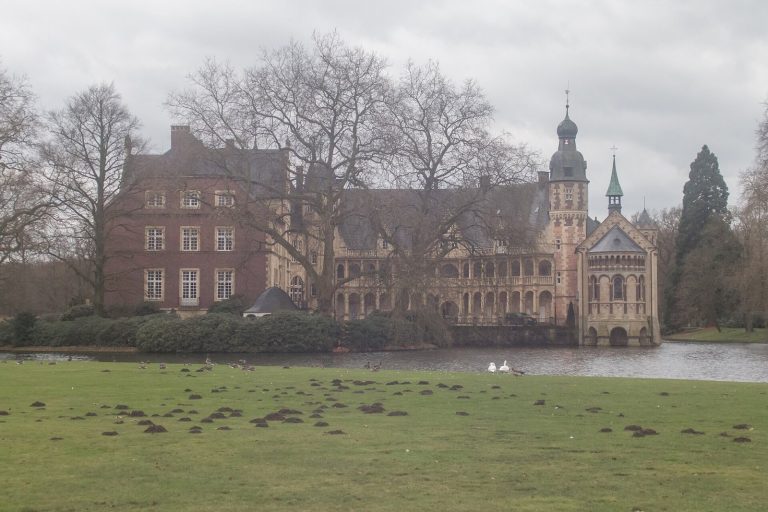
The south wing was built during the seventeenth or eighteenth century. The east wing dates from 1684, while the forecourt was rebuilt in brick in 1707 and the northwest wing followed in 1709. These buildings formed the principal surviving fabric of the former monastery and its service areas.
Parts of the complex were demolished during the nineteenth century, and further changes reshaped the remaining buildings into a castle during the nineteenth and early twentieth centuries. The east facade was redesigned in the Classical style in 1828 by the architect Adolph von Vagedes. The present complex consequently preserves a combination of monastic planning, early modern construction, and later residential alterations.