Mraconia Monastery: A Romanian Orthodox Monastery on the Danube


Site at a Glance
- Rating
- 4.7
- Popularity
- Medium
- Country
- Romania
- Primary era
- Modern
- External website
- Open
- Eras represented
- Modern
- Civilizations
- Unclassified
- Site type
- Religious
- Remains
- Monastery
On this page8 sections
History
Mraconia Monastery is a Romanian Orthodox monastery in Romania, located on the left bank of the Danube in the Kazan sector of the Danube Gorge. It stands on the site of a foundation believed to have existed by the mid-fifteenth century and first recorded in 1453 under the jurisdiction of the Diocese of Vršac. The monastery is now part of the Severin and Strehaia Diocese.
Medieval foundation and the 1523 church
The original founder of Mraconia is unknown. In 1523, Nicola Gârlișteanu, the Severin ban, a high-ranking military and administrative official responsible for a border region, erected a new church with members of his family. They included his wife, Anca, their daughter Irina Banașica, her husband Ban Ubul, and their daughter Nasta. The church was dedicated to the Prophet Elijah.
A different tradition attributes the monastery’s foundation to Serbian monks who crossed the Danube after the Battle of Kosovo. Written and material evidence does not support that tradition. A 1829 chronicle by Nicolae Stoica of Hațeg, a Romanian Orthodox cleric and chronicler, instead connects the monks’ departure with fear of Ottoman forces. It states that they fled to Orșova, particularly after the Battle of Varna and the Ottoman capture of Constantinople in 1453.
Destruction and rebuilding
On the evening of Saint George’s Day in 1715, Ottoman forces killed the monks and burned the church. Only its walls remained. The monastery was destroyed again during the Russo-Austro-Turkish War of 1787–1792, although it was still inhabited in 1788. Rebuilding took place after 1810.
The damaged monastery continued to yield objects associated with its past. In 1823, a seal bearing a Slavonic inscription referring to the Lubostinja Monastery was found among the ruins. An icon of the Virgin Mary was discovered beneath the ruins in 1853. The Munich painter Victor Schram later took the icon to an exhibition in Vienna.
Submergence and re-establishment
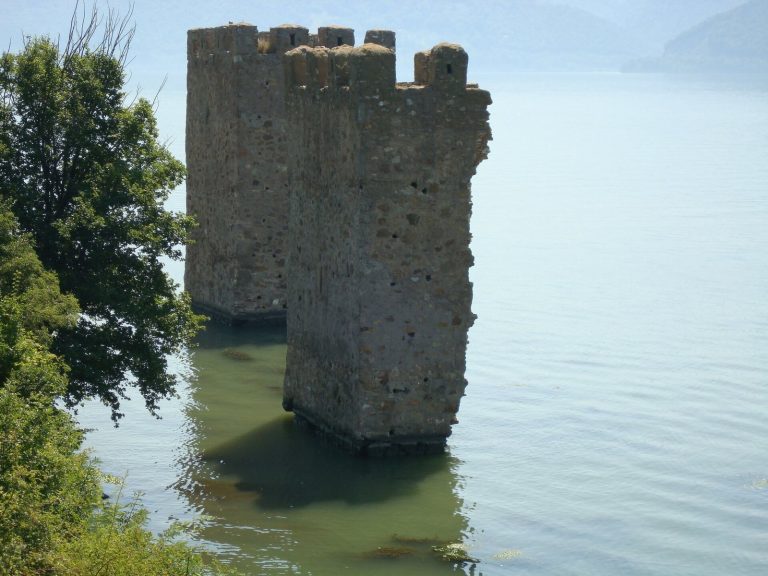
Restoration efforts began in 1931 through an action committee and the work of the monk Alexe Udrea. The site’s history changed fundamentally in the 1960s, during construction of the Iron Gates I hydroelectric facility and reservoir. The old monastery was demolished, and its ruins were submerged by the Danube. By 1967, the former monastery had disappeared beneath the water, giving rise to the name “Monastery under Water.”
After 1989, the Metropolitanate of Oltenia initiated the re-establishment of Mraconia Monastery. The foundation stone of a new church was laid in 1993, and the monastery was re-established in 1995. Work on the church was completed in 1999–2000. The monastery had previously been associated with Ogradena Veche, a village submerged during construction of the reservoir, and with the names Mrăcuna and Ogradena Veche. After its restoration, Mraconia became the exclusive name.
Remains
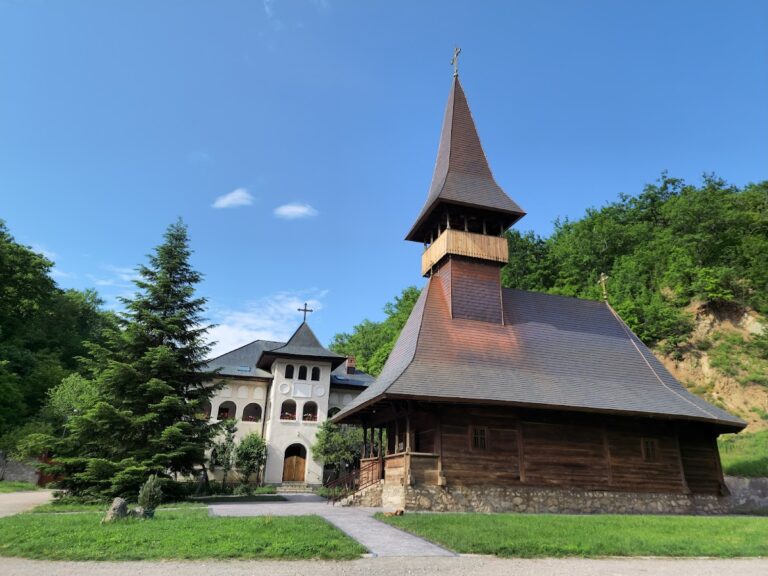
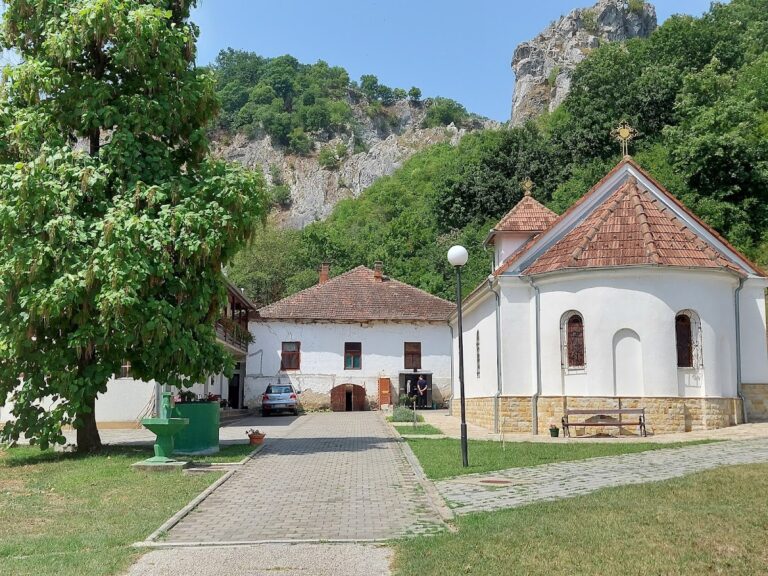
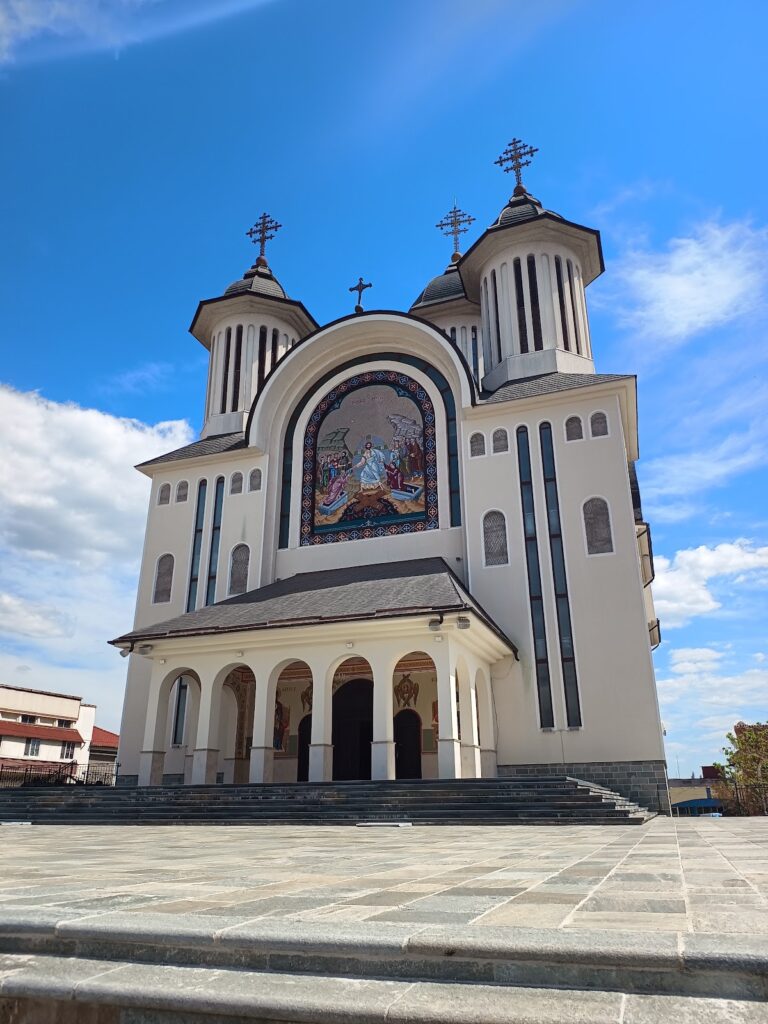
The present monastery occupies the former site in the Danube Gorge, on the Romanian bank of the river in the Kazan sector. Its current church is a brick building with a cruciform plan, organized into an altar, naos, pronaos, and an open porch. The naos is the principal worship space of an Orthodox church, while the pronaos forms the entrance area. The church is dedicated to the Holy Archangels Michael and Gabriel and to the Holy Trinity.
Submerged remains and surviving objects
Former church
The earlier church lies beneath the Danube. It had a cruciform plan, and after the fire of 1715 only its walls survived. The ruins may become visible when the river level falls substantially, although the former monastery was ultimately submerged by the Iron Gates reservoir.
Surviving objects
The former church’s imperial doors, the central doors of an Orthodox iconostasis, survived outside the submerged ruins. A hanging lamp, an oil lamp suspended for devotional use, also survived. Both objects are preserved in the parish museum at Eșelnița.
The seal found in 1823 bears the inscription “Peceat manastirea Lubostinie Uspenia Presvistaia Bogaraditi Leto 1723” and is identified with the Lubostinja Monastery near Kruševac. The icon of the Virgin Mary found in 1853 was later taken to Vienna for exhibition by Victor Schram.