Sant’Adoeno: A Romanesque Church in Bisceglie, Italy
Site at a Glance
- Rating
- 4.5
- Popularity
- Very Low
- Country
- Italy
- Primary era
- Medieval
- Eras represented
- Medieval, Early Modern, Modern
- Civilizations
- Norman
- Site type
- Religious
- Remains
- Church
On this page7 sections
History
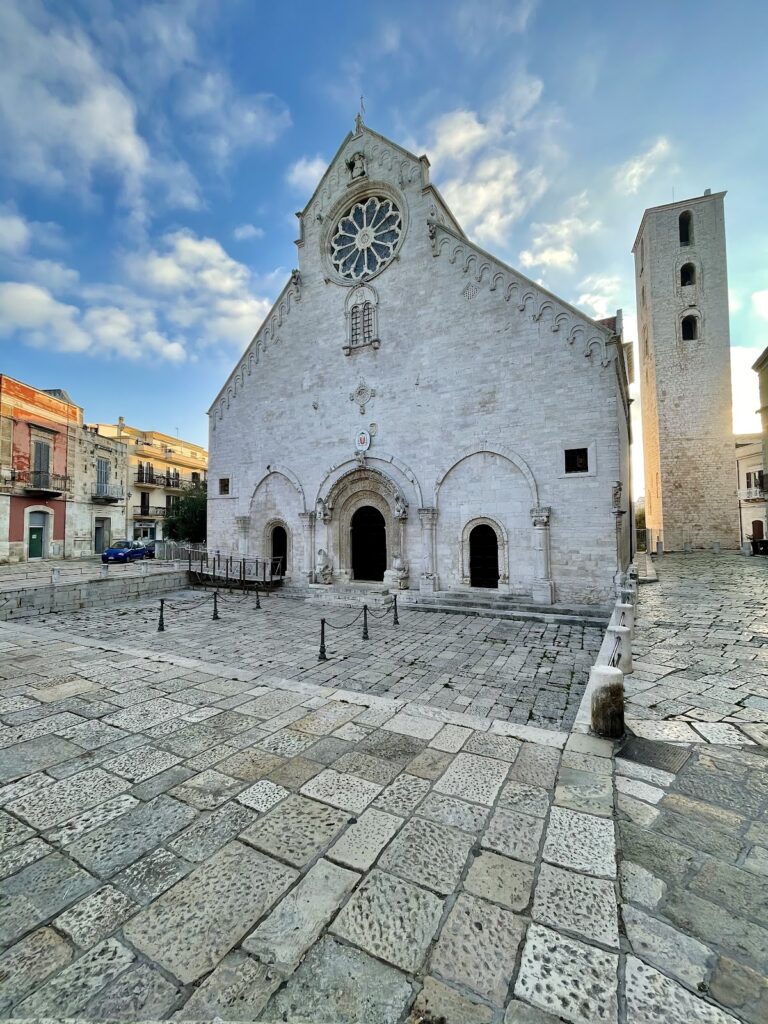
Sant’Adoeno is an eleventh-century Romanesque church in Bisceglie, Italy, traditionally associated with Norman soldiers and built within the city’s oldest walled urban core. Consecrated in 1074, it is regarded as one of the most archaic and pure examples of Apulian Romanesque architecture. The church was dedicated to the Virgin Mary, Saint John the Evangelist, and Saint Audoin, the seventh-century Frankish bishop of Rouen who is also known as Saint Ouen.
Foundation and medieval chapter
In January 1074, Bishop Dumnello of Bisceglie granted Sant’Adoeno to inhabitants who had previously lived in the rural settlements of Cirignano, Primignano, also called Pacciano, and Zappino. Tradition connects the church’s construction with Norman soldiers, whose expansion into southern Italy helped establish Norman political and military power in the region. They are said to have dedicated the church to Audoin, their patron. A small relic of the saint, brought from Normandy, remains inside the church.
The church developed as the seat of a chapter, a body of clergy responsible for its religious administration. In 1306, Bishop Leone ratified the chapter’s decision to establish fourteen canonries. A canonry was a position held by a canon, a member of a cathedral or collegiate chapter. Between 1316 and 1317, the chapter, represented by Simeone, its abbot and rector, disputed the appointment of two vacant canonries with the church’s deacons. Bishop Nicola acted as arbitrator in the dispute.
Bishops, Angevins, and ecclesiastical change
Bishop Simone de Rayano reconsecrated Sant’Adoeno in 1367 in the presence of six other bishops. Around the same period, the abbot received three valuable illuminated antiphonaries as a reward for his fidelity to the Angevins, the French-origin dynasty that ruled the Kingdom of Naples during this period. An antiphonary is a liturgical manuscript containing chants and texts for the Divine Office, while illumination refers to painted decoration, figures, ornament, and sometimes gold. The three manuscripts are now preserved in the diocesan archive.
In 1387, Nicolò Petracino, who had been elected schismatic bishop of Bisceglie by Antipope Clement VII, established his episcopal seat in Sant’Adoeno. Between 1408 and 1413, the church’s abbot, Nicolò Falconi, was appointed bishop of Bisceglie. These episodes reflect the church’s continuing place in the ecclesiastical affairs of the city.
Transformation and modern status
The building underwent major enlargement and transformation during the seventeenth century. In 1769, a decree of the Sacred Congregation of Rites declared the church ad instar Ecclesiae Rothmagensis, placing it on the model of the Church of Rouen. The Sacred Congregation of Rites was a former department of the Roman Curia responsible for Catholic liturgy and procedures connected with the recognition of saints.
In August 1843, the Holy See accepted the collegiate chapter’s appeal for Sant’Adoeno to receive the status of a true collegiate church. A collegiate church is governed by a chapter of canons rather than by a monastic community. The new status was confirmed by royal rescript in January 1844, and chapter statutes were issued in 1847, although they did not receive royal exequatur, the official approval required for certain ecclesiastical acts to have legal effect.
Between 1861 and 1867, following Italian laws that expropriated ecclesiastical property, the State acquired all the possessions of the abbey connected with pastoral functions, despite opposition from the collegiate chapter. The State’s Cult Fund argued that the church’s lay, patrimonial, and conventual character, together with its status as a ricettizia institution, authorized the acquisition. A ricettizia church was supported through assigned or endowed revenues under locally defined ecclesiastical arrangements. Sant’Adoeno is affiliated with Roman Catholicism and belongs to the Archdiocese of Trani-Barletta-Bisceglie. Restoration of the baptismal font was completed in 2010.
Remains
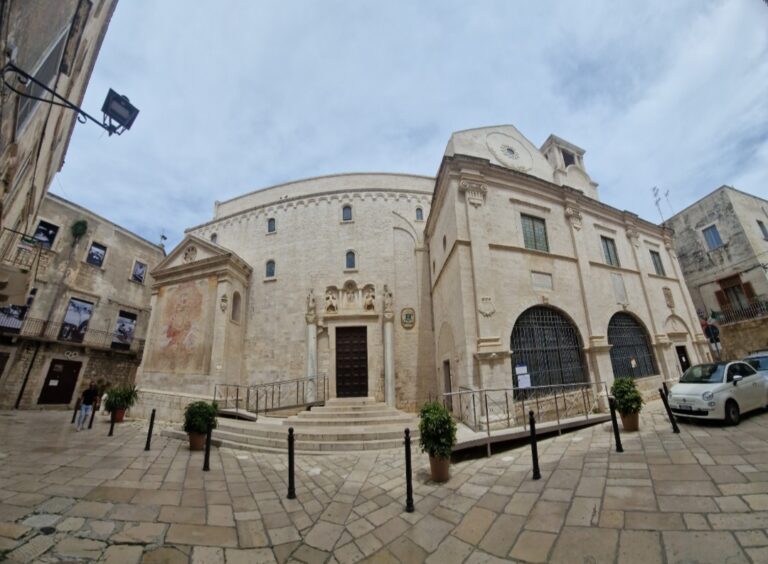
Sant’Adoeno is built entirely of local limestone and follows a three-aisled plan without a transept. The central nave is divided into four bays by robust pillars. Later enlargement and decorative work changed the building’s original spatial organization. The interior floor is paved with local stone slabs and contains funerary slabs commemorating bishops and prominent families, including the Soldani, Tafuri, Tupputi, and Veneziani families. In the nineteenth century, the original wooden trussed roof over the central nave was replaced by a barrel vault with lunettes.
Facade and entrances
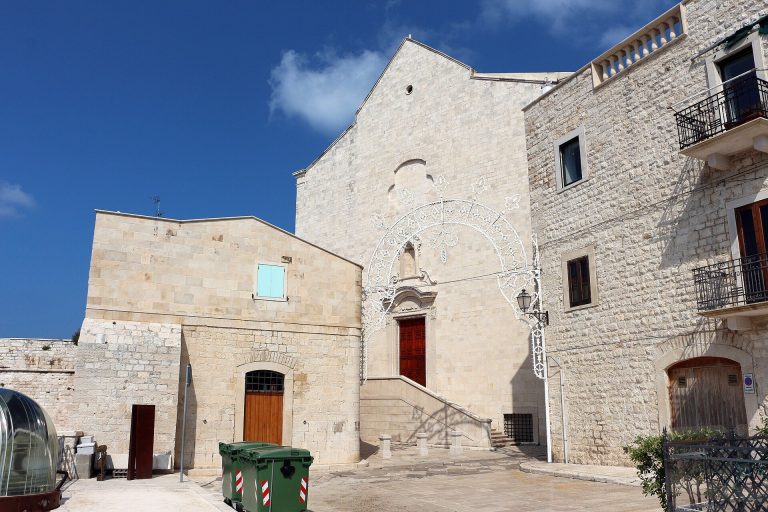
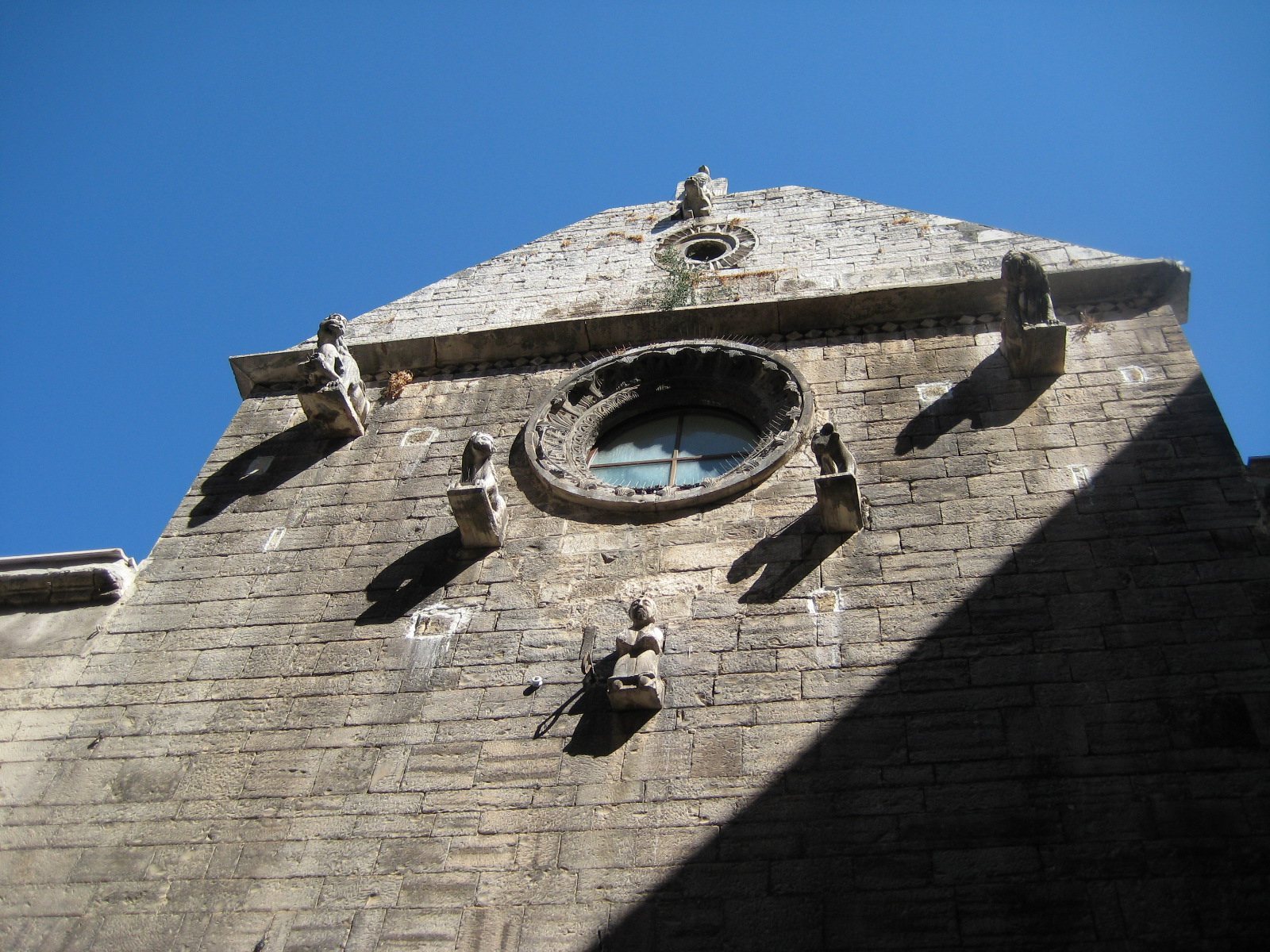
The truncated-gable facade is faced with carefully worked dark limestone blocks laid in courses of varying height. An eagle above a fierce animal crowns the upper part. A small oculus in the gable contains four lozenges alternating with seven saw-tooth elements, a design representing the lunar calendar. Beneath the gable cornice, the central rose window carries reliefs and vegetal motifs. Two pairs of brackets on either side support Romanesque lions, while a lower central bracket supports a small statue probably representing the church’s patron saint.
The lower facade has a central round-arched portal enclosed by an ornamented frame, flanked by two lateral entrances. To the right of the main portal stands a funerary aedicule, a small shrine-like monument, with a pediment and a Latin inscription commemorating a deceased man named Bartolomeo.
Baptismal font
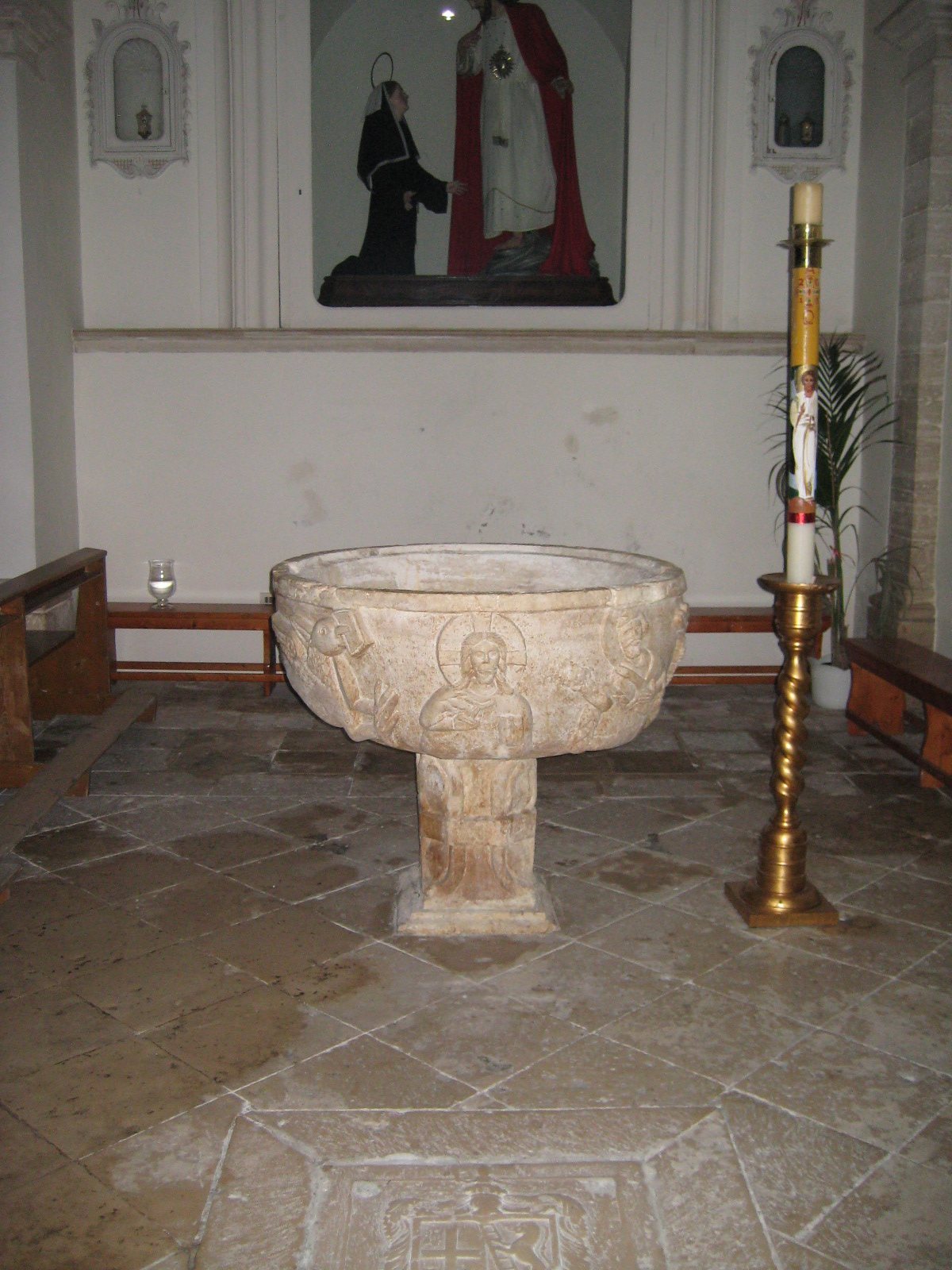
An eleventh-century stone baptismal font stands to the right of the main portal on a square pedestal with chamfered corners. Its six high-relief panels represent the baptism of Christ and the symbols of the Evangelists. The font’s restoration was completed in 2010, preserving a feature associated with the church’s earliest period.