San Bartolomeo dell’Olivella: A Deconsecrated Medieval Church in Genoa
Site at a Glance
- Rating
- 4.7
- Popularity
- Very Low
- Country
- Italy
- Primary era
- Early Modern
- Eras represented
- Medieval, Early Modern
- Civilizations
- Genoese
- Site type
- Religious
- Remains
- Church
On this page9 sections
History
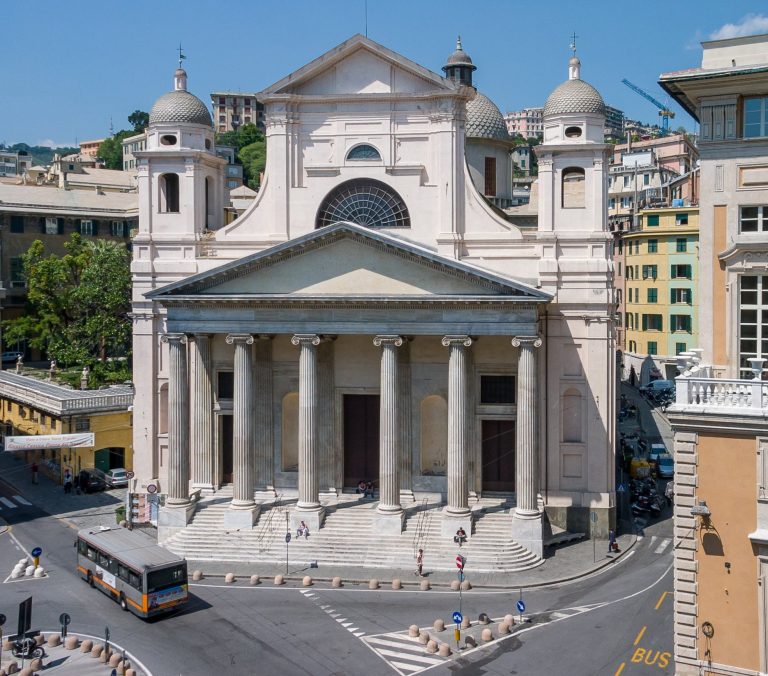
San Bartolomeo dell’Olivella is a deconsecrated Roman Catholic church in Genoa, Italy, founded as part of a monastery in the medieval period. Bonagiunta Valente established the monastery on Olivella hill in 1305, after first considering the Peralto hill, and construction was completed in 1312. Dedicated to Saint Bartholomew, one of the Twelve Apostles traditionally associated with martyrdom, the complex began as a house for Cistercian nuns.
Foundation and religious communities
The Cistercians followed a Western Christian monastic tradition that developed from Benedictine practice and emphasized communal religious life under a monastic rule. The later institutional history of the monastery has been described in more than one way. One reconstruction places the transfer to Lateran canonesses in 1470. Another account relates that the plague of 1493 caused severe losses, after which the remaining nuns were removed in 1514 and replaced by Augustinian nuns. They adopted the Augustinian rule in 1517 and became Lateran canonesses in 1520. Lateran canonesses were communities of regular women religious following the rule of Saint Augustine within the Lateran canonical tradition.
Restoration and Baroque decoration
The church and monastery underwent restoration that continued until 1640. Around four decades later, Giovanni Battista Carlone was commissioned to decorate the church interiors with frescoes. His work, together with paintings by Giovanni Andrea Carlone and architectural illusionism by Paolo Brozzi, gave the interior much of its seventeenth-century character.
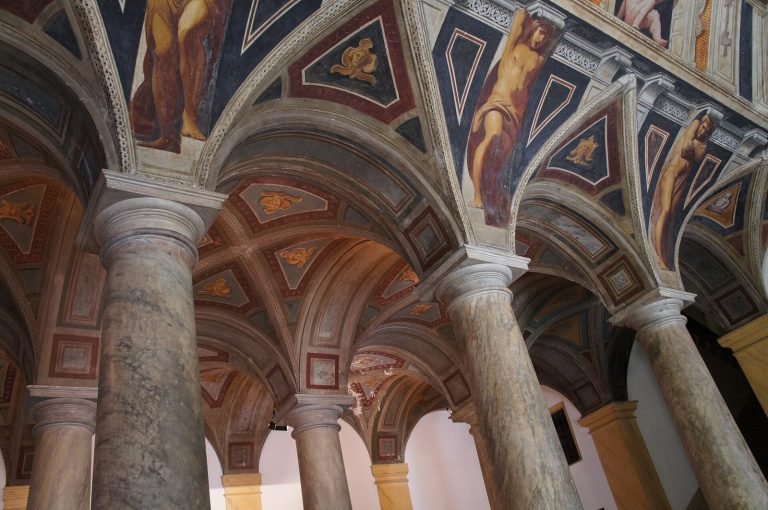
Giovanni Battista Carlone painted Glory of Saint Bartholomew in the presbytery and vault between 1676 and 1680. He also produced Saint Bartholomew Overthrowing an Idol on the left wall of the presbytery and Saint Bartholomew Freeing a Possessed Woman on the right wall. The latter fresco is no longer legible. In 1681, Giovanni Andrea Carlone painted Glory of Saint Augustine on the central vault, along with Virtues, Angels and Flowers on the cornice and The Stories of the Life of Saint Augustine on the walls beneath the choir. He also painted The Baptism of Saint Augustine above the choir. The Descent of the Holy Spirit on the same vault is attributed to him and possibly to Nicolò Carlone. Brozzi’s architectural quadratura, an illusionistic painting technique that creates painted architectural frameworks and perspectives, dates from 1676 to 1680.
Deconsecration and changing uses
In 1798, the nuns moved to the monastery of Santa Maria delle Grazie. The complex was then progressively dismantled. Its contents were first sold at auction, followed by a compulsory sale in 1807, while the former monastic rooms were converted into civilian dwellings. After its deconsecration in 1798, the church itself served first as a warehouse and barracks.
The building reopened in 1820 as the seat of the Confraternity of Our Lady of Mount Carmel. It later passed to the Confraternity of Saints James and Leonard and then to the youth congregation of Saints Raphael and Dorothy. After the First World War, major alterations changed the interior, including several demolitions and the insertion of a mezzanine halfway along the nave. In the postwar period following the Second World War, the building became a cinema-theatre. After that use ended, it was abandoned and later reused for parish youth activities. Urban-planning and archaeological restrictions administered by heritage authorities protect the building.
Remains
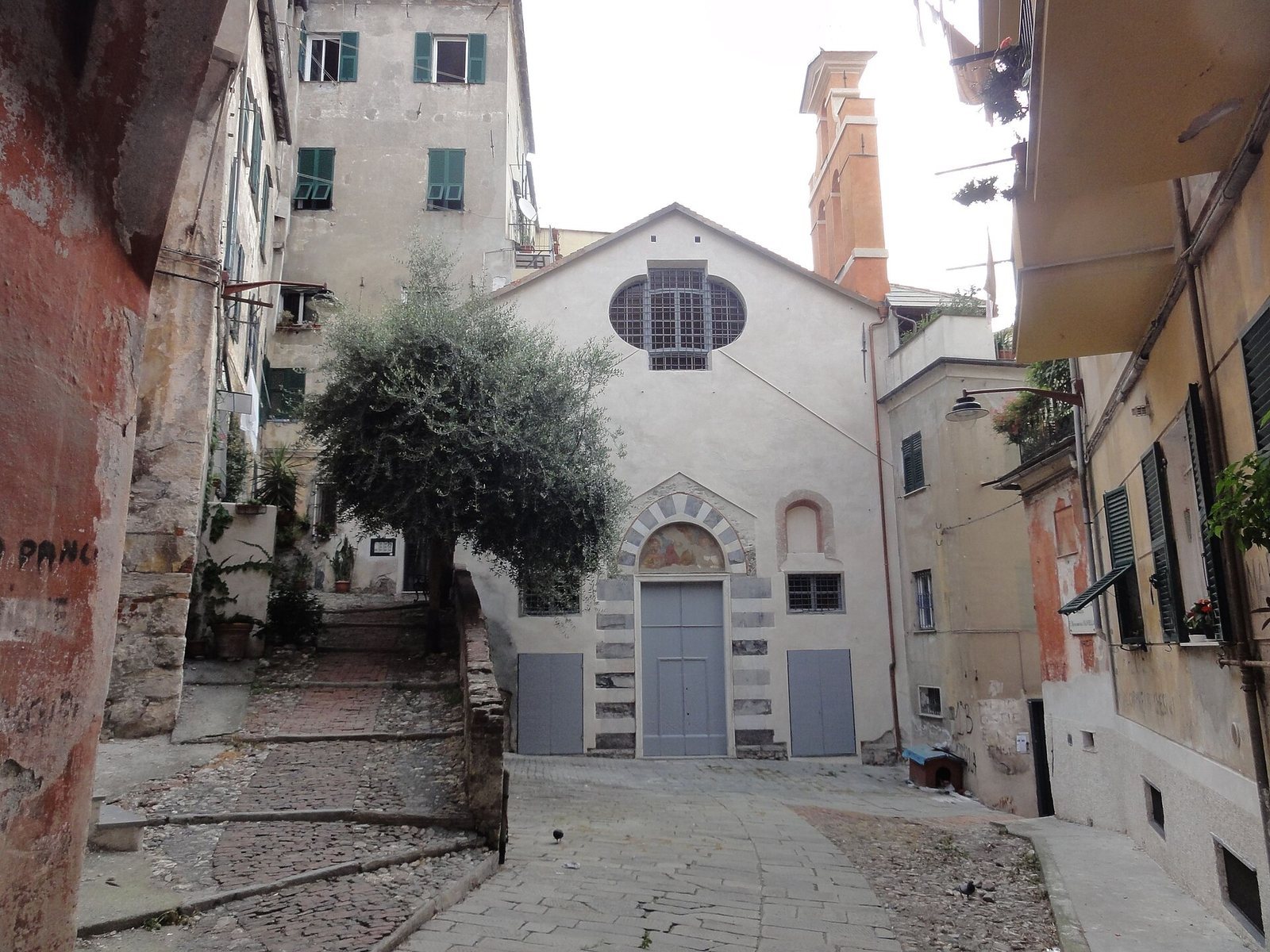
The surviving complex combines parts of the medieval church with altered interior spaces and former monastic rooms now incorporated into civilian houses. The facade retains sections of medieval walling, portions of the original window openings, and the entire portal. Inside, seventeenth-century fresco cycles remain alongside later lunettes and fragments of painted decoration in the former monastery.
Medieval facade and portal
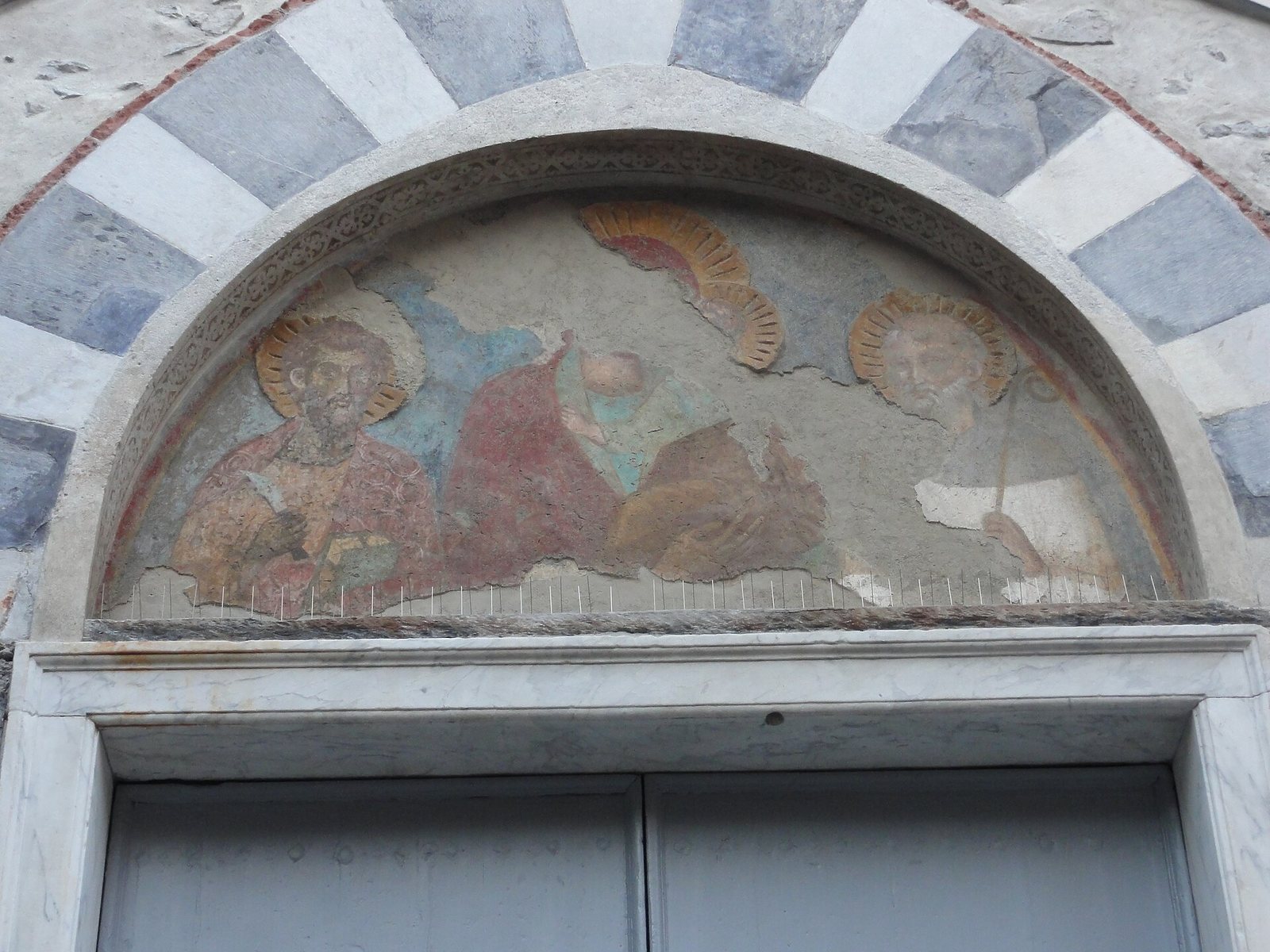
Parts of the facade preserve the church’s medieval fabric, including sections of wall construction and parts of the window openings. The complete portal is the most distinctive surviving entrance feature. Its lunette contains The Madonna and Child between Saints Bartholomew and Bernard of Clairvaux, painted by Manfredino da Pistoia in 1305. Saint Bernard was a twelfth-century Cistercian abbot and theologian, so his presence connects the entrance decoration with the community for which the monastery was founded.
Church frescoes
The presbytery and vault retain Giovanni Battista Carlone’s Glory of Saint Bartholomew, painted between 1676 and 1680. The same area includes Saint Bartholomew Overthrowing an Idol and the damaged fresco Saint Bartholomew Freeing a Possessed Woman. Giovanni Andrea Carlone’s work occupies the central vault and the space around the choir, with images of Saint Augustine, virtues, angels, flowers, and episodes from the saint’s life. His Baptism of Saint Augustine is above the choir, while The Descent of the Holy Spirit is attributed to him and possibly Nicolò Carlone. Painted architectural frameworks by Paolo Brozzi complete the illusionistic decoration of the walls and vault.
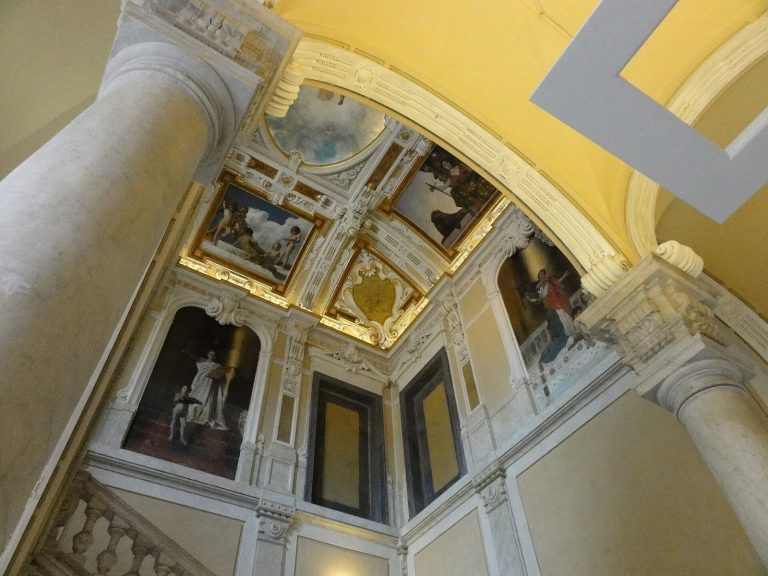
Other painted features include the seventeenth-century lunettes Immaculate Conception and Tobias and the Angel. Nineteenth-century lunettes depict Saint James Driving Away the Moors and an episode from the life of Saint Leonard. The painters of these works are unidentified.
Former monastic rooms
The houses created from the former monastic rooms retain fragments of fresco decoration. These include the seventeenth-century Madonna and Child Giving the Flagellum to a Nun, eighteenth-century depictions of the Madonna of Mercy of Savona and Christ in the Garden of Gethsemane, and an eighteenth-century Pietà in the area of the former cloister.
Dispersed paintings and altar furnishings
Several works once associated with the church were destroyed or transferred elsewhere. Luca Cambiaso’s Martyrdom of Saint Bartholomew, an oil painting dated 1564 that stood on the high altar, was destroyed. A copy by Bernardo Castello is preserved in San Nicolosio, while two preparatory studies are held in the Uffizi Gallery. Cambiaso’s Assumption and the Apostles, an oil painting dated 1567 and measuring 248.5 by 156.5 centimetres, formerly stood on a side altar and is now in San Bartolomeo di Vallecalda in Savignone. San Nicolosio preserves a copy made by Castello in 1612.
Cambiaso’s Saint Augustine and Other Saints, dated 1580 and measuring 167.5 by 253.5 centimetres, also came from a side altar and is now preserved in San Bartolomeo di Vallecalda. The Archangel Raphael and Tobias, attributed to Bernardo Castello, is a seventeenth-century oil painting measuring 180 by 140 centimetres. It was moved to the high altar in the late nineteenth century and is now in the sacristy of the church of Our Lady of Mount Carmel and Saint Agnes.
Giulio Benso’s Saint Leonard of Limoges Freeing Bohemond, an oil painting from the 1630s measuring 300 by 215 centimetres, is now on the right wall of the presbytery in the church of Our Lady of Grace and Saint Jerome. The marble crowning element of the high altar, made by Lorenzo Redi, known as Il Parraca, in 1614, is in a chapel of the Church of Saints Nazarius and Celsus in Arenzano. A marble altar made by Francesco Chiarino between 1654 and 1656, without its crowning element, is now in a chapel of the Church of Saint Nicholas of Tolentino. Another seventeenth-century marble altar from a side aisle, made by an unidentified sculptor, is in the Church of Saints Roch and Sebastian in Parodi Ligure.