Church of St. Andrew (Levanto): A Romanesque Parish Church in Liguria


Site at a Glance
- Rating
- 4.5
- Popularity
- Low
- Country
- Italy
- Primary era
- Medieval
- Eras represented
- Medieval, Early Modern, Modern
- Civilizations
- Genoese
- Site type
- Religious
- Remains
- Church
On this page13 sections
History
The Church of St. Andrew (Levanto) is a Roman Catholic parish church in Italy and an example of thirteenth-century Romanesque architecture in eastern Liguria. Dedicated to Saint Andrew the Apostle, one of the Twelve Apostles traditionally regarded as the brother of Saint Peter, it serves as the seat of its parish within the Riviera vicariate of the Diocese of La Spezia-Sarzana-Brugnato.
Medieval origins
The exact date of construction is unknown, but the church appears repeatedly in thirteenth-century documents. A record from 1222 may mark the beginning of its construction. Around 1230, the building was possibly complete, or at least substantially advanced, when it hosted a notarized meeting between the Da Passano lords, the feudal holders of Levanto, and the town’s citizens.
The meeting concerned agreements made in 1229, including Levanto’s submission to the Republic of Genoa. The church therefore served not only as a place of worship but also as a setting for an important political agreement involving the town and its feudal rulers.
Fifteenth-century enlargement
Major enlargement began in 1450. The side walls were opened to expand the interior from three naves, originally divided by four columns, to five naves with interconnected side chapels. The enlarged church was consecrated on 20 May 1463.
This campaign changed the scale and internal organization of the medieval building. Its later appearance also reflects the decorative language associated with Genoese Gothic architecture, especially the alternating marble and green stone bands used on the facade and on the slender columns of the central nave.
Early modern changes
Further alterations took place in 1584 and 1585. The presbytery, the area surrounding the main altar, was lengthened, and the circular apse, the semicircular sanctuary end of the church, was rebuilt to accommodate a wooden choir. These changes followed requirements associated with the Council of Trent, the sixteenth-century Catholic council that defined doctrine and promoted reforms in worship and church administration.
The bell tower was rebuilt or transformed between 1614 and 1621, and it acquired its present form in 1805. The church’s furnishings continued to develop through the early modern period, while its artworks and devotional objects supported Catholic worship and local religious practice.
Restoration and continuing worship
Between the late nineteenth century and the first decades of the twentieth century, restoration affected the facade, rose window, and interior. The work was supervised by Alfredo d’Andrade, an architect and restorer known for conservation work in Genoa and Liguria. Its purpose was to return the church as a whole to what d’Andrade regarded as its medieval appearance.
The bell complex was restored in 2005, when two bells were added to the existing set. The church now has six bells tuned in C3. Bells 4, 5, and 6 were cast by the Picasso brothers in 1904, bell 2 was recast in 1954, and bells 1 and 3 were made by the Capanni firm of Castelnovo ne’ Monti and installed in 2005.
Local devotion is especially associated with a fifteenth-century wooden crucifix found on Vallesanta beach, west of Levanto, after a storm surge. Its discovery made it an object of fervent popular devotion and established a lasting connection between the church and the coastal community around it.
Remains
Facade and bell tower
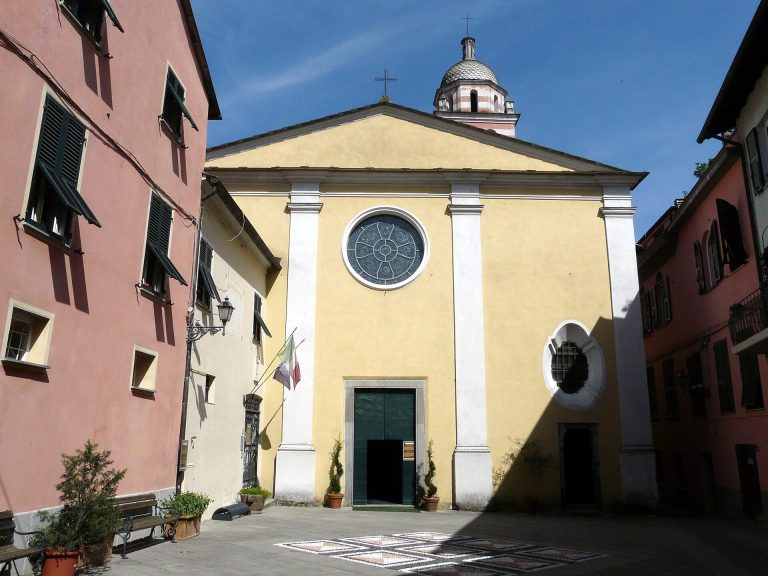
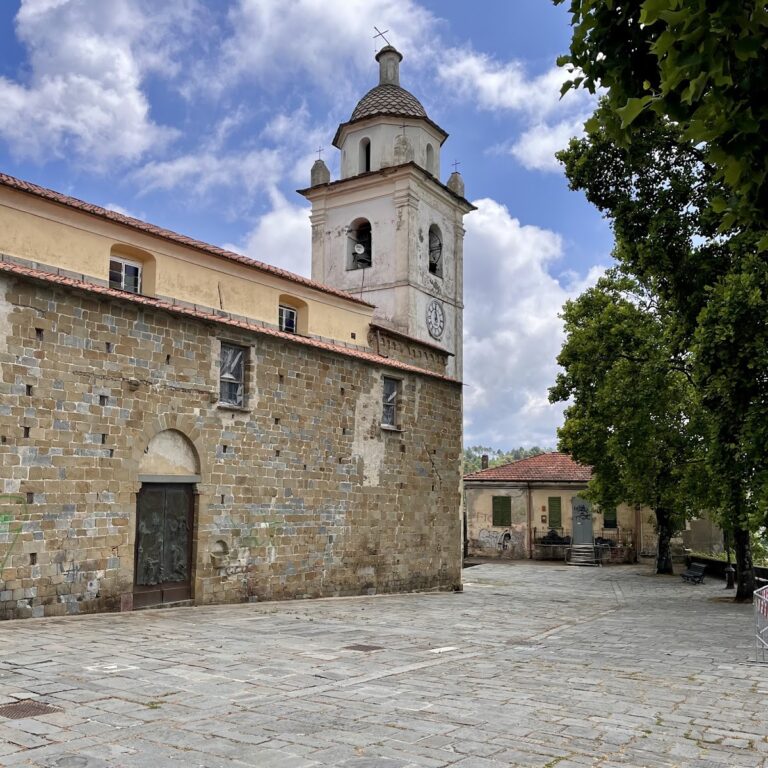
The facade is faced with alternating bands of white Carrara marble and green serpentinite, a scheme characteristic of Genoese Gothic architecture. Its upper section ends in hanging arches with apotropaic heads, decorative elements intended to ward off harmful influences. A marble rose window, a large circular medieval window, occupies the facade above the portal.
Above the Gothic entrance, the lunette, the semicircular space over a doorway, contains a fifteenth-century fresco from the Piedmontese school. It shows the Madonna enthroned with the Christ Child, Saint Andrew, and Saint John the Evangelist, who is traditionally identified as one of the Twelve Apostles and the author of the Gospel of John. The saints are accompanied by a cross and a scroll, and a Gothic inscription above the fresco remains difficult to read. The adjoining bell tower has a polygonal drum and presents the form acquired in 1805.
Naves and central furnishings
The interior is organized into five naves, the result of the fifteenth-century enlargement. The side chapels are interconnected, while the slender columns of the central nave repeat the facade’s alternating bands of white marble and green serpentinite. On the triumphal arch of the central nave is a fresco of Saint Jerome Penitent, depicting the Christian scholar and translator in a penitential setting.
The main altar is a Genoese work in white Carrara marble dating from the middle of the eighteenth century. It was transferred from the former Church of the Most Holy Trinity, now the Oratory of San Rocco. The marble pulpit, dated 14 July 1716, was made by an unknown Ligurian sculptor. It depicts Saint Andrew, with Levanto’s coat of arms rendered below in marble inlay.
Apse and presbytery
The apse contains a carved and sculpted wooden choir dated 1589. It also holds a monumental Serassi organ from Bergamo, made in 1825 and 1826. The instrument was completely modified by the Ruffatti firm in 1958 and restored by Michelotto of Albignasego in 2000.
Two paintings on the presbytery walls portray Saint Gregory the Great, the sixth-century pope and theologian, and Saint Augustine, the late-antique Christian bishop and theologian. They probably date from the eighteenth century. In the chapel to the right of Saint Augustine is an Adoration of the Magi attributed to Andrea Semino, while the chapel on the left contains the seventeenth-century Death of Saint Joseph by Giovanni Battista Merano.
Side chapels and devotional art
Right nave
The right nave contains a white Carrara marble relief of Bartolomeo Pammoleo, a bishop from Levanto, sculpted by the Genoese artist Michele d’Aria. Above it hangs a Crucifixion by the Dutch painter Martinus Jacob van Doorn. Nearby, a sixteenth-century Martyrdom of Saint Sebastian is enclosed in a marble frame dated 1577.
Another painting, Saint Andrew in Glory Among Angels and Saints Roch and Nicholas of Tolentino, was made by Paolo Gerolamo Brusco of Savona. It includes a view of part of Levanto as it appeared in the mid-eighteenth century. The nave also contains an altar carved by Bernardo Mantero in 1750, with a seventeenth- or eighteenth-century Genoese-school statue of Our Lady of Mount Carmel. A seventeenth-century Martyrdom of Saint Stephen is attributed to a follower of Lorenzo Borzone.
Left nave
In the left nave, the fifteenth-century wooden crucifix associated with local devotion stands above a baptismal basin made of red Levanto marble. A baptismal basin is the vessel used in the rite of baptism. To the crucifix’s left, a niche holds a seventeenth-century polychrome statue of Our Lady of Sorrows with the dead Christ, made by an unidentified Genoese sculptor.
Farther along the nave is an altarpiece by Antonio da Carpena showing the Madonna enthroned with the Christ Child and Saints Bartholomew and Bernard. Art-historical studies have suggested that its background may resemble the Uffizi Palace in Florence. The same side of the church contains a white Carrara marble statue of Our Lady of Mercy, an altarpiece of the Coronation of the Virgin with Saints Francis and Ignatius, and a statue of Our Lady of the Rosary surrounded by the fifteen Mysteries of the Rosary.
Treasury
The treasury includes Renaissance silverwork and other religious objects. Among them is a fifteenth-century Lombard monstrance, a Catholic vessel used to display the consecrated Eucharistic host. It has a cylindrical case and retains partly Gothic forms. The treasury also contains a Parisian chalice dated 1532 and 1533, traditionally known as the “Henry VIII” chalice. It is normally kept at the Diocesan Museum of La Spezia and is brought to Levanto only on particular occasions.
Other treasury objects include vitreous-paste enamels depicting prophets. Together with the silverwork and liturgical vessels, these objects form part of the church’s material record of Catholic worship and local devotion.