Our Lady of the Scapular church in Rodnowo: A Gothic Church in Poland


Site at a Glance
- Rating
- 4.6
- Popularity
- Very Low
- Country
- Poland
- Primary era
- Medieval
- External website
- Open
- Eras represented
- Medieval, Early Modern
- Civilizations
- Brandenburg-Prussia, Crusader, Duchy of Prussia, Kingdom of Prussia, Teutonic Order
- Site type
- Religious
- Remains
- Church
On this page13 sections
History
Medieval origins
Our Lady of the Scapular church in Rodnowo is a Gothic church in Poland, completed in the second half of the fourteenth century. Its foundation date has not been established, although a parish may have existed at Rodnowo by about 1326. Records mention a local parish priest in 1377 and the church in 1384. The present brick building may have replaced an earlier wooden church.
The church belonged to the von Tettau owners of the Tolks estate, whose patronage connected the estate with the parish at Reddenau. Tolks village itself belonged to the parish at Borken. This arrangement linked the church to the local landowning family and to the ecclesiastical organization of the surrounding area.
Lutheran parish before 1945
From the Reformation until 1945, the church served the Lutheran parish of Reddenau in East Prussia. Michael Lucas became its first Lutheran pastor in 1568, followed by 27 other clergy before the end of the German period. The parish first belonged to the Bartenstein ecclesiastical inspection and later to the Landsberg superintendent district within the East Prussian Church Province of the Church of the Old Prussian Union, a Protestant church body in the former Prussian territories.
In 1925, the parish had 1,455 members living in 16 surrounding localities. Before the Second World War, Catholic residents of the area belonged to the parish at Bartenstein in the former Diocese of Warmia.
Postwar Catholic use
The flight and expulsion of the local population during and after the Second World War ended the German Lutheran congregation. After 1945, the former Protestant church was transferred to the Roman Catholic Church and became a Catholic place of worship.
An independent Roman Catholic parish dedicated to Our Lady of the Scapular was established at Rodnowo on 13 December 1983. The church at Tolko was assigned to it as a filial church. The parish now belongs to the Deanery of Górowo Iławeckie in the Archdiocese of Warmia. The dedication refers to the vision traditionally associated with Simon Stock, an English Carmelite religious figure linked to the scapular, a devotional garment or object associated with Catholic religious orders and lay devotion.
The church entered the heritage register as monument no. 762 on 28 November 1967. It remains in Roman Catholic use. Protestant residents of Rodnowo belong to the parish in Bartoszyce, a filial parish of St John’s Church in Kętrzyn within the Masuria Diocese of the Evangelical-Augsburg Church in Poland.
Remains
Building and layout
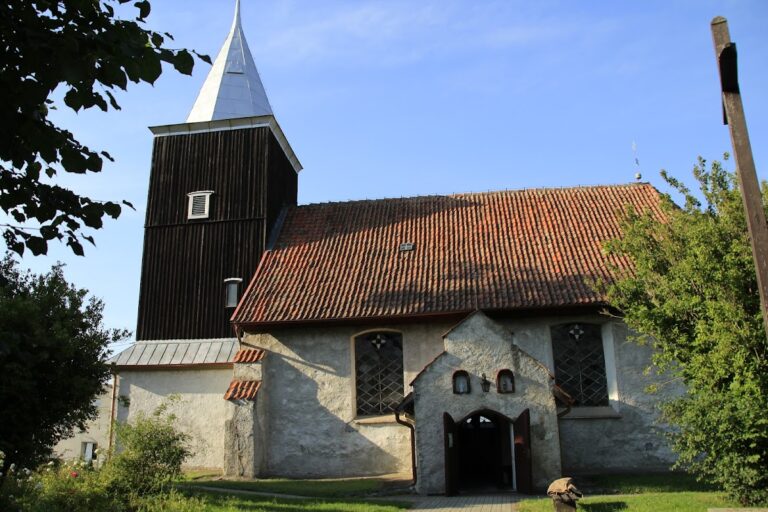
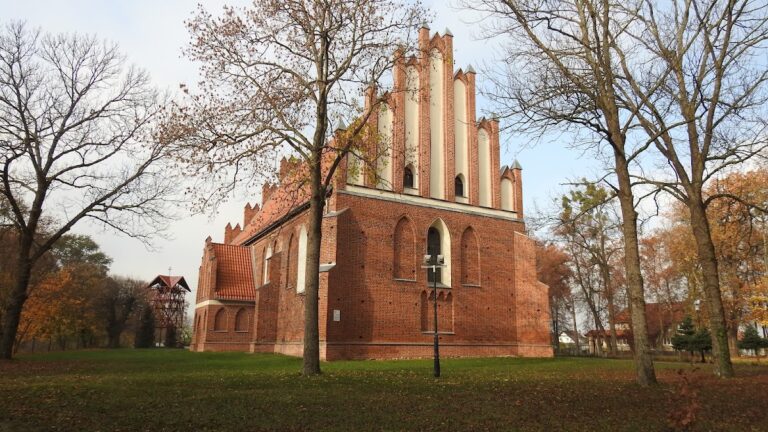
The church is an eastward-oriented, single-nave Gothic building with no separate choir. It is constructed of brick on a stone base, with plastered walls strengthened by buttresses. The windows end in flattened arches. An eastward extension was added in 1619, when the building was also raised and given additional reinforcing buttresses. Further major building work followed in 1676.
The low, square tower occupies the west side of the church. Its ground level contains a porch, and it is covered by a pyramidal sheet-metal roof. A sacristy stands on the north side, while another porch projects from the south. The tower collapsed during a storm on 17 January 1818 and was rebuilt in 1819.
Interior and furnishings
The interior forms a hall-like space beneath a ceiling decorated with stucco ornament dated 1750. The church has one tower and three altars. Its furnishings are chiefly Baroque and late Baroque, reflecting the interior’s development during the seventeenth and eighteenth centuries.
Altars and pulpit
The main altar dates from about 1730. It was formerly connected with the pulpit, whose carved elements were made between 1680 and 1687 in the workshop of Johann Pfeffer. The pulpit was incorporated into the altar ensemble in the mid-eighteenth century. A confession box from about 1730 also survives.
Gallery and church objects
The surviving patrons’ gallery, a reserved seating area traditionally associated with a church patron or founding estate, has a carved enclosure made around 1725. Other furnishings include a seventeenth-century oil painting of the Crucifixion, an eighteenth-century figure of Christ, an eighteenth-century organ gallery, and eighteenth-century sacristy doors. Eighteenth-century altar vessels remain in the church, together with a baptismal dish donated in 1898 by the organist Eduard Guske.
Memorials and burials
Epitaphs
The church contains eighteenth-century epitaphs, commemorative monuments for the dead, dedicated to Georg Dietrich von Tettau, who died in 1733, and his wife Barbara, born von Wallenrodt, who died in 1710. Portraits associated with these epitaphs were removed after 1945.
Tomb slabs and crypt
Two tomb slabs from the transition between the sixteenth and seventeenth centuries commemorate members of the von Tettau and von Lesgewang families. A von Tettau family crypt, a burial chamber beneath a church or altar, lies beneath the altar. In front of the altar is a tomb slab associated with the Lesgewang and von Tettau families.
Tower bells and clock
The original peal contained two bells. The bronze bell, dated 1781, was removed and taken to Germany during the final months of the Second World War, while the cast-iron bell dated 1925 remained. The tower also preserves an unusual inactive clock mechanism without hands, designed to strike the quarters and hours. The church and its furnishings survived the war and the subsequent period in notably good condition.