Our Lady Queen of Poland Church in Garbno: A Historic Parish Church

Site at a Glance
- Rating
- 4.7
- Popularity
- Very Low
- Country
- Poland
- Primary era
- Early Modern
- Eras represented
- Medieval, Early Modern, Modern
- Civilizations
- Kingdom of Prussia, Teutonic Order
- Site type
- Religious
- Remains
- Church
On this page8 sections
History
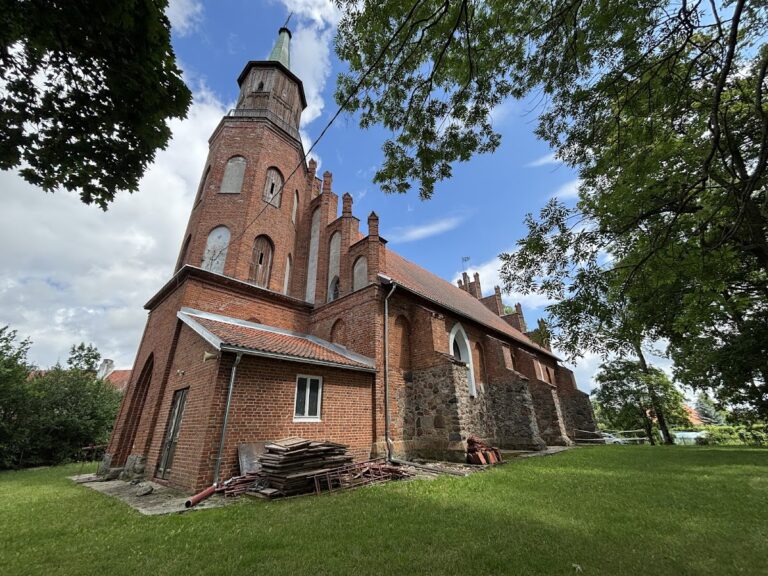
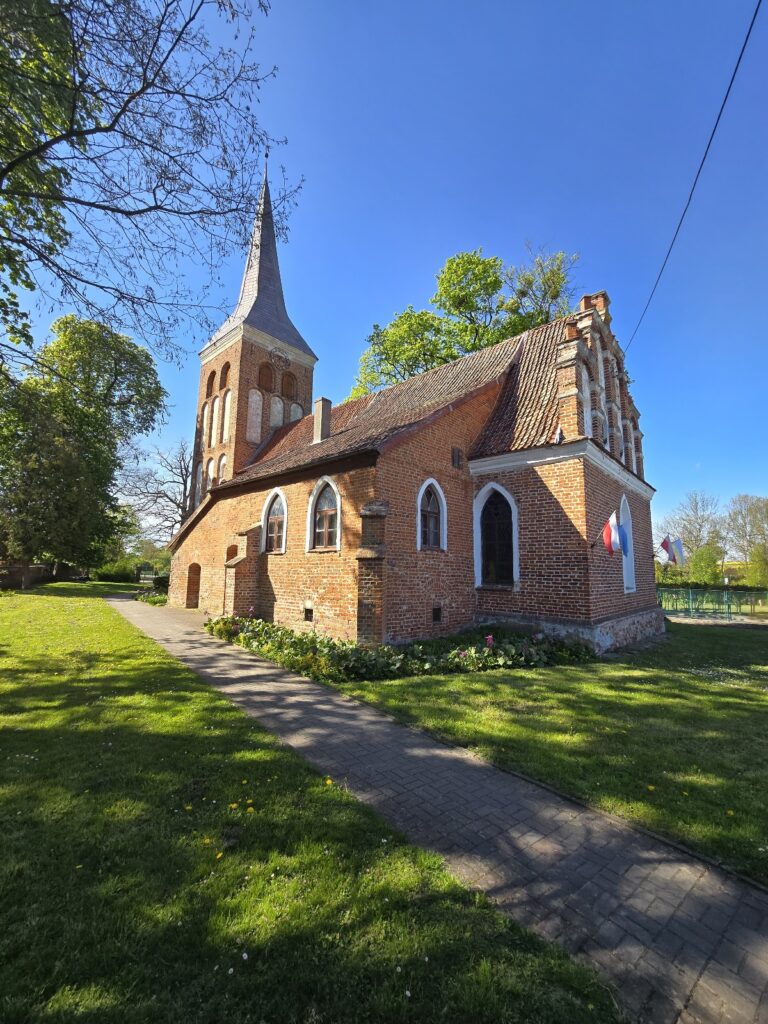
Our Lady Queen of Poland Church is a Roman Catholic parish church in Garbno, Poland. A church stood here by the mid-14th century, when the settlement was known by its former German name, Lamgarben. The present building belongs chiefly to the first half of the 18th century, with its nave rebuilt between 1728 and 1732 and characterized as a neo-Gothic brick structure. Until 1945, it served the Evangelical parish of Lamgarben in the Rastenburg church district of the East Prussian Church Province, within the Church of the Old Prussian Union, the Protestant organization historically associated with the former Prussian territories.
From medieval church to Protestant parish
The medieval congregation became Protestant during the Reformation in East Prussia. On 11 June 1528, the parish was assigned the churches of Schönfließ and Tolksdorf. Both churches had their own pastors and were independent, though still connected, parishes by 1603. During the 16th and 17th centuries, two clergy members sometimes served Lamgarben jointly.
The parish remained connected with the Lamgarben manor, whose owner held its patronage. In 1925, it comprised 1,850 members living across 20 villages, localities, or residential places. Its institutional setting remained Evangelical until the upheavals at the end of the Second World War.
Rebuilding and restoration before 1945
The church underwent a major transformation in the 18th century when its nave was rebuilt from 1728 to 1732. In 1740, the carpenter Christian Böttcher covered the interior with a vault. The church also possessed an organ by 1830. An inventory from 1785 lists an instrument made in 1760 by Adam Gottlob Casparini, an 18th-century organ builder active in the historic Prussian region, but the relationship between that organ and the instrument noted in 1830 is uncertain.
A severe storm on 17 January 1818 brought down the tower onto the church’s roof vault. Fundamental restoration followed between 1818 and 1824 under the direction of Felisch, the provincial building master. The church’s three bells formed its peal before the later destruction of its furnishings.
War, population change, and a new parish
The nave and its furnishings were destroyed during the Second World War. After the war, the building was reconstructed and adapted for Roman Catholic worship. This change followed the displacement and expulsion of the indigenous population and the arrival of Polish residents, which greatly increased the local Catholic congregation. The former Evangelical church was transferred to the Roman Catholic Church and became dedicated to Our Lady Queen of Poland, a Marian title referring to the Virgin Mary as Poland’s patronal queen.
Before 1945, the area’s small Roman Catholic population belonged to the parish at Heiligelinde and, from 1905, to the parish at Rastenburg. The Diocese of Ermland established an independent parish in Garbno on 29 May 1981. It now belongs to the Kętrzyn I deanery of the Archdiocese of Ermland. Tolksdorf serves as its filial church, meaning a dependent church attached to the main parish, and the parish also provides pastoral care to the prison in Dubliny.
Evangelical residents of Garbno now belong to the parish in Kętrzyn, within the Masuria Diocese of the Evangelical-Augsburg Church in Poland, the country’s Lutheran church body. The church therefore retains a history that extends from a medieval foundation through an Evangelical period to its present Roman Catholic role.
Remains
The church stands beside the Guber River. Its surviving fabric combines a medieval tower with a later plastered hall church, whose single main interior is not divided into a basilican arrangement. The nave has corners cut off at an angle rather than meeting in sharp right angles. After the Second World War, the interior was rebuilt with a wooden trapezoidal ceiling and arranged for Roman Catholic worship.
Medieval and later building elements
Stone tower and baptismal furnishing
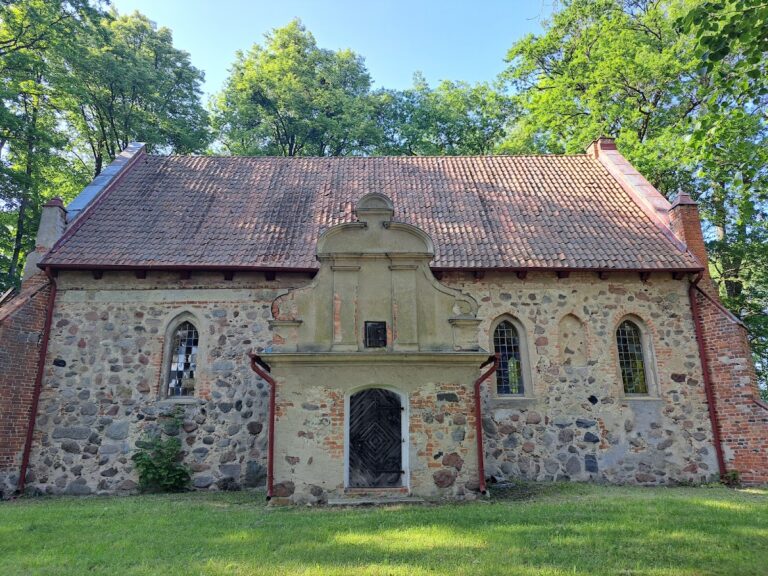
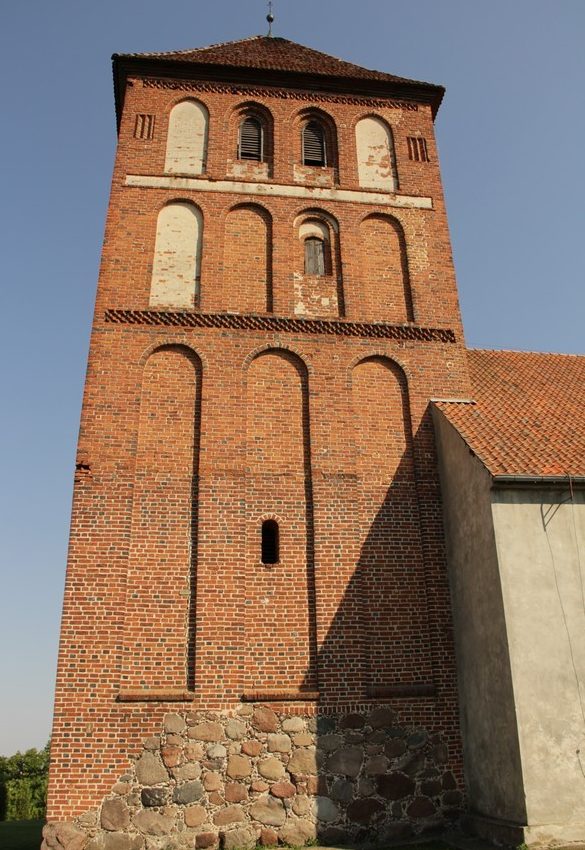
The tower dates from the first half of the 15th century and is the principal surviving architectural element associated with the medieval church. A granite holy-water font from the 15th century stands in front of the building, providing another physical link with the church’s earlier history.
Rebuilt nave and interior
The nave is a plastered hall with chamfered corners and is also described as a neo-Gothic brick structure. Its interior was vaulted in 1740 by Christian Böttcher. Before the wartime destruction, the furnishings included an altar, a richly decorated pulpit dated 1740, and gallery fronts from the second third of the 18th century bearing biblical scenes. A limewood crucifix from around 1500 was also part of the pre-war interior.
The church had an organ by 1830. The 1785 inventory identifies an earlier organ made in 1760 by Adam Gottlob Casparini, whose pipes produced sound through supplied air, but the surviving information does not establish whether this was the same instrument later recorded in the church. The pre-war peal consisted of three bells.