Jesuit College in Litoměřice: A Baroque Religious and Educational Complex


Site at a Glance
- Rating
- 4.5
- Popularity
- Very Low
- Country
- Czechia
- Primary era
- Early Modern
- Eras represented
- Early Modern, Modern
- Civilizations
- Habsburg, Holy Roman Empire, Kingdom of Bohemia
- Site type
- Religious
On this page11 sections
History
The Jesuit college in Litoměřice, Czechia, is a former Baroque religious and educational complex founded under Emperor Ferdinand II in the seventeenth century. Its establishment formed part of the Catholic Church’s Counter-Reformation, the effort to strengthen Catholic teaching and institutions in response to the Protestant Reformation. The college occupied a strategic position in northern Bohemia, near the frontier with Lutheran Saxony, and was intended to support the extension of Catholic influence through the region.
Before the Jesuit foundation
The site had religious and educational associations before the arrival of the Jesuits. Beside the Church of the Virgin Mary, a small community of the Knights of the Cross with the Red Star operated with a hospital that already existed by the mid-thirteenth century. The church and hospital later came under the administration of Litoměřice. The area probably belonged to the former estate of Blessed Hroznata, a medieval Bohemian nobleman venerated as a Catholic blessed and associated with religious foundations. It originally lay outside the town walls, in the outer area of the former royal town.
A Latin school was founded there in 1549. For a period its rector was Pavel Stránský, the author of On the State of Bohemia, who left Litoměřice for exile in 1627. The planned Jesuit foundation inherited this earlier educational setting. Its initial endowment included the Church of the Virgin Mary, the Latin school, six houses, including Stránský’s house, and a large house at Mlékojedy confiscated from him. Ferdinand II also assigned the college half of the Úštěk–Liběšice estate, which had been purchased from Jan Merode, to provide income.
Foundation and expansion
Ferdinand II issued the formal founding resolution on 3 August 1629. Construction of the college building began in 1630, and the main building was erected in 1638. The first three Jesuits were ceremonially established in Litoměřice on 21 June 1631, but they fled during the Saxon invasion. Two Jesuits created a stable presence from 1634, and the first recorded superior of the residence was appointed in 1637.
The residence became a college headed by a rector in 1643, under Father Mikuláš Pavlat. By the 1640s it had twelve members. The complex developed into a religious, educational, and missionary institution comprising a church, gymnasium, seminary, and residence. The building was later extended by a wing toward the Elbe, and work on the college was not complete until 1739. Its southern wing dates from after 1770.
Education, preaching, and missionary work
The gymnasium continued the tradition of the earlier Latin school and received the title of Imperial Gymnasium in 1660. A gymnasium in this period was a secondary school preparing students for advanced study. The head of the Seminary of Saint Joseph, an institution for the education and formation of clergy, also served as gymnasium director. The seminary grew from about twenty residents to approximately seventy, while the gymnasium had around 100 to 150 students, including about forty seminarians.
Among its students were František Antonín Steinský, later a professor of auxiliary historical sciences at Charles University; Alois Klár, later a professor and founder of Prague’s institute for the blind; and the composer Václav Praupner, who later directed the choir of Prague’s Týn Church. After the establishment of the Litoměřice bishopric, the Jesuit community regularly supplied two preachers at St. Stephen’s Cathedral. One preached in Czech and the other in German, until secular clergy replaced them in 1757.
The college also sent members on missions beyond Bohemia. František Tillisch, who served as a subregent at Litoměřice in 1649, later travelled to China, became the emperor’s personal mathematician, and wrote an account of his journey. Another Litoměřice Jesuit, Father John, worked in the Philippines. Within the college, Jan Kořínek, a historian of Kutná Hora, served as rector from 1666 to 1669, while Bohuslav Balbín worked there in 1666. Both maintained a friendship with Maxmilián Rudolf of Schleinitz, the first bishop of Litoměřice.
Church, performances, and the eighteenth century
The new Marian church was built by Octavio Broggio between 1700 and 1731 and consecrated in a major ceremony on 16 September 1731. The college’s cultural activity included dramatic performances. Students staged the “Great Comedy” on 28 August 1700 during the blessing of the church’s foundation stone, and performed melodramas during celebrations for the installation of Bishop Mořic Adolf in 1733.
Suppression and later uses
Pope Clement XIV suppressed the Society of Jesus, the Catholic religious order commonly known as the Jesuits, in a brief issued on 21 July 1773. Eighteen Jesuits remained at the Litoměřice college at the time. Its last rector was Father Jan Filipi, and its prefect was Father František Fritsch. The members received money for secular clothing and a monthly allowance until they found employment. Some former Jesuits stayed in Litoměřice and entered pastoral service. Father Vojtěch Hrbatý continued preaching in Czech.
After the suppression, the college building was valued at 5,000 florins and converted into barracks. The Seminary of Saint Joseph was sold to a Litoměřice burgher, while the church was placed under the town parish dean. The town council petitioned for the preservation of the gymnasium, allowing its educational continuity. Former Jesuit Father Bernard Schirmer directed it after 1773 and helped bring about a renewed flourishing. He was also a mentor and friend of Josef Jungmann, who worked in Litoměřice from 1799 to 1815, and of other Czech revivalists.
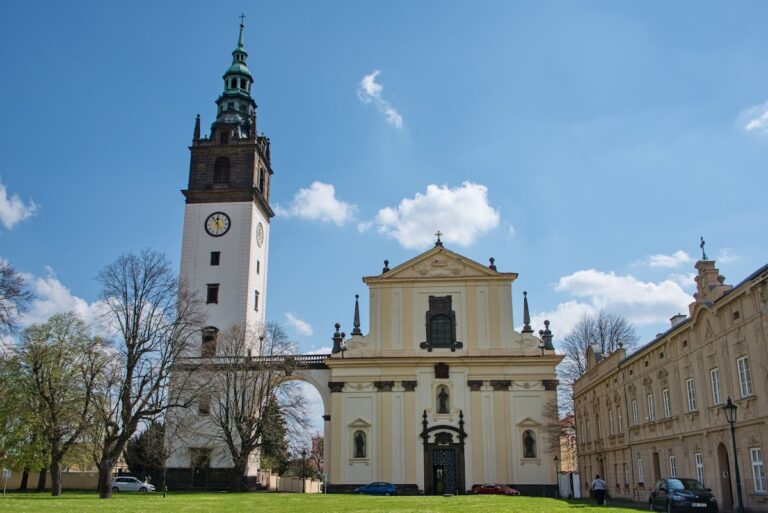
The former college was used again as a priestly seminary from 1810. The college and church were connected by an overhead passage in 1818. Although the Society of Jesus was later restored, the Jesuits did not return to Litoměřice. After the Second World War, the building housed the transport-revenue control office and a computing centre of the Czechoslovak State Railways. It was later used as the headquarters of a local construction company. The college and the Church of the Annunciation of the Virgin Mary are now recorded as a protected monument complex in Litoměřice.
Remains
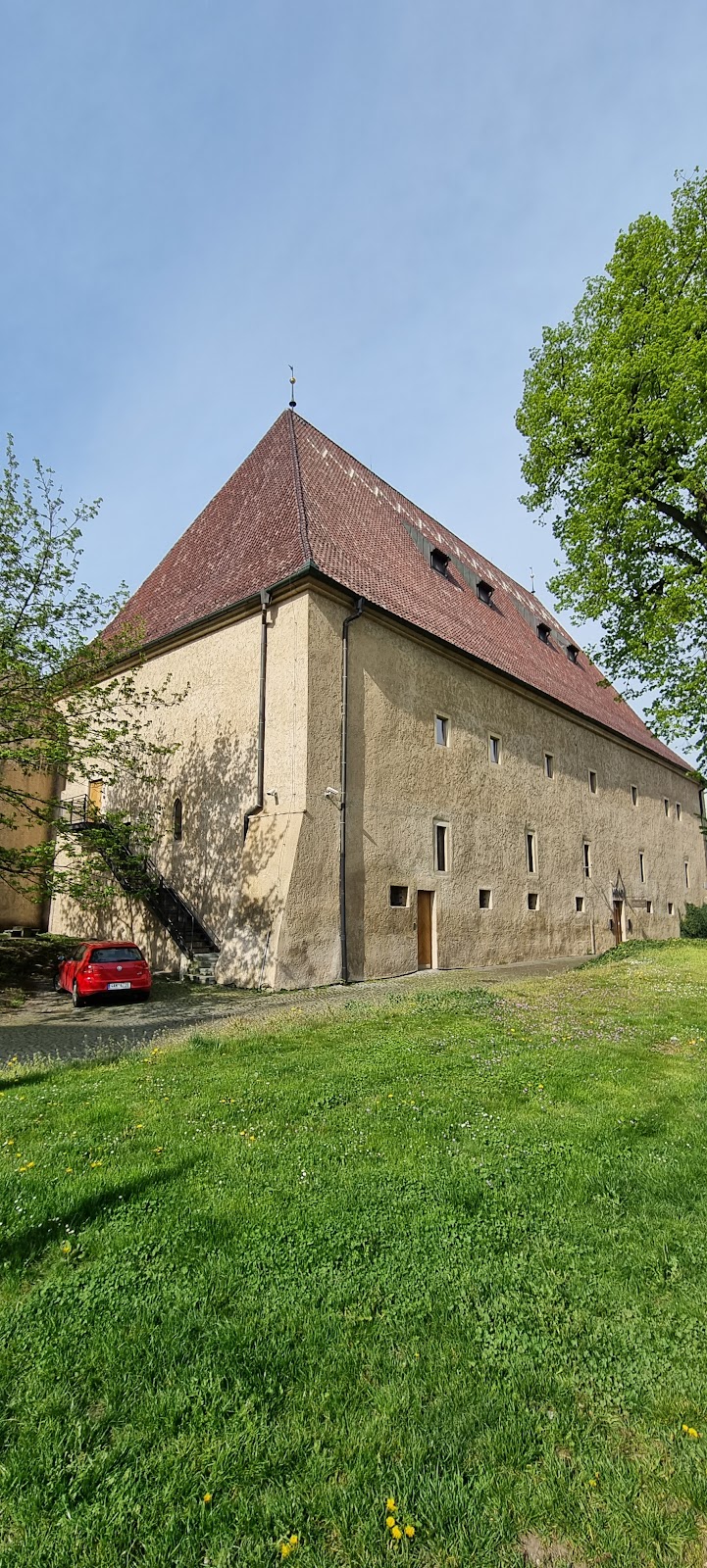
The former Jesuit residence stands on Jezuitská Street opposite the Church of the Annunciation of the Virgin Mary, on elevated ground above the river. Together, the residence, church, gymnasium, seminary, and associated buildings formed a larger institutional complex. Its surviving architecture reflects a long building history that began with the college’s construction in the 1630s and continued through extensions into the eighteenth century.
College residence and connected complex
Jesuit residence
The college building is a Baroque structure designed and built by the Italian-born architects and builders Giulio Broggio and his son Octavio Broggio. It was constructed according to their own design. Work began in 1630, and the building was erected in 1638. A later wing extended toward the Elbe, while the southern wing belongs to the period after 1770. These additions preserve the evidence of the college’s gradual enlargement as its religious, educational, and residential functions developed.
Church of the Annunciation
The associated Church of the Annunciation of the Virgin Mary replaced the earlier Gothic Church of the Virgin Mary. Octavio Broggio built the new church between 1700 and 1731. It is a high-quality Baroque building with valuable frescoes by Kramolín, Lauterer, and Hiebel, together with valuable furnishings. An overhead passage at first-floor level joined the church and college in 1818, creating a physical link between the two principal parts of the complex.
Earlier buildings and school site
The earlier religious and educational landscape included the small Gothic Church of the Virgin Mary, its adjoining hospital, the Latin school, six houses, and the large house at Mlékojedy. The Gothic church was enlarged in 1650 and later abandoned when the new Baroque Marian church was built. The Latin school continued as the institutional predecessor of the Jesuit gymnasium, while the surrounding houses and endowed properties formed part of the college’s original material foundation.