Village Church Jühnsdorf: A Medieval Fieldstone Church in Germany


Site at a Glance
- Rating
- 4.3
- Popularity
- Very Low
- Country
- Germany
- Primary era
- Medieval
- External website
- Open
- Eras represented
- Medieval, Modern
- Civilizations
- German, Holy Roman Empire, Kingdom of Prussia, Margraviate of Brandenburg
- Site type
- Religious
- Remains
- Church
On this page9 sections
History
Village Church Jühnsdorf is an Evangelical fieldstone church in Blankenfelde-Mahlow, Germany. Its core is traditionally dated to the fourteenth century, although that dating remains possible rather than certain. The church belonged to the parish organization of Jühnsdorf by 1375, when the land register of Charles IV, a fourteenth-century Holy Roman Emperor and King of Bohemia, listed four parish hides there. A parish hide was land assigned to support a parish and its priest, so the entry indicates an established church community at Jühnsdorf by that time.
Medieval parish origins
The fourteenth-century church formed the historical core of the building that survives today. Its congregation is now part of the Zossen-Fläming church district within the Evangelical Church Berlin-Brandenburg-Silesian Upper Lusatia. The church therefore preserves both a medieval foundation and a continuing institutional connection with the surrounding region.
Nineteenth-century rebuilding
A major transformation took place in 1869 under the direction of the Zossen master builder Klehmet, working for the von dem Knesebeck estate family. The west tower and semicircular apse were added in yellow brick, the nave walls were raised, and the windows were enlarged with round arches in the manner of Friedrich August Stüler, a nineteenth-century German architect associated with historicist church and civic architecture. The Wilhelm Remler organ was also made in 1869.
The interior was redesigned in 1898, when the furnishings were probably renewed as well. The church was connected to the electrical grid in April 1938. Its organ later suffered from wartime and postwar pressures: many of its pipes were surrendered for military purposes in 1917, while dismantling was narrowly prevented in 1947. A lightning strike in 1968 damaged the electric motor, leaving the instrument unusable for many decades.
Repair and commemoration
Since the mid-1990s, the interior has had an open roof structure. The congregation renovated the interior in 1999 and repaired the apse roof in 2002. A support association was established in 2014. Three new bells were installed in 2015. Two had come from the deconsecrated Church of the Holy Family in Rodewald, Lower Saxony, while a third was cast in Innsbruck in July 2016 and placed in the bell frame for the Harvest Thanksgiving festival.
In 2017, the congregation sought donations for the organ repair, which was estimated at 200,000 euros. Restoration began in 2020 at the Berlin workshop of Karl Schule and ended in 2021 after about 3,000 hours of work. In 2024, the installation of a water connection led to the discovery of human remains. Examination identified them as those of a woman whose identity was unknown. She was reinterred in a new grave in the church cemetery during a funeral service in September 2024.
The cemetery’s historic monuments have also received attention. Stone and granite graves were cleaned in 2022, including the oldest zinc-cast grave cross, dated 1828. By the end of October 2024, the family tomb ensemble of the von dem Knesebeck family had been restored. The work included crosses, stone plinths, and surrounding structures, and clarified the grave marker of Heinzo von dem Knesebeck, who died at the age of two in the middle of the nineteenth century.
Remains
Village setting and exterior
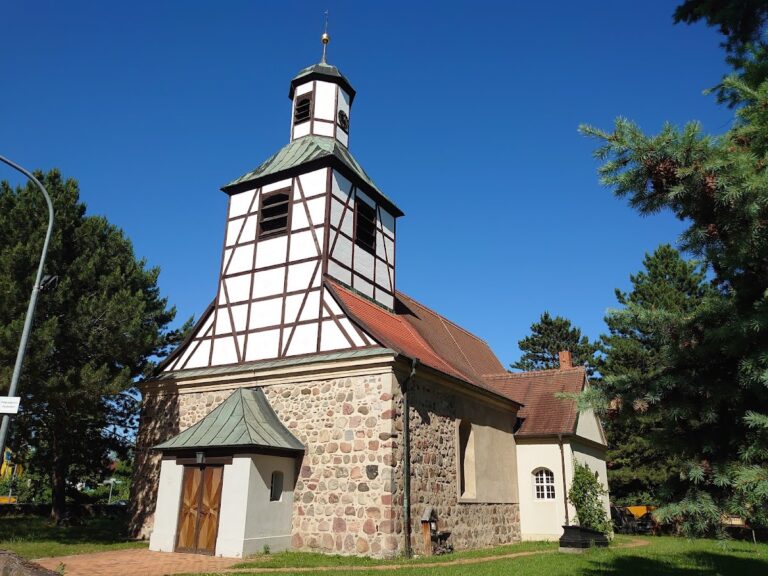
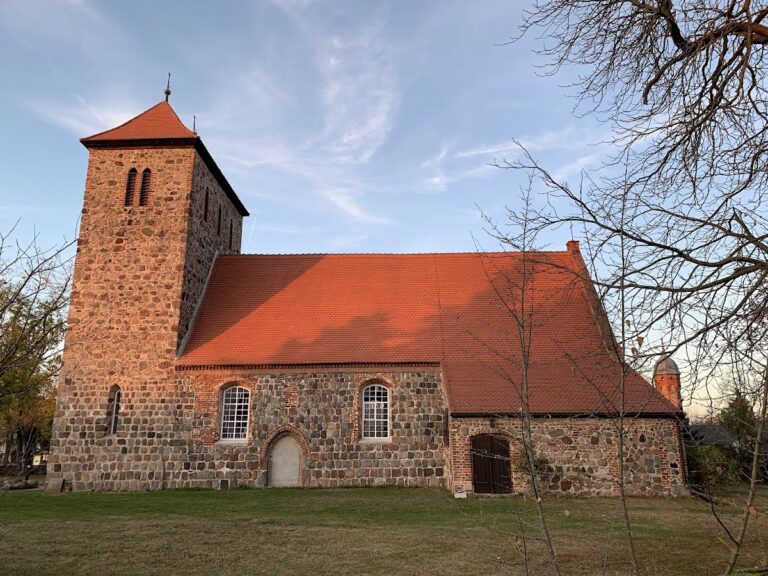
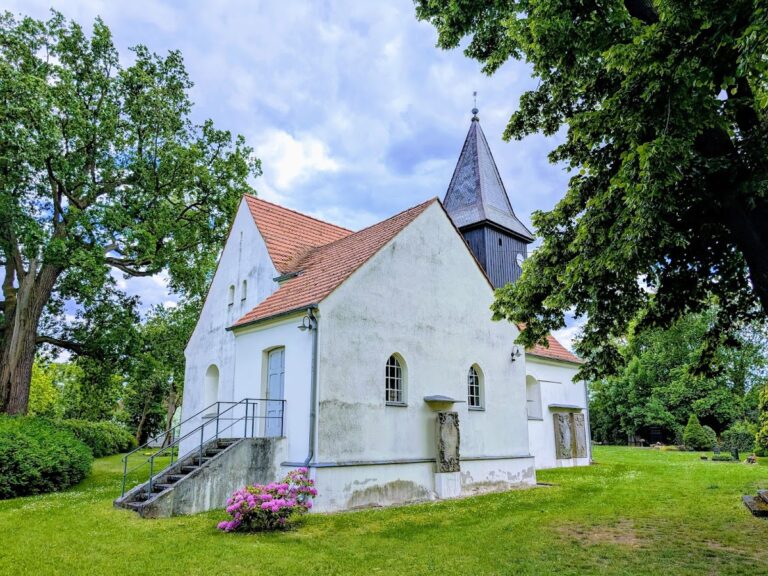
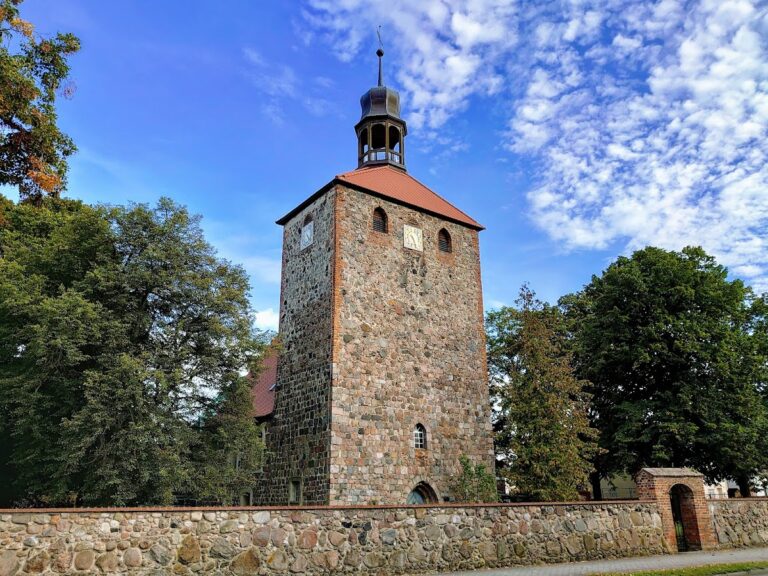
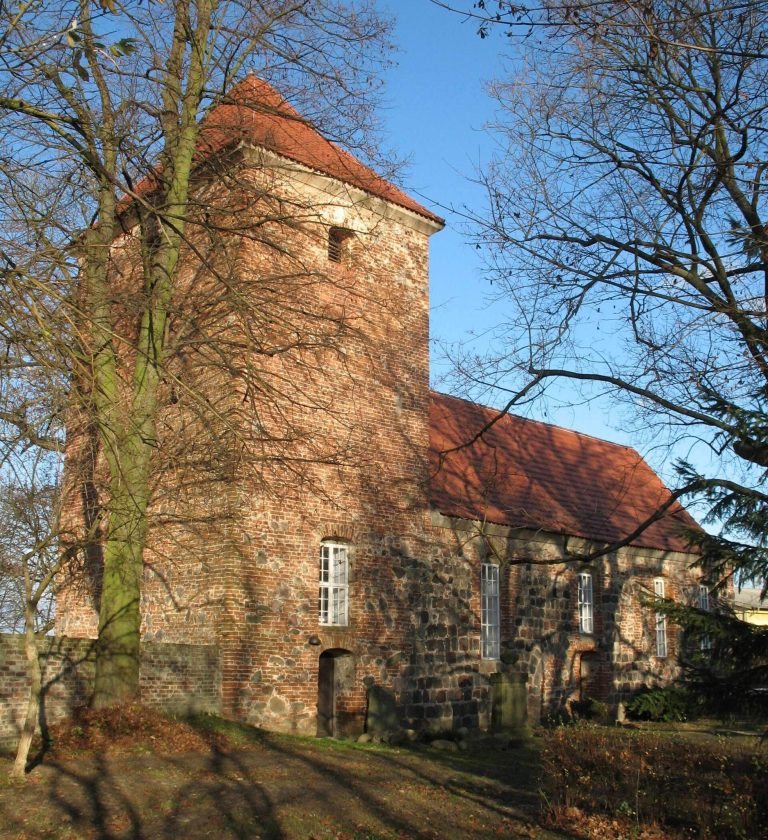
Dorfstraße forms the settlement’s central north-south axis and divides around the slightly raised plot occupied by the church at the historic village green. A fieldstone wall encloses the grounds on the east. The building is a hall church, with a rectangular nave, a recessed semicircular apse to the east, and a west tower.
The nave is built from unworked fieldstone laid in irregular courses. On the east wall, granite chips fill the gaps between the stones, while the gable contains two small paired windows with segmental arches. The long walls are symmetrically arranged and each has three large arched windows associated with the Baroque remodeling. Their surrounds are picked out in light plaster. The plain gabled roof is covered with reddish pantiles.
Apse and west tower
The apse is strongly recessed and built of yellow brick, including its base. Each side wall has a small segmental-arched window with a brick reveal. A simple continuous frieze divides the walls from the half-conical roof, which is covered in black slate.
The tower begins with a fieldstone lower storey as wide as the nave and narrows above to a square brick-built upper storey. Its ground floor contains a large portal framed by three stepped brick courses, with a window on each side and a circular window above. The west face of the upper storey has three narrow rectangular windows. Clocks occupy the north and south faces, whose recessed rectangular panels contain further arched panels with two sound openings. A triangular frieze, diagonally placed bricks, and a cornice complete the upper design. Above them rises an octagonally kinked roof crowned by a finial ball and cross.
Interior furnishings
The altar consists of a simple mensa, the horizontal slab forming an altar’s top, with a modern crucifix. The chancel behind it is painted reddish brown, contrasting with the white nave. Against the south wall stands a light-colored pulpit basket whose panels have carried images of the Evangelists, Matthew, Mark, Luke, and John, since the late 1920s.
A sandstone epitaph, a memorial monument for a deceased person, commemorates Louise von Hake, who died in 1737. Several further epitaphs for members of the von Knesebeck family are mounted beside the organ. The west gallery has a partitioned lower section used as a winter church, a part of the building set aside for worship during colder months. The Wilhelm Remler organ occupies the upper gallery.
The furnishings also include communion vessels, a baptismal stand, and a baptismal font cast from the golden communion-bread bowl in Halberstadt Cathedral. Their funding came from a foundation established by Wilhelm Boldewin Ropert Leopold von dem Knesebeck, who died in the Battle of Königgrätz in 1866.
Cemetery monuments
The cemetery contains further monuments connected with the church and the local estate. These include graves of the von dem Knesebeck family and the hereditary burial place of the Lademann teachers’ family, associated with the period from 1750 to 1904. The family included the local historian Willy Lademann, who lived from 1884 to 1976. A memorial plaque installed at the tower’s southwest corner in 2012 bears a Low German quotation attributed to him: “I have watched people closely and listened to them.”