Frohnauer Hammer: A Historic Hammer Mill in Germany


Site at a Glance
- Rating
- 4.7
- Popularity
- Medium
- Country
- Germany
- Primary era
- Early Modern
- External website
- Open
- Eras represented
- Early Modern
- Civilizations
- Electorate of Saxony, Holy Roman Empire
- Site type
- Economic
- Remains
- Production Complex
On this page12 sections
History
Frohnauer Hammer is a historic hammer mill in Annaberg-Buchholz, Germany, whose origins reach back to a fifteenth-century corn mill. It became an important material witness to proto-industrial development in the Ore Mountains, where organized, often water-powered manufacturing supported mining and metal production before modern factories.
Mill, Mining Court, and Mint
The site began as a corn mill with four millstones, mentioned in the fifteenth century. On 28 October 1491, Caspar Nietzel discovered silver ore on the nearby Schreckenberg, and mining courts were subsequently held in the mill garden. On 21 September 1496, a meeting at the mill decided to establish the New Town on the Schreckenberg, later St. Annaberg. Ulrich Rülein von Calw, Annaberg’s master builder, was the most prominent representative of the founding commission present there.
After the new mining town received minting rights in 1498, the mill was enlarged to serve as a mint. It produced the Schreckenberger silver coin until the mint moved to Annaberg in 1502. The mill ceased operating around 1590 and fell into ruin.
Conversion During the Thirty Years’ War
From 1611, the buildings housed an oil mill processing flax and a scissor-grinding works. Plans to create an iron hammer mill existed by 1616, and the conversion was completed in 1621. A hammer mill was a water-powered industrial works in which heavy hammers forged metal.
The Thirty Years’ War, the major European conflict of 1618 to 1648, brought disruption and monetary debasement that repeatedly altered the works. Elector Johann Georg I took over the mill and converted it into a silver hammer mill producing silver bars. It operated for only two years. Since converting it back into a mill was considered uneconomic, Johann Georg I sold it in 1629 to a scissorsmith. Wartime turmoil led the new owner to abandon the operation in 1631.
From 1632, the facility operated as a copper hammer. Continuing wartime hardships probably caused its abandonment in 1642. The works remained idle until 1657, when the Annaberg merchant Gottfried Rubner arranged a conversion completed by 1660. It became a strip-iron, implement, and shovel hammer at a cost of 740 gulden, responding to increased demand for iron goods during the economic recovery after the war.
Iron Production and Closure
The iron hammer reached its operational peak in the second half of the seventeenth century. It supplied the Annaberg mining industry with miners’ hammers, picks, and other tools, while also producing agricultural implements and wrought-iron work. Unlike many hammer works in the Ore Mountains, Frohnauer Hammer had no blast furnace, a furnace used to produce pig iron from ore. Instead, other ironworks supplied its pig iron.
On 6 February 1692, the hammer burned down to its foundations. The owner, the smith Johann Klauß, rebuilt it immediately. The reconstruction included the representative baroque hammer master’s mansion, built in timber-framed construction in 1697. The hammer continued operating into the late nineteenth century and eventually served as a village smithy. It closed in 1904 when its equipment had become outdated and unprofitable.
Preservation and Later History
After the closure, local heritage advocates and museums sought to preserve the works because it retained much of its original seventeenth-century technology. The Annaberg district administration secured a right of first refusal in 1907, while the Hammerbund association, headed by district administrator von Welck, pursued the acquisition. The association bought the complex in 1908 and converted it into Saxony’s first technical monument. The museum and inn opened on 1 October 1909.
The three tilt hammers, which are raised by rotating shafts and fall onto metal workpieces, were demonstrated again from 1925. In 1935, designs for an Ore Mountain festive and Sunday costume, promoted by Max Günther, were presented at Frohnauer Hammer. Ownership passed to Heimatwerk Sachsen in 1938 and, after the Second World War, to the Saxon state government.
Further preservation work was initially prevented by a lack of funds. SDAG Wismut, the Soviet-German uranium-mining enterprise that operated in East Germany after the Second World War, then seized the buildings for use as a storage and catering facility serving nearby exploration shaft No. 132. After Wismut’s activities ended, ownership changed several times among Dresden University of Technology, the Saxon state government, and the council of Karl-Marx-Stadt. Management was assigned to the Cultural Department of the Annaberg District Council.
Museum operations resumed in 1951. In 1952, the East German government provided 100,000 marks to secure the complex and later allocated just under 20,000 marks annually for its preservation. Since 2019, the hammer master’s mansion, the hammer works, and the water-supply ditch have formed part of the Annaberg-Frohnau Mining Landscape within the UNESCO World Heritage property Erzgebirge/Krušnohoří Mining Region. This international designation recognizes historic mining landscapes and associated industrial sites on both sides of the German-Czech border.
Remains
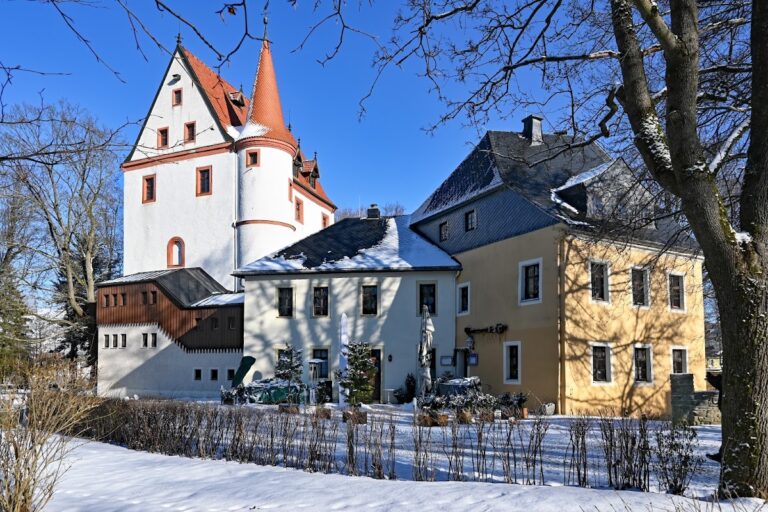
The complex stands beside the Sehma River and comprises the hammer smithy, the timber-framed hammer master’s mansion, an exhibition of forged products, a free-form hammer, a mechanical Christmas hill, a bobbin-lace room, and an inn in the mansion. Its central surviving group is the hammer works, whose machinery follows the arrangement and technology of the second half of the seventeenth century. Three water wheels receive water through a shared millrace system.
Hammer Works
Tilt Hammers and Bellows
The hammer works contain three tilt hammers weighing 100, 200, and 250 kilograms. Their shafts are driven by an overshot water wheel, and the hammers can deliver impacts of up to 12 tonnes. Only the smallest hammer is operated during present-day demonstrations. A second overshot water wheel powers the surviving bellows, which supplied air for the forge.
Water-Powered Outbuilding
An outbuilding contains a water-powered hand lathe and a drill spindle. Together with the three water wheels and the shared millrace system, these machines preserve the arrangement of a water-driven metalworking complex.
Buildings and Industrial Displays
Hammer Master’s Mansion
The representative hammer master’s mansion was rebuilt in timber-framed construction after the fire of 1692 and has a surviving form dated to 1697. The building also contains the inn, while the wider complex includes exhibitions of forged products, a mechanical Christmas hill, and a bobbin-lace room.
Free-Form Steam Hammer
An open-die steam drop hammer, a forging machine that shapes heated metal without enclosing it in a die, is displayed on the museum grounds. Built in 1918 by Richard Hartmann of Chemnitz, it weighs seven tonnes without its anvil block and has a 600-kilopond hammer tup drop weight, equivalent to about 5,884 newtons. Its maximum stroke is 80 centimetres, and it could deliver up to 105 blows per minute. The machine operated until 1983 at the VEB “Unity” Stamping and Forging Works in Brand-Erbisdorf. Steam hammers of this type replaced water-powered hammers from around 1860.