Saint Catherine of Alexandria Church in Kraków: An Augustinian Gothic Church


Site at a Glance
- Rating
- 4.7
- Popularity
- Low
- Country
- Poland
- Primary era
- Medieval
- External website
- Open
- Eras represented
- Medieval, Early Modern, Modern
- Civilizations
- Kingdom of Poland, Polish–Lithuanian Commonwealth
- Site type
- Religious
- Remains
- Church
On this page14 sections
History
Saint Catherine of Alexandria and St. Margaret is a Roman Catholic Augustinian conventual and parish church in Poland, founded in 1342 as part of the medieval city of Kazimierz. Built in the Gothic period by the Order of Saint Augustine, it formed the religious centre of a monastery established during the urban development promoted by King Casimir III the Great.
Foundation and medieval construction
Casimir III brought the Augustinians from Prague in 1342 while establishing Kazimierz, a medieval city later incorporated into Kraków and now a historic district of the city. He intended the new foundation to have a church comparable in beauty with those in neighbouring Kraków. The foundation also followed conflicts between Kraków’s councillors and his father, Władysław I the Elbow-high.
Construction began with the eastern range of the monastery, including the chapels of St. Thomas and St. Dorothy. Jan Bodzanta, Bishop of Kraków, consecrated the presbytery in 1378. The nave was then built in successive stages by different workshops. Work on the nave body continued until about 1426, although the planned fifth bay was never completed.
Around 1404, Ścibor of Ściborzyce founded the Chapel of St. Monica on the site intended for the western bay. One workshop built the southern nave, part of the western wall, and the eastern section of the northern nave, while a later workshop continued the northern side. The southern nave and porch were completed in 1448 through the initiative of the Lanckoroński family and Bishop Zbigniew Oleśnicki. A separate bell tower was built during the fifteenth century.
Disasters, rebuilding, and changing uses
An earthquake in 1443 caused the nave vault to collapse. Its reconstruction continued until 1505. The complex later suffered a flood in 1534, a fire in 1556, and another earthquake on 3 December 1786, which cracked the vaulting.
During the Swedish Deluge, the Swedish invasion and occupation of much of the Polish-Lithuanian Commonwealth in the mid-seventeenth century, the church was used as a lazaret, or military hospital. It also served as a warehouse and stable. In 1634, the present high altar replaced the former Augustinian multi-panel altarpiece, which is now held by the Gallery of Old Polish Art of the National Museum in Kraków. The Chapel of Blessed Isaiah Boner was built in 1766.
During the period when Poland was divided among neighbouring powers, Austrian authorities suppressed the Augustinian order. They converted the church first into an arms store and later into a storehouse for straw and hay. The Augustinians returned in 1814.
Nineteenth century to the present
The church’s deteriorated condition led the Senate of the Free City of Kraków to consider demolition in 1827. Bishop Skórkowski and Senate president Kasper Wielogłowski intervened, and a restoration committee was formed in 1833. Karol Knaus and Karol Kremer directed the restoration, preserving the complex from demolition.
For part of the interwar period, the monastery buildings housed a student residence. During the German occupation, almost all the monks were deported to concentration camps, and the church became a parish church in 1942. The Augustinian order was dissolved in Poland during the communist period and re-established in Kraków in 1993.
Conservation has continued since the 1970s, including the discovery of several fragments of polychromy, the use of multiple colours in wall or architectural decoration, depicting St. John the Evangelist. The church and monastery are protected as a historic monument. They form part of the Historic Centre of Kraków, inscribed on the UNESCO World Heritage List in 1978, and the Kraków historical city complex designated a Historic Monument of Poland in 1994. The complex is also entered in the regional monument register as A-5.
The church is dedicated to St. Catherine of Alexandria and St. Margaret. Other stated patrons include Blessed Isaiah Boner, St. Rita, and the Blessed Virgin Mary, Mother of Consolation. The principal liturgical commemorations take place on 25 November and 20 July.
Remains
The complex occupies the area between Skałeczna, Augustiańska, Paulińska, and Skałka streets. Its principal church is a three-aisled basilican Gothic building, meaning that its tall central nave rises above lower side aisles. It is built of brick and stone and has no towers or transept, the crosswise arm of a church intersecting the nave. Its tall, slender form, varied architectural shapes, and detailed medieval stonework are regarded as among the finest examples of their kind in Poland.
Church interior and furnishings
Presbytery and high altar
The five-bay presbytery ends in a five-sided polygonal termination. Its Late Gothic star vault, a ribbed vault whose ribs form a star-like pattern, was made after the earthquake of 1443 through the foundation of Jan of Bobrek Ligęza. The bosses, decorated elements at the intersections of the vault ribs, carry the Ligęza coat of arms, Półkozic.
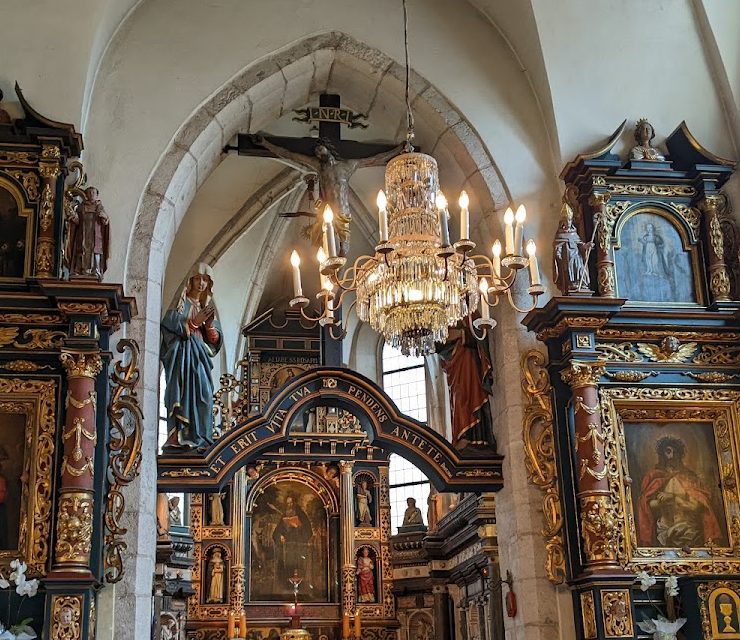
A seventeenth-century crucifix stands on the chancel arch, surrounded by angels holding the instruments of the Passion. The associated sculptures were made during the Second World War by Karol Muszkiet. The presbytery also contains Neo-Gothic choir stalls and a music gallery dating from the second half of the nineteenth century.
The three-tiered Baroque high altar was made in 1634 through the foundation of Prior Stanisław Starczowski. Its central field contains Andrzej Wenesta’s 1674 painting of the Mystical Marriage of St. Catherine. The painting was based on a print by Paul Pontius after a work by Anthony van Dyck and funded by Maciej Kazimierz Treter, mayor of the city.
Nave and side aisles
The nave has four bays because construction of the planned fifth bay was abandoned. The present vault over the main nave is a nineteenth-century wooden imitation of the earlier vault destroyed in the earthquake. The church contains five altars in total, with relatively restrained furnishings that emphasize the clarity of its architectural lines.
The southern nave contains the Late Renaissance tombstone of Wawrzyniec Spytek Jordan, made around 1603 in the workshop of Santi Gucci. It also preserves the Renaissance allegorical painting Wheel of Death, dating from around 1588, and an image of Our Lady of the Anchor. The northern nave contains a Baroque cycle of Augustinian paintings by Zachariasz Dzwonowski, a pupil of Tomasz Dolabella.
Organs and porch
Two nineteenth-century organs remain in the church. The smaller instrument, with nine stops, was completed in 1867 by the Kraków organ builder Ignacy Wojciechowski and stands on the presbytery gallery. The larger organ, completed in 1896 by the Lviv builder Jan Śliwiński, has 28 stops and two manuals with pedals. It stands on the western gallery in a case designed by Karol Knaus.
A Late Gothic porch adjoins the church on the south. Its two portals have elaborate carved stone decoration.
St. Monica’s Chapel
The Gothic Chapel of St. Monica adjoins the church on the west. Built approximately between 1402 and 1422 through the foundation of Ścibor of Ściborzyce, it served as a burial chapel and was known as the Hungarian Chapel from the beginning of the sixteenth century.
The chapel has a Gothic vault supported by an octagonal pillar. Since 1727 it has served as an oratory for Augustinian nuns whose convent house stands across Skałeczna Street. A covered gallery built over the street in 1728 connects the house with the chapel.
Before the chapel entrance is a 1647 image of Our Lady of the Anchor. Inside stands a Mannerist altar from around 1630 with a statue of the Virgin Mary, together with a Baroque-Classical altar containing Leopold Nowotny’s 1861 painting Our Lady of Good Counsel. The chapel also contains paintings of the Vision of St. Monica and the Prayer of St. Monica, as well as a five-stop organ built by Jan Śliwiński in 1880.
Monastery and cloister
Cloister and frescoes
The Gothic Augustinian monastery adjoins the church on the north and includes a cloister and inner garden. The cloister preserves Gothic and Renaissance frescoes, including Mercy of the Lord, made around 1470 and repainted in the sixteenth century; St. Augustine Gives the Rule to the Augustinians, made around 1425; and a Crucifixion from the middle of the sixteenth century.
Chapel of Our Lady of Consolation
A separate chapel in the cloister contains the Gothic-Renaissance image of Our Lady of Consolation. The miraculous image is surrounded by particular veneration and is probably the oldest miraculous Marian image in Poland.
Chapel of St. Dorothy
The Gothic Chapel of St. Dorothy adjoins the cloister and is the oldest part of the monastic complex.