Allenau Church in Porechye: A Fifteenth-Century Brick Gothic Parish Church


Site at a Glance
- Rating
- 4.6
- Popularity
- Very Low
- Country
- Russia
- Primary era
- Medieval
- Eras represented
- Medieval
- Civilizations
- Crusader, Teutonic Order
- Site type
- Religious
- Remains
- Church
On this page8 sections
History
Allenau Church in Porechye, Russia, is a fifteenth-century parish church built in the Brick Gothic tradition, a medieval form of Gothic architecture that used brick for both structure and decoration. Its foundation is traditionally and tentatively associated with Ulrich von Jungingen, Grand Master of the Teutonic Order, a medieval German military-religious order that ruled territories around the southern and eastern Baltic. Construction probably began in the early fifteenth century.
Medieval parish church
The main body of the church and its sacristy were completed during the later fifteenth century. The western part of the nave, the upper courses of the walls, and the gables probably reached completion by the latter third of the century. The church originally belonged to the archpresbyterate of Friedland, a regional church district headed by an archpresbyter. Friedland is now known as Pravdinsk.
Reformation and later repair
After the Reformation and the spread of Lutheranism, Allenau became a subsidiary church of the church at Böttchersdorf, a settlement that no longer exists. A major repair took place in 1682 under Ludwig von Schimmelpfennig, the feudal lord of the church and hereditary lord of Zuninken, Allenau, Katzbalken, and Menditten. The work was commemorated with a German inscription and heraldic emblems on the altar cornice.
War damage and ruin
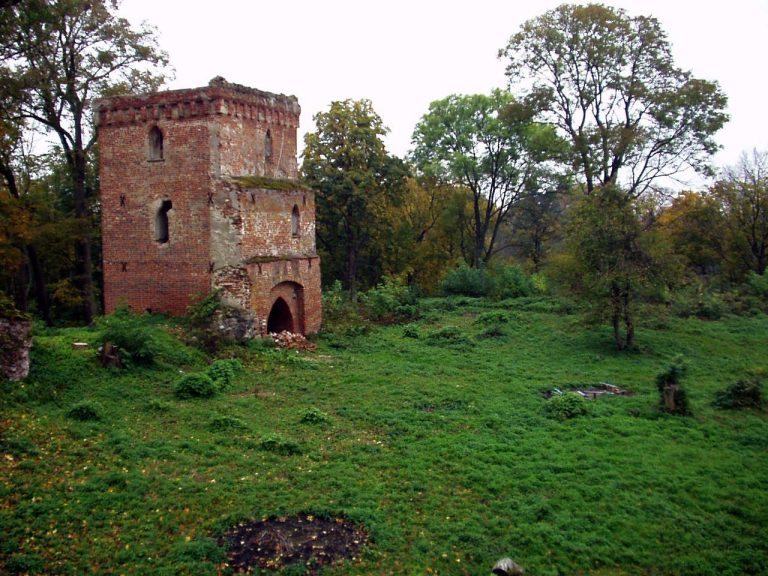
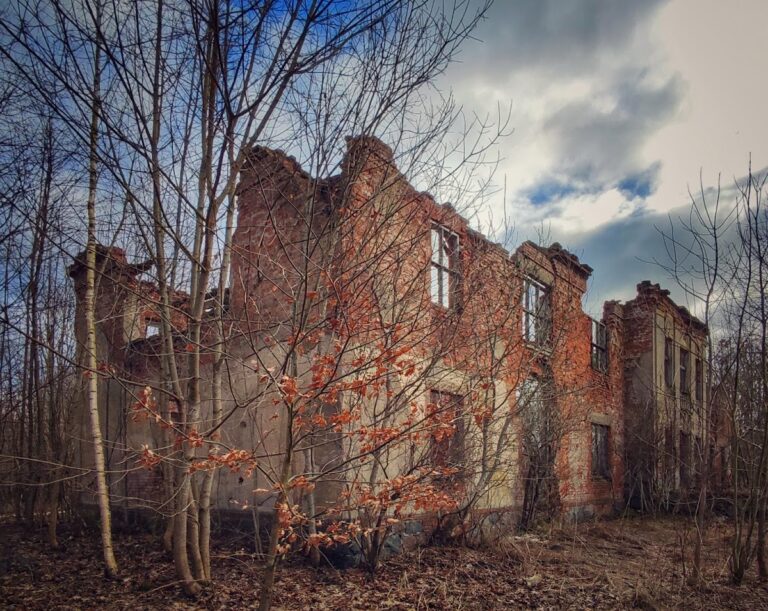
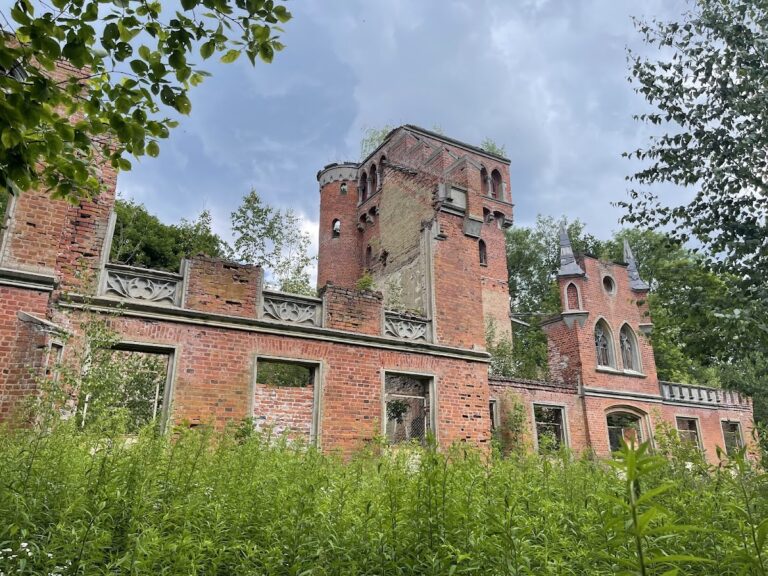
Artillery fire damaged the church during the Second World War in 1945, especially the roof, tower, and eastern gable. Ecclesiastical use ended after the war, and the building was later used as a warehouse. By the 1980s, deteriorated roof tiles had accelerated the church’s decay. The eastern gable and the remaining roof sections collapsed in 2003. The building has been functionless since 1994 and continues to stand as a ruin.
A resolution of the Government of Kaliningrad Oblast dated 23 March 2007 designated the church a regional cultural-heritage site of the peoples of the Russian Federation. In 2010, the ruins were transferred to the Kaliningrad Eparchy, an administrative territory of the Russian Orthodox Church. The church remained in ruined condition in 2024.
Remains
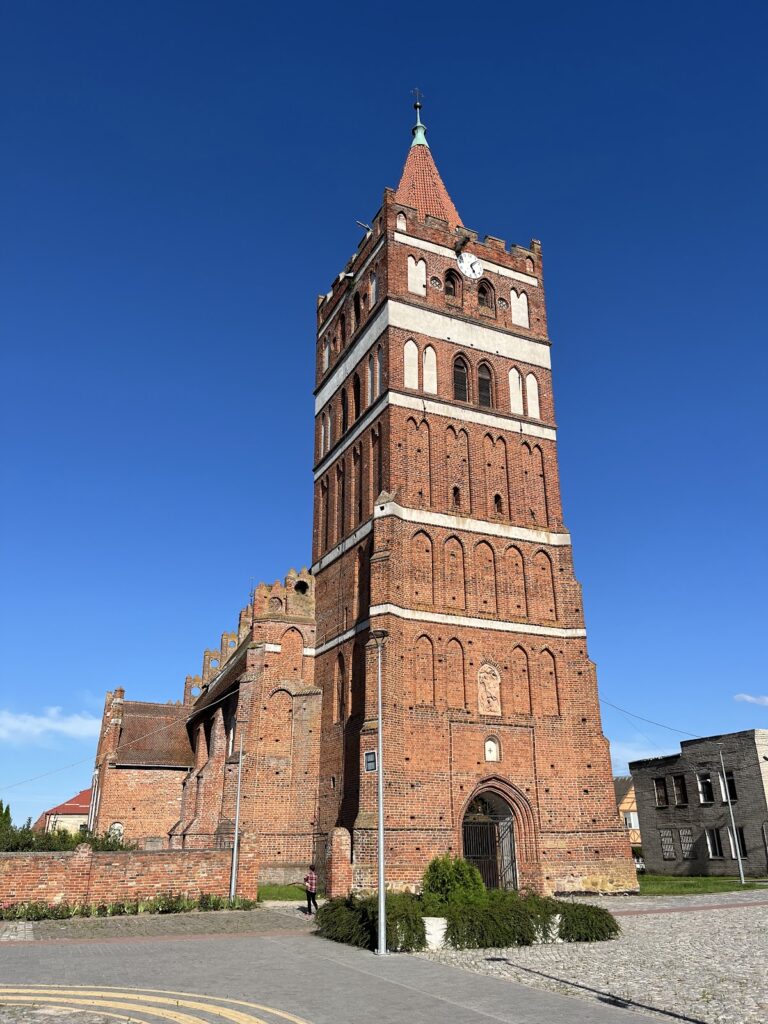
Allenau Church is a rectangular, unvaulted hall church, meaning that its single worship space has no stone or brick vault. It is built mainly of brick, while fieldstone forms the foundation and plinth. Buttresses strengthen the nave walls, with the corner buttresses placed diagonally. The longitudinal walls are divided into three sections, giving the surviving structure a clearly organized late Gothic appearance.
Nave and entrances
The south wall contains two tall pointed-arch windows and a stepped portal. A small vestibule was later built in front of this entrance. It was not bonded into the main masonry of the nave and was eventually demolished. On the east wall, a central buttress stands between two small, high-set pointed-arch windows. These features belong to the towerless hall-church type developed in Ermland, the historic German name for Warmia in what is now northeastern Poland.
Stepped gables and sacristy
The west gable is a seven-axis stepped gable, rising through a series of stepped levels. Tall pointed-arch blind arcades, decorative rows of recessed arches that do not open into the interior, enrich its surface. Triangular pilaster-like divisions separate the niches and end in finial-like forms, while horizontal bands mark the different levels. A sacristy, an ancillary room for storing liturgical objects and preparing for worship, is attached to the north-east side. Its three-axis stepped gable repeats the composition of the west gable.
Interior features
Fragments of medieval frescoes survive on the interior walls. The 1682 renovation also produced an altar and altar table made from plastered brick. Heraldic emblems representing Ludwig von Schimmelpfennig and his wife, together with a commemorative German inscription, were placed on the altar cornice and preserve a record of the church’s early modern repair.