Monastero di Santa Maria di Torre: A Medieval Church and Monastery in Italy


Site at a Glance
- Rating
- 4.8
- Popularity
- Very Low
- Country
- Italy
- Primary era
- Medieval
- Eras represented
- Medieval
- Civilizations
- Venetian
- Site type
- Religious
- Remains
- Monastery
On this page14 sections
History
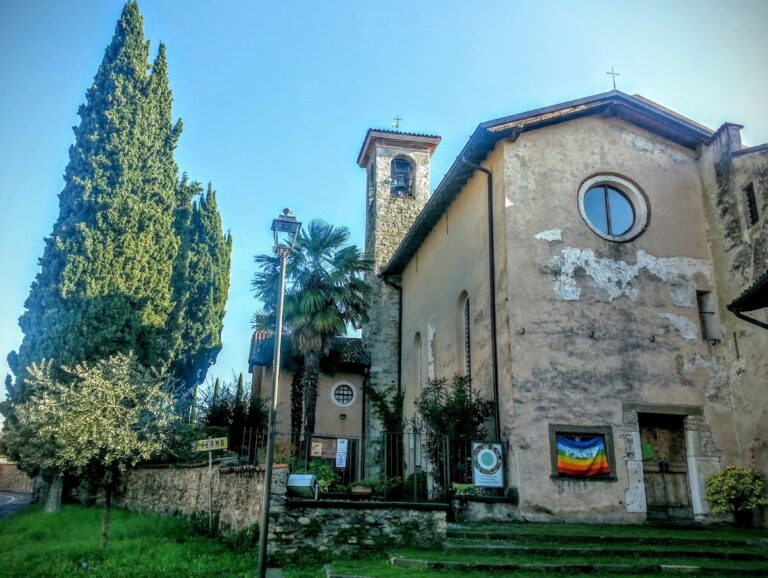
Monastero di Santa Maria di Torre is a Catholic church and monastery in Torre Boldone, Italy, dedicated to the Assumption of the Virgin Mary. Known also as Santa Maria Assunta and Santa Maria di Turre, it developed in the fourteenth century from the former residence of Giorgio Del Zoppo, a wealthy Guelf nobleman of Bergamo. In medieval Italy, the Guelfs were the faction traditionally aligned with the papacy during political conflicts between rival communities and elites.
From noble residence to monastery
In 1315, fighting between Bergamo’s Guelf and Ghibelline factions forced Del Zoppo and other Guelf leaders to leave the city. They took refuge at Ginami castle in Gromo, where Del Zoppo met Anexina, also called Anesina, the daughter of Bono de’ Bucelleni. The two married in 1324, in Del Zoppo’s second marriage.
While receiving treatment at the monastery of Sant’Agostino, Del Zoppo made his will on 28 July 1342. He left his properties to Anesina and allowed her to become a nun and convert their residence into a monastery. Del Zoppo died in August that year. His body was transferred to the cloister of Sant’Agostino, where his funerary inscription remains visible.
Anesina took monastic vows on 15 December 1342 and later became abbess. The first document naming the Monastery of Santa Maria de Turre dates from May 1343. The community followed the Rule of Saint Augustine, a set of monastic principles associated with Augustine of Hippo and used by Augustinian religious communities. A building decree followed on 21 February 1344, and Bishop Bernardo Tricardo confirmed the monastery on 6 November 1345.
Union, division, and restoration of independence
Santa Maria di Torre possessed comparatively strong revenues, and in 1347 Bishop Bernardo Tricardo ordered its union with the weakened monastery of San Giorgio di Redona. He appointed Anesina prioress of both communities. A prioress was the female superior of a religious community.
The arrangement was soon challenged. After the Black Death reached the Bergamo area in 1348, only two nuns and two friars remained at Redona. The religious there opposed union with Torre Boldone and instead supported incorporation into the Monastery of Matris Domini in Bergamo. The dispute continued for years and was resolved in Anesina’s favour in 1367, after she appealed to Pope Urban V.
In 1454, Bishop Giovanni Barozzi suppressed the monastery because he judged its location too isolated and joined it to Matris Domini. Prolonged disputes followed, and Santa Maria di Torre regained its status as an independent monastery in 1481.
Decline, recovery, and continuing religious use
In 1575, the monastery’s properties were placed in the hands of tenant farmers. Neglect then damaged parts of the church and caused many artworks to deteriorate. The Cisalpine Republic, a state established in northern Italy during the revolutionary period, sold the properties to the Camozzi family in 1797.
In 1869, the Camozzi family transferred the properties to the religious institute of the Poverelle Sisters. The sisters undertook the recovery of the buildings and their frescoes, and the church was incorporated into the Palazzolo Institute. Santa Maria di Torre remains a Catholic place of worship and belongs to the Diocese of Bergamo.
Remains
The church is built mainly from local stone, with inserts of red brick, and has an east-facing apse with a square end. The apse is older than the main body and contains thirteenth-century frescoes. It may originally have served as the private chapel of the Del Zoppo family, while the nave was added when the monastery was founded in the fourteenth century.
Exterior and entrance
Renaissance portico
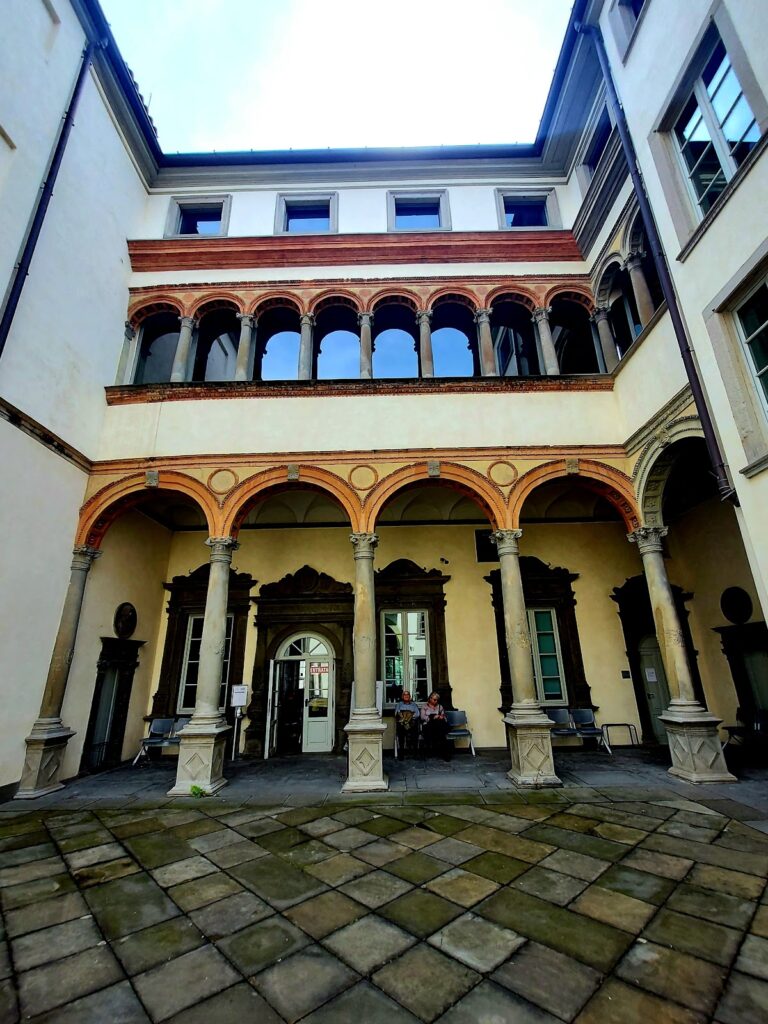
Entrance is through an L-shaped Renaissance portico formed by arches and columns. Frescoes decorate the lower passage, while the upper level repeats the arrangement with round arches resting on columns. Its rhythm is twice that of the lower level. The arches are edged with terracotta, and their undersides also carry fresco decoration.
Interior arrangement
Nave and presbytery
The interior consists of a single nave beneath a gabled roof supported by a timber structure. At the eastern end, a raised presbytery is enclosed by a pointed arch. A small window rises above the arch, with frescoes of the Annunciation on either side.
The presbytery repeats, on a smaller scale, the presbyterial arrangement of Sant’Agostino in Bergamo. This arrangement appears to reflect provisions in Giorgio Del Zoppo’s will. The apse forms the oldest part of the church, while the later nave provided the principal interior space for the monastery founded around the earlier chapel.
Medieval frescoes
Presbytery paintings
The presbytery retains an Annunciation above the arch and a heavily altered Crucifixion behind the altar. Other painted subjects include the Mystic Marriage of Saint Catherine, a devotional image of the saint’s symbolic marriage to Christ; the Martyrdom of Saint Peter of Verona; and the Glory of Saint Thomas Aquinas with Saint Dominic. The decoration also includes the Assumption, Saint Anthony, a bishop saint, Mary Magdalene in the desert, a Madonna lactans showing the Virgin nursing the infant Jesus, Saint Luke, and Saint Helena. Dates incorporated into the frescoes preserve references to episodes in the monastery’s history.
Mystic Marriage of Saint Catherine
A late-fourteenth-century fresco of the Mystic Marriage of Saint Catherine occupies the right wall. Its style resembles paintings in the convent of San Francesco, and both groups are attributed to the Master of the Tree of Life. This is a conventional name for an otherwise unidentified painter, derived from a work associated with the Tree of Life motif.
Portrait of the founders
Another painting, less accomplished artistically, depicts Giorgio Del Zoppo, Anesina, and a further nun. The former parish church and the old settlement of San Martino appear in the background, linking the figures associated with the monastery’s foundation to the local setting.
Fresco cycle of the nave
The nave appears originally to have been covered throughout with fifteenth-century frescoes. Their condition deteriorated severely when the premises were used as a stable and warehouse. The surviving works are attributed to the Master of the Tree of Life, whose artistic identity remains unknown.